
Writer-director Laura Piani’s “Jane Austen Wrecked My Life” is the kind of romantic comedy where the ending is preordained, and the stumbling blocks are all too evident. Some of you will care; I didn’t. This sumptuously filmed movie invites you in if you’ll let it.
Agathe, pretty in an awkward, open-faced sort of way, works at Shakespeare & Company, the storied English-language bookstore in Paris on the banks of the Seine facing Notre Dame. As the camera pans over the shelves, it lingers very briefly on a Jane Austen novel. Agathe, a novice writer, feels like she is from a different era, romantic with the unrealistic standards that go with it. She waits endlessly for a prince who will match her sense and sensibilities.
Tightly wound, Agathe lives with her free-spirited sister Mona and young nephew Tom. Agathe hasn’t been on a date in years; Mona is out every night. Agathe hasn’t been out of Paris in ages and avoids cars at all costs. There is a reason, but it’s slow in coming and when it does, it explains a lot. Everyone loves Agathe, certainly more than she loves herself. Félix has read the first chapters of Agathe’s novel and is more impressed than she is. She has never had any trouble starting a novel; it’s the ending that never comes as is the case in this one. What she doesn’t know is that Félix has submitted her unfinished novel to the prestigious Jane Austen Society Writers’ Residency in England. When a letter of acceptance arrives, she is shell-shocked. All her self-doubts surface, and even her fear of riding in cars seems to be an insurmountable complication. But Félix is determined to make this happen, and he does.
Setting foot on the dock after the ferry ride from France, she spies a sign with her name on it held by Oliver, a distant relative of Austen and unwilling heir to his parents’ Residency program. In true Austen fashion, they do not hit it off. He is the quintessential snob, the type of disdainful Englishman she reviles. She is no better in his eyes. Their cultural clash is older than the books Agathe reveres. He, a professor of contemporary literature, has no use for anything reeking of the 19th century, the very definition of Agathe.
The Residency is idyllic but even so, Agathe has a major case of imposter syndrome. She’s not like the others; they have talent, they deserve to be there. Still, she perseveres in getting to know the other writers, none of whom seems to suffer from the same writer’s block that she does. Wandering the idyllic grounds, so very English that you can smell the lavender, she begins to relax. Writing, however, is still out of her grasp. Will our heroine be able to finish her novel? Will she find love? Will she become more insightful and less self-doubting? Even if you think you can answer those questions, there will be bumps along the road in Agathe’s journey to self-awareness and I’m betting that you’ll want to go there with her.
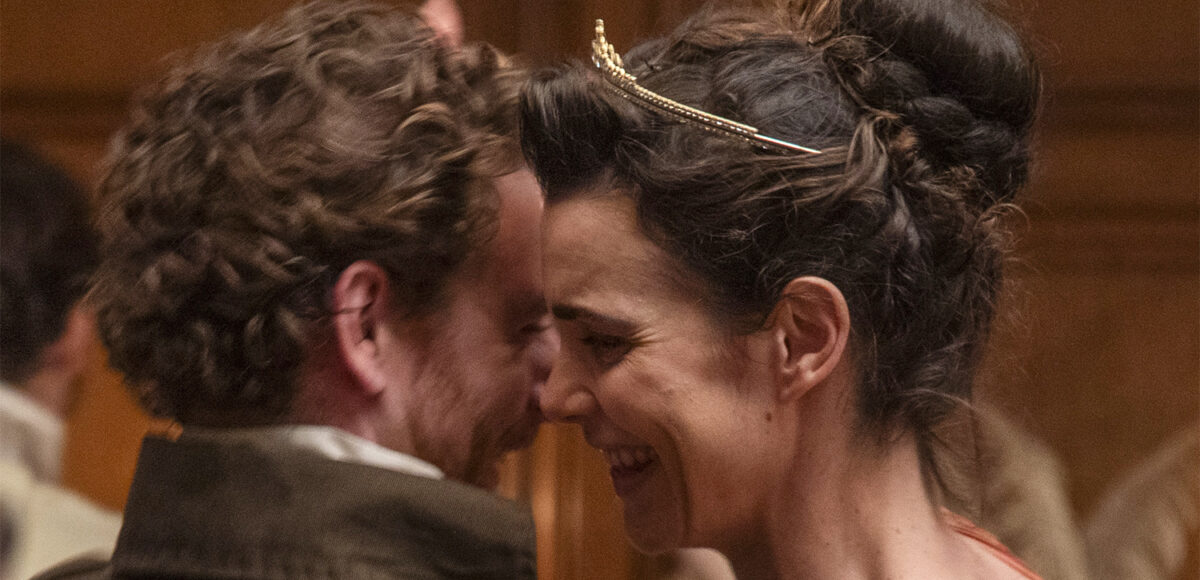
The characters, all clichés of one sort or another, generally straight out of Austen, are as charming as the actors playing them. Félix (Pablo Pauly) is the engine that gets the story moving. Going from girlfriend to girlfriend, never lingering long, he, too, is in search of an elusive ideal, one who may be staring him in the face. A classic man-child, he may never grow up, but he’ll have a good time along the way. His best-friend chemistry with Agathe is fun to behold and experience. Wouldn’t we all like to have a friend who watches out for us, sings funny songs and seems to know what we need before we need it? That’s Pauly’s Félix. Charlie Anson plays Oliver, an academic conflicted in nature between the very contemporary literature he loves and teaches and the old-world values of his parents and their Austen heritage. Like Agathe, Oliver is straight out of any number of Jane Austen novels, something he would recognize if he read one. Camille Rutherford is Agathe in every way possible. Gauche, she seems to lead with her left foot, timing always off and appearance slightly askew. In other words, endearingly charming. Her warmth and empathy for others make her always the bridesmaid and never the bride. Rutherford makes us root for Agathe, and we do.
From the moment that Agathe’s best friend and coworker, Felix, chastises her for uselessly waiting for her Mark Darcy, the plot and probable ending are revealed. The close-up of a Jane Austen novel and the Darcy reference were dead giveaways. Nevertheless, the characters and setting were so lovely I still wanted to take the trip. This is a story that has been done innumerable times and will be done again, over and over. For me, they did it well. I wasn’t looking for twists and turns, thrills and chills. I was looking for a film that was easy to follow, with identifiable characters losing their way and then finding it in gorgeous locations. No one is mean, or at least not all the time, and everyone learns something. A truly bilingual film set first in a very famous English bookstore in Paris and then in the prototypical English countryside, the English characters all speak French, and the French characters speak English, making the cultural lines blur in immersive fashion. Pierre Mazoyer’s lush cinematography makes me want to ride a bike through the side streets of Paris, wander through the gardens of England and scour the shelves at Shakespeare & Company. I might not meet Agathe there, but perhaps Piani, who worked there while completing her film studies and still haunts the stacks.
In English and French with English subtitles.
Opening May 23 at the Laemmle Royal and AMC 14, opening nationwide on May 30.