
“Among Neighbors,” Yoav Potash’s powerful documentary, started simply and grew more complex and insightful as his explorations expanded over a 10-year period. Growing up Jewish and learning about the Holocaust, an important part of his Eastern European heritage, he was intrigued by the concept of shtetls, small rural Jewish villages. So prevalent in Eastern Europe before the war, he wondered what happened to them after World War II.
Invited to Poland in 2014 by his friends Aaron Friedman Tartakovsky and Aaron’s mother Anita Friedman, he accompanied them to a rededication of the Jewish cemetery in their ancestral home of Gniewoszów, Poland. They had been to Gniewoszów 10 years earlier but were chased away, literally and figuratively, by suspicious and antisemitic residents. There was something to hide, but it would take many years to unearth the details and that is what Potash set out to do.
Rumors had persisted over the years of the postwar treatment of Jews who had dared return to Gniewoszów, but it would take time, patience and luck to unearth the details. Further adding to the difficulty of revealing the truth, the newly elected far-right Polish government enacted a new law in 2018 that made it illegal, punishable by prison and/or a substantial fine, to even suggest that Poland had any part in the Holocaust. Revealing anything negative about the Polish people’s actions during or after the war, no matter how well-researched and substantiated by respected historians, was squelched and punished. The law, under pressure from Western European neighbors, was eventually downgraded from criminal offense to civil offense, but the chilling effect remained.
Learning from the previous experiences of Friedman and Tartakovsky, Potash realized that it would be difficult, if not impossible, to get the residents of Gniewoszów to talk. All around, he found evidence of what had been done to erase any remnants of a Jewish presence in a town that had been almost 40% Jewish before the war. At that time, many Poles and Jews interacted harmoniously. Their children often played together, attended the same schools and shopped in the same stores, whether owned by Jews or Poles. An initial detail comes immediately to light. Jews were never referred to as Poles, no matter how many hundreds of years they had been in the country. They had been welcomed, even recruited for their skills in crafts and banking during the 15th century when there was a push in Western Europe to establish Christian uniformity. Jews were either forced to convert or were killed. But Poland offered a safe haven, and many settled in the small towns that flourished with the addition of these newcomers. Never considered Polish, the Jews, like in so many places, were the “other.”
Potash faced many dead ends. The younger residents of Gniewoszów refused to speak with him, although there was a certain willingness on the part of their elders. This was most evident when he arrived at the home of Henryk and Sławomir Smolarcyk, a father and son guided by different memories. Henryk had many positive recollections of his Jewish friends prior to the war. Sitting among the debris and junk in their yard, Potash notices a Jewish headstone. The Jewish cemetery had long since been bulldozed and the headstones disappeared mysteriously. Not so mysterious, really. The Smolarczyks were not the only ones to purloin the stone grave markers. Although neither can articulate why they have a Jewish tombstone in their yard, each has a different story about why it is there. Neither makes sense. The local contractors who tore up the cemetery sold the stones to residents. Many were also stolen to be repurposed. They could be cut into circles to make grindstones, which can still be found in local stores; they were used to shore up stone walls; some were effaced and made into Christian grave markers. This was just one way the Jewish history of Gniewoszów could be erased.
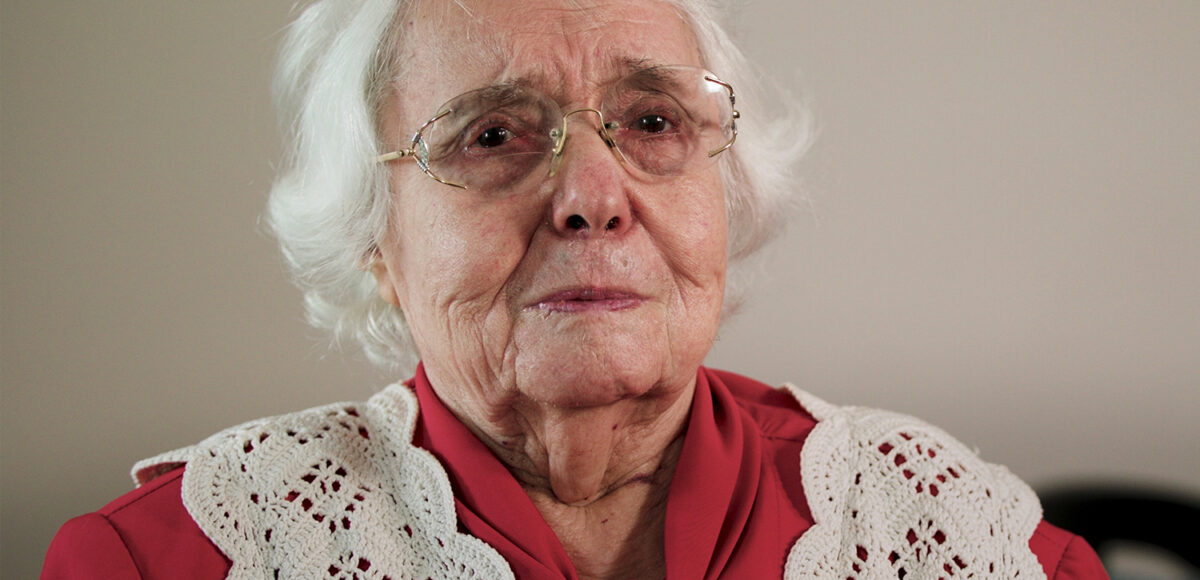
Potash interviews journalists, historians and local citizens who give perspective to what happened in Poland. Most important to him, though, is to follow the trail from the Nazi occupation to the continued murder of the few Jews who returned after the war. Among all the present-day citizens of Gniewoszów, he was lucky enough to find Pelagia Radecka. Reluctant to talk at first, she slowly opens up about what happened to the Jewish family who lived across the street. The Weinbergs owned one of the local stores, patronized by everyone. Mrs. Weinberg was respected and loved by all. Pelagia was smitten by their son Yanek and has never forgotten him. After the Nazis arrived, many Poles beat their Jewish neighbors and stole from them. Their situation grew worse and worse until all the town’s Jews were rounded up and put behind the walls of a hastily constructed ghetto before being sent to Treblinka, a nearby concentration camp. Revealing how broken-hearted she was when the Nazis came and rounded up the family, she begins to open up about the murders of returning Jews by Polish bands, hinting at a mass grave. Throughout her conversation, she continues her longing to know what happened to Yanek.
Tracing one lead after another, always looking for a link between Gniewoszów and its former Jewish citizens, he is very lucky to find Yaacov Goldstein, a Holocaust survivor and quite possibly the only living link between the Gniewoszów of yesterday and today. Now a professor in Israel, he has a harrowing tale to tell. In 1942, the Germans started implementing the Final Solution (the systematic slaughter of the Jews) and brought in trucks to ship residents of the Gniewoszów ghetto to Treblinka. Mother and son were loaded onto a truck; his father was kept behind to assess confiscated property. Audaciously, his mother made the decision to escape, and holding Yaacov’s hand, they jumped from the truck. Together, they returned to Gniewoszów to find his father. Hiding in the countryside, they had the money to pay suspicious farmers to hide them, but it was always a risk that their “hosts” would take the money and turn them in. Traveling in secret, his parents realized they would not be able to do it with young Yaacov. They had already given their baby to a farmer who, paid a great sum of money, promised to keep him safe. Reluctantly, they handed Yaacov over to another Polish family, providing them with a generous sum of money and the promise of more to come. For the next two years, Yaacov was kept in an attic; a place so small he couldn’t straighten his legs. His story is both harrowing and horrifying, but he escapes when the Red Army arrives and “liberates” the town.
Potash’s determination and fortitude to follow these stories plays out in so many satisfying ways. His ability to gradually tease out what Pelagia has kept hidden inside her for more than 70 years is breathtaking. Despite the risk of imprisonment, she finally has the courage to reveal that she was an eyewitness to the murder of her neighbors in 1945, months after the war had ended. Recently returned from hiding, but without Yanek, the Goldsteins hoped to reclaim their store and business. Janek was alive, they told Pelagia, and they would soon go to bring him home. It wasn’t to be; local thugs rounded up the few local Jews who had returned and murdered them, setting fire to the store where they had been taken. Pelagia, a witness to the event, was threatened with death should she ever reveal what she had seen. Still longing to see Janek once more, still hoping that he escaped, she kept this secret from 1945 until she revealed it on camera to Potash, a secret that also hinted at a mass grave.
Much of the wartime story of the Goldsteins, both in and out of Gniewoszów, is told using hand-drawn animation to illustrate the past, whether painting a portrait of the loving Goldstein family and Pelagia’s relationship with them; the harrowing escape by Mrs. Goldstein and her son; or the postwar murder of the Jews. These animations are engaging and a very effective means of storytelling.
Truly, a highlight of this powerful film is the miraculous encounter between Pelagia and her Janek, brought about by the filmmakers. Potash would have you believe that his documentary reveals both the best and worst of human nature: evidence of the best in human nature in the actions of the Poles, renowned for their antisemitism, is sorely lacking, resting almost entirely on the shoulders of Pelagia. It is quite telling that the revisionist Polish leadership wants to erase any evidence that there was Polish complicity during the war or criminal acts after it. But of course, Poland was not alone in their collaboration with the Nazis. For many years, France, another country with a dark history of antisemitism, would have had you believe that all their citizenry belonged to the Resistance. The United States allowed very few Jews into the country despite proof they were in mortal danger, and recently, it has been revealed that the Dutch were not as saintly as they would have had you believe. You can try to rewrite history, but, eventually, the truth will out. In Poland, under the new right-wing leadership, the sins of the father will be revisited on the son.
In English and Polish with English subtitles.
Opening Oct. 17 at the Laemmle Royal