
James Vanderbilt, as director and writer, has created a thoughtful, if flawed, film based on Jack El-Hai’s book, “The Nazi and the Psychiatrist.” Taking place before and during the famous Nuremberg trials that sought to bring about accountability for Nazi leaders still alive in 1945, Vanderbilt seeks to illuminate all the moving parts necessary to create such a forum. There had never been an attempt to put war criminals on trial. Even the term “war criminal” was a novelty. There were winners and losers, and very little neutral ground. But, recognizing that the almost successful effort to eradicate Jews from Western Europe made the goal of winning or losing a war almost insignificant when compared to such an unprecedented criminal act. The killing of soldiers and even the collateral damage of women and children in war zones paled in comparison to the wholesale targeted murder of people whose only “crime” was their belief system. Jews were not, of course, the only non-war targets. Their ranks were filled out by homosexuals, Romany (Gypsies) and the disabled, all thought to damage the purity of the German “race.”
Recognizing that the Allies had humiliated and bankrupted Germany after the First World War, acts of revenge against a vanquished foe that created the atmosphere that brought Hitler to power, President Truman did not want to put the enemies on trial just because they lost the war. He tasked Supreme Court Justice Robert H. Jackson with creating a tribunal of “justice” to hold the remaining Nazi hierarchy responsible for crimes against humanity. Truman was against the wholesale hanging of the perpetrators without a trial, something that our allies, especially the Russians, favored. Jackson must create a system that the rest of the world could trust—one that was seemingly devoid of obvious revenge against the losing side.
Following American common practice, one that remains today in potential capital cases, a psychiatrist, Lt. Col. Douglas Kelley, was assigned to assess the mental competence of the first group of defendants, among whom was Reichsmarschall Hermann Göring, second in command after Hitler and the highest-ranking Nazi captured alive. Assigned an interpreter, Sgt. Howie Triest, Kelley began his interviews using the tools available at that time. Administering Rorschach tests and interviews, he closely observed his subjects, amused by the disdain many showed, believing he was a Jew because he was part of what they considered a Jewish practice. Speaking to his subjects with the help of Triest, his interpreter, he is convinced that Göring was fluent in English despite his denials.
When Göring begins to trust him, Kelley tells Triest, they will be able to conduct their tests and interviews in English. And soon enough that happens. Kelley and Göring bond; so much so that Kelley is soon doing the Nazi’s bidding, transporting letters back and forth to Mrs. Göring, in hiding from the Americans. Keeping copious notes, crossing boundaries that are clear, not only from his mandate from the army but also professional psychiatric parameters, Kelley feels he is mining gold, the kind of gold that may make him famous. He has, seemingly, allied himself with the enemy, at times grabbing the bait that Göring is tempting him with.
Cutting back and forth to Jackson’s struggles to define the extent as well as the limitations of the court he is trying to create, we are given a firsthand view of how he brought about a court that was tasked with impartiality. Not insignificant was the difficulty in bringing the Russians into the fold. They were fully behind hanging them all. Jackson, knowing that the eyes of the world would be on this tribunal, assembles an unimpeachable cast of prosecutors, judges and jailers. He will be one of the prosecutors, aided by his British counterpart, David Maxwell-Fyfe. The danger, of course, is that any or all of the Nazis may be acquitted based on the evidence presented.
As Kelley slips further down the slippery slope of transference, his superiors, led by Burton C. Andrus, head of the prison, begin to doubt his impartiality and bring in a psychologist, Gustave Gilbert, whose agenda, a postwar book about those on trial, clouds his interpretation and skews the questions he uses to interview the war criminals. His postwar goals are not all that unlike those of Kelley. Discouraged and demoralized by his demotion, Kelley reveals to a journalist that he doubts that the prosecutors will be up to the task of convicting the brilliantly manipulative Göring.
There is a lot of good to be said about this film. Although heavy on the expositional side, it reveals much that is fairly new material. Vanderbilt wanted to give a 360-degree view of the tribunal process, from the building of the courtroom, the assembling of the prosecutorial pieces, to the process of determining competence, not just of the accused but also of the accusers. His storytelling was primarily divided into two parts: the story of Jackson, the Supreme Court justice who will establish new, international case law, and Kelley, the psychiatrist on whose research so much will hinge. The basis for the book was the story of Kelley and Göring. Ostensibly, everyone in this movie was based on a real individual; their motives and actions, however, are probably portrayed for dramatic effect. What was unmistakably real was the footage from the camps, used to support the prosecutors’ contentions that the Nazis knew full well what was taking place throughout their territories, despite Göring’s claims to the contrary.
Jackson, as played by Michael Shannon, is seen as having a great deal to lose. His is the most expositional of all the characters as he explains each and every move he makes. Shannon is a good enough actor that he triumphs over the expositional writing and allows us to experience the whys and wherefores of this new and important world court, so much of which will underpin future international trials.
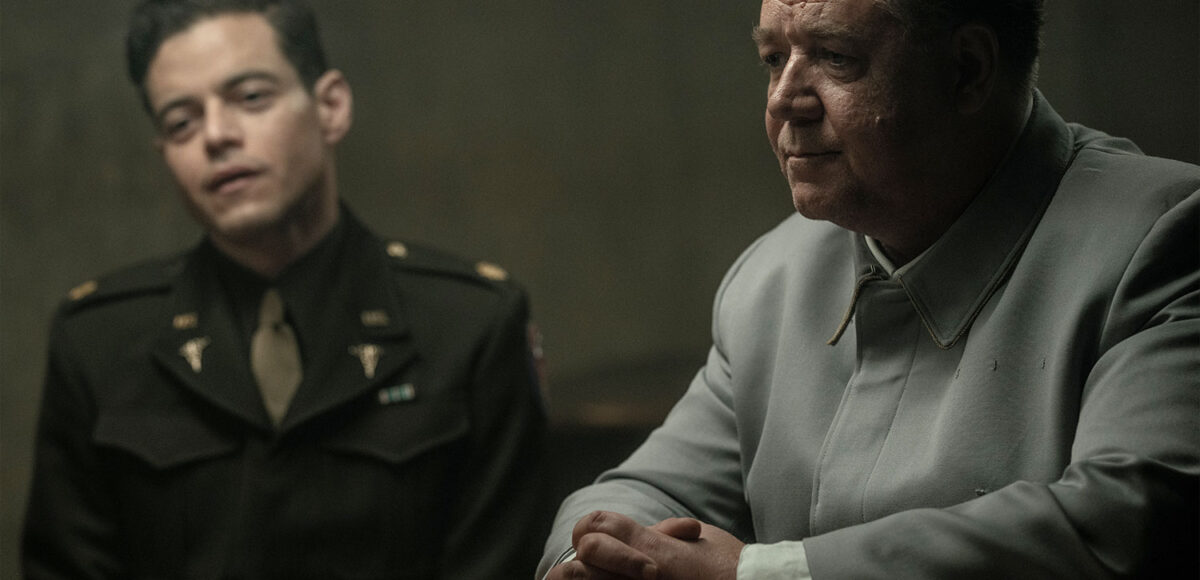
Vanderbilt, however, based this film on the book about Kelley, so it’s safe to assume that he intended that part of the film to dominate the rest. In Russell Crowe, he found a formidable actor to portray Göring. No histrionics, no extraneous gestures, Crowe’s Göring fills the screen frighteningly with his brilliance and arrogance. As Kelley, unfortunately, Rami Malek is less than equal to Crowe’s Göring. Full of ticks, nervous energy and speech mannerisms, Malek does not command the screen. From the narrative standpoint, it is hard to identify with his subjugation to his patient. His betrayal of his superiors and his turnaround at the end are not entirely believable. It is possible that his actions are straight out of the book, but even so, it’s important to buy into all of his actions, and I didn’t. A stronger, less eccentric actor might have been more effective.
In smaller roles, Burton Andrus, in charge of the prison, is played by John Slattery as a one-note villain. No one expects a sympathetic jailer who must oversee Nazi criminals, but surely he has more than a scowl in his repertoire.
Richard E. Grant as David Maxwell-Fyfe was particularly strong. His prosecutor, always above the fray, was ever so British, effectively stiff upper lipped and sympathetic. Leo Woodall as Sgt. Triest, the interpreter, was a scene stealer. Always quiet, wide-eyed and observant, he was the soft-focused brush of reality, questioning Kelley’s actions but never inserting himself. The reveal of his background was poignant and worked to underscore his skepticism and heighten the sympathy he engendered.
Vanderbilt undermines his film by trying to tell too many stories. The drama and tension are kept too much in check. Not as dramatic as the 1961 movie classic “Judgment at Nuremberg,” it is far more factual but much less emotional. A more effective and much better film is the documentary called “Filmmakers for the Prosecution.” Directed by Jean-Christophe Klotz from an article written by Susan Schulberg, it documented the footage of atrocities uncovered by brothers Budd and Stuart Schulberg before the Nuremberg Trials, footage that was instrumental in proving Nazi intent and crimes.
The production design is outstanding, creating realistic World War II villages and bombed out buildings. Long, at 145 minutes, “Nuremberg” could have used some trimming and better editing. I wish it had been a more interesting film, but it does have a compelling performance by Russell Crowe that is reason enough to see it.
Opening Nov. 7 at the AMC Century City 15.
Neely Swanson spent most of her professional career in the television industry, almost all of it working for David E. Kelley. In her last full-time position as Executive Vice President of Development, she reviewed writer submissions and targeted content for adaptation. As she has often said, she did book reports for a living. For several years she was a freelance writer for “Written By,” the magazine of the WGA West, and was adjunct faculty at USC in the writing division of the School of Cinematic Arts. Neely has been writing film and television reviews for the “Easy Reader” for more than 10 years. Her past reviews can be read on Rotten Tomatoes where she is a tomatometer-approved critic.