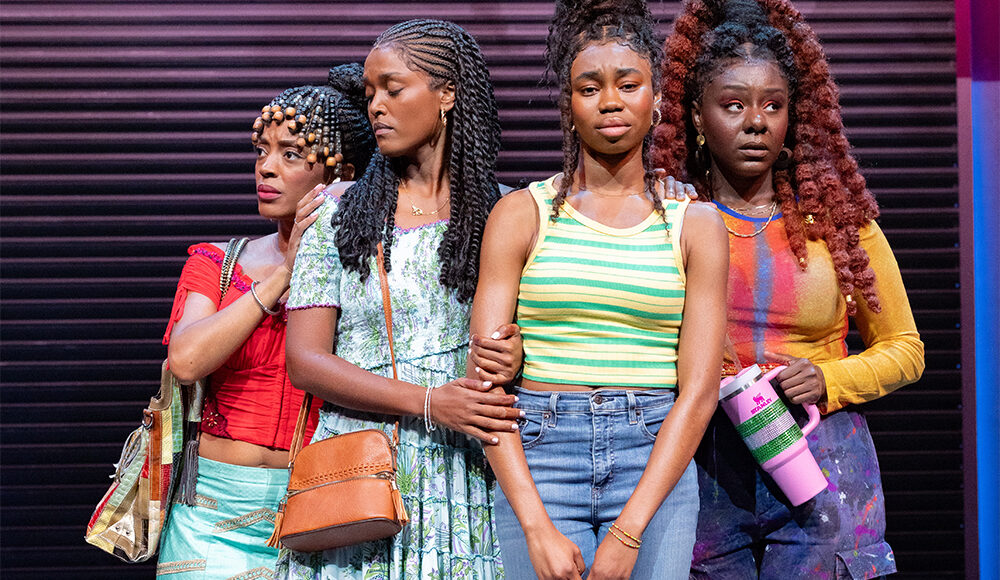

“Jaja’s African Hair Braiding” has finally twisted its way to the Mark Taper Forum in Los Angeles after a national tour. Despite its short run on Broadway last year, it garnered two Tony Awards and three other Tony nominations. A bit of an acquired taste, the play has a lot to say about bonding, conflict, trust and betrayal.
Bearing a bit of a bond with the “Barbershop” movies but with more depth, the stylists in the salon are all African immigrants from the diaspora of that continent. One woman is from Sierra Leone, others from Senegal, another from Nigeria. They all may be Black but their cultural backgrounds define them more than the color of their skin.
Marie, the daughter of a noticeably missing Jaja, is in the country as a DACA (Deferred Action for Childhood Arrivals) recipient. She aspires to college but cannot afford the schools that would be available to her as class valedictorian. Her peers naturally assume she’s on her way to Harvard or Princeton, but they would be wrong. Marie has been attending school under the names and birth certificates of various cousins. Although her mother tells her to dream big, Marie is a realist. Today, she is running the salon because her mother is getting married. She has no illusions. The groom is a sketchy white guy promising, for a large sum of money, to marry Jaja so she can get her green card. Marie begged her not to do this but Jaja, who has had considerable success up to this point, will brook no opposition.
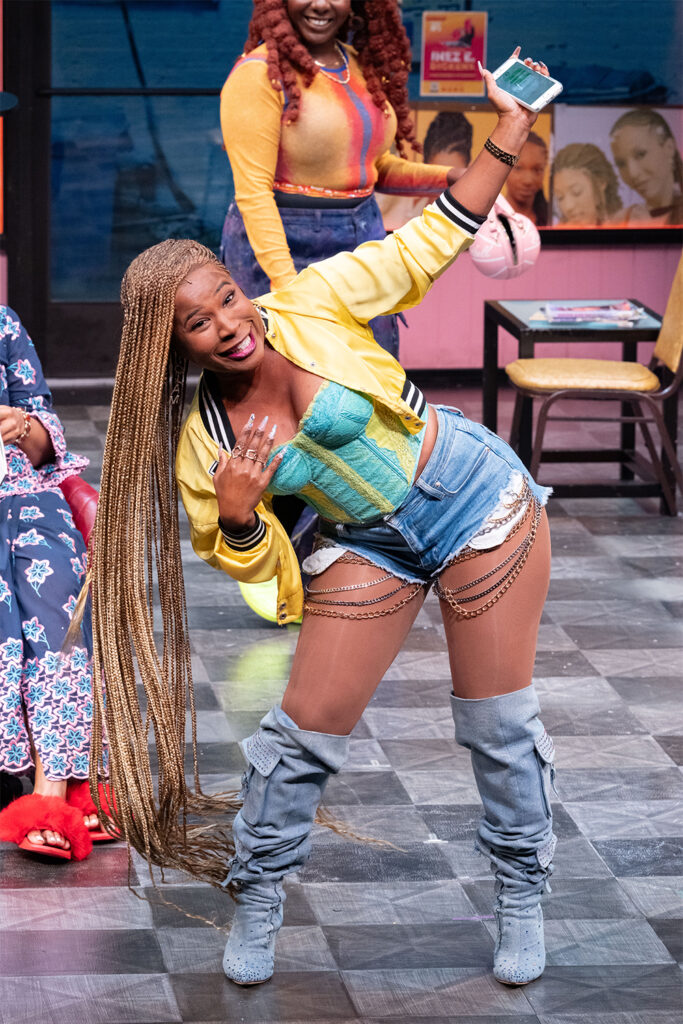
Opening the salon, Marie greets Miriam, one of the stylists, who has been waiting. Soon they are joined by Bea and Aminata and the gossip begins. Bea, the eldest, has an opinion on everything and most of them reflect back on how the shop should have been hers. She is particularly upset that Jaja has given a chair to Ndidi, a talented braider awaiting the reopening of the salon where she worked previously. Bea has nothing good to say about her and is very upset that some of her clients have strayed over to Ndidi. Never considering that her personality or deteriorating skills might have been the cause, she tries to make it as difficult as possible for the new woman, even confronting her clients.
Minor skirmishes, family drama and demanding customers make up their day as time flies by, denoted on the ever present television screen playing Nollywood movies as a digital clock flashes the advancing time. The clients who warm those chairs are rather upscale and bougie. They make it known that their occasional trip to Harlem is a novelty and know exactly how they want their hair to look. One wants the Beyoncé lemonade braid, thrilled with the result and ready to conquer the world. Another wants micro braids and still another wants cornrows. No matter what style, braiding is an all-day event as the clients sit patiently, some taking a lunch break before they resume a process that will continue past dinner time. For the hairdresser, it’s very time consuming and wreaks havoc with their fingers, often drawing blood from the intense weaving and chemicals used in the process.
Jocelyn Bioh, the playwright, also wrote “School Girls; Or the African Mean Girls Play” and “Nollywood Dreams”—plays that looked into the hopes and usually unrealistic dreams of young African women, whether in Ghana or Nigeria. The protagonists of both are looking to escape their daily lives and become stars, of one sort or another. “Jaja’s African Hair Braiding,” taking place in Harlem instead of the native Africa of the stylists, is no less about dreaming big and unrealistically. The biggest dream for all of them is that elusive green card that would turn their lives around. Bea would get her own shop, because, as she often repeats, this one should have been hers because it was her idea and Jaja, her best friend, stole it from her. Rarely mentioned is that Jaja used her savings to start her business, savings that Bea didn’t have. Aminata would love to leave her feckless, cheating husband and Miriam would like to bring her young child, still in Sierra Leone, to this country. Marie’s dream, probably as hopeless as the others, is to go to school legally. Out of all of them, Marie may be the only realist, knowing full well that she will remain in limbo despite her mother’s joyous exhortations of a better future with the sketchy husband and a newly obtained green card.
There are many warm, funny moments in the play and they make “Jaja’s African Hair Braiding” worth seeing. The cast is uniformly good, especially the way Bioh subtly, or maybe not so subtly, underscores the difference between these immigrant African women and the American women who come into the shop. Not entirely a “haves and have nots” scenario, the cultural and socioeconomic gaps are illustrated by the rich girl who happens into the shop and discovers that Marie, the classmate who beat her out for valedictorian, works there; or the aloof business woman who wants braids but insists that Aminata use only the combs and brushes she has brought with her.
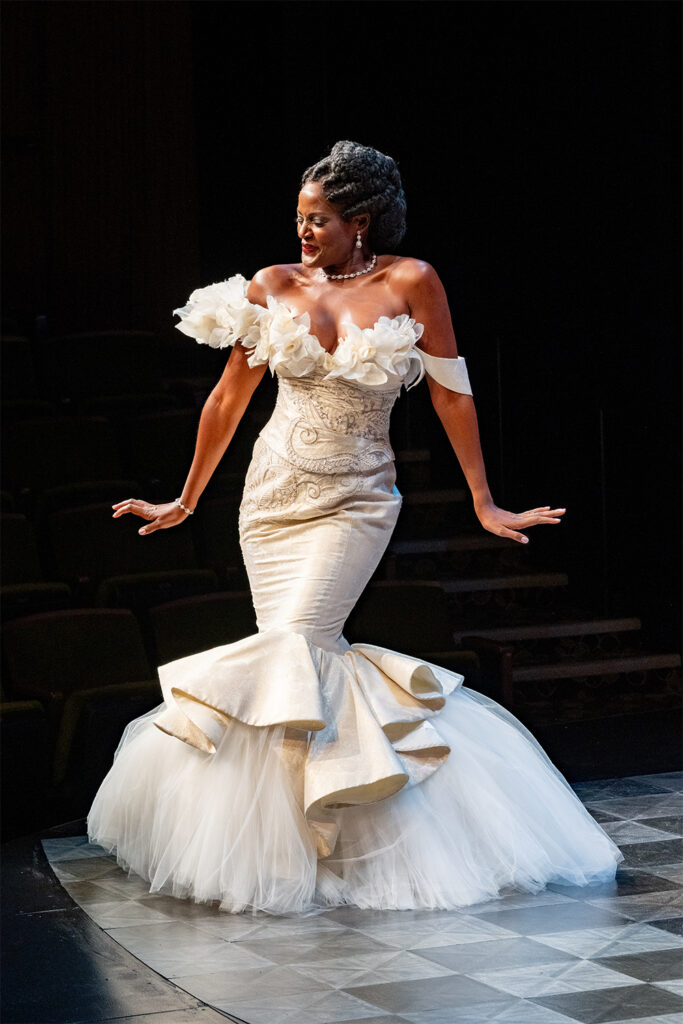
When Jaja finally appears, it is to show off her wedding outfit, one that will be put to use shortly when she meets her betrothed at city hall. Joyous, swanning, she ignores her daughter’s concerns. Marie begs her to reconsider; the money could be put to better use. No! With a final flourish, she is off to be married and live her happily ever after.
There is never a happily ever after in these scenarios and there isn’t one here, shifting the tone from snappy, gossipy and petty to serious, one that highlights all of their greatest fears in this anti-immigrant climate.
With the exception of Marie, none of the other salon ladies seemed to be elevated beyond stereotype, never digging deeper than exposition into their characters. Too often, Bioh goes for the easy laugh, rooted in the petty jealousies. The final moments of the play, a serious tone not present earlier, finally show the depth lying within the characters. The undercurrent of their precarious status might have been better explored earlier.
Now playing through Nov. 9 at the Mark Taper Forum, 135 N. Grand Avenue. Performances at 7:30 p.m., Tuesday-Thursday; 8 p.m. on Fridays, 2 and 8 p.m. on Saturdays; and 1 and 7 p.m. on Sundays.
Neely Swanson spent most of her professional career in the television industry, almost all of it working for David E. Kelley. In her last full-time position as Executive Vice President of Development, she reviewed writer submissions and targeted content for adaptation. As she has often said, she did book reports for a living. For several years she was a freelance writer for “Written By,” the magazine of the WGA West, and was adjunct faculty at USC in the writing division of the School of Cinematic Arts. Neely has been writing film and television reviews for the “Easy Reader” for more than 10 years. Her past reviews can be read on Rotten Tomatoes where she is a tomatometer-approved critic.