

The hits, or at least the shows, keep on coming. Here’s a sampling of what’s out there.
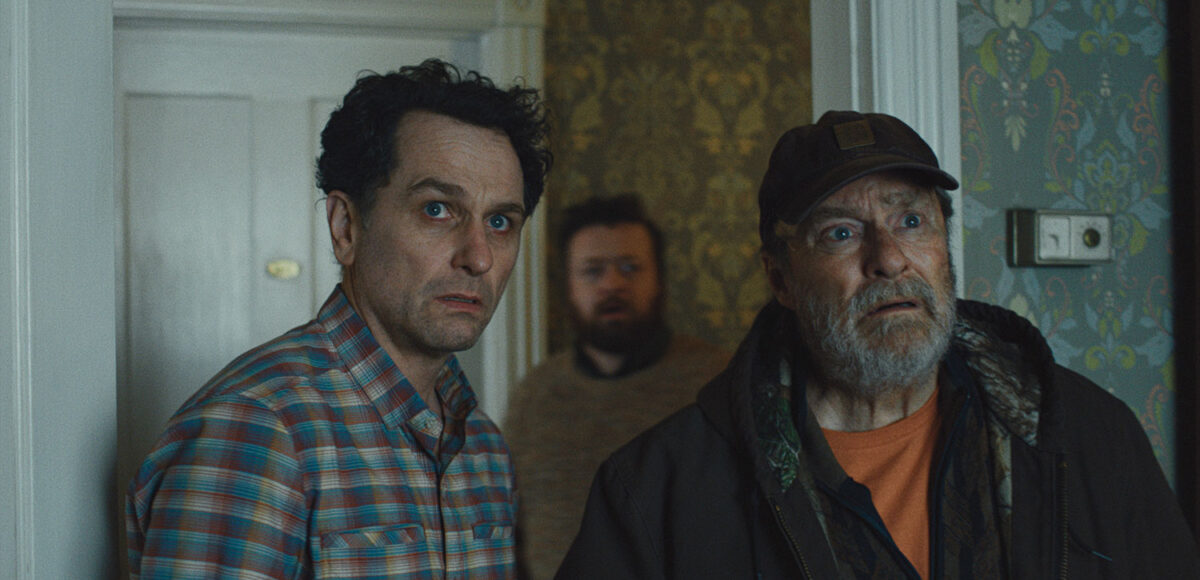
“Widow’s Bay” rather effectively marries comedy with horror. Mayor Tom Loftis is something of an outsider on this picturesque New England island. He met his wife here and returned, determined to make this unknown island into the tourist mecca he feels it deserves. Loftis, however, is deaf to the pleas and explanations of the town folk, people whose respect he would like to earn. Ignoring their old wives’ tales and negativity, he plows ahead with his ideas to attract tourists. “No, no!” exclaim the villagers. The island’s history is cursed; bad things happen there. “What town doesn’t have a checkered past?” he asks.
Tone-deaf, bad things are happening around him and he is warned repeatedly. But when a mainland critic arrives to take a look at the island, Loftis successfully avoids the glaring pitfalls and charms the journalist. His rave review turns the island into a tourist mecca and that’s when things go rapidly downhill. There’s more truth than tall tale in the village history and when he finally sees the light, it may be too late.
Creator Katie Dippold straddles the high bar of comedy and horror. An outstanding cast was assembled, starring Matthew Rhys, whose exquisite timing makes him a perfect foil as the clueless mayor, hitting all his marks in both comedy and drama. He is ably abetted by that seasoned scene stealer Stephen Root as his knowledgeable antagonist in the town whose presence here is a reminder of what the stakes may be. Dale Dickey, a personal favorite, is the mayor’s assistant and uses her malleable smoky alto and lived-in face to illustrate the hilarious but human side of the townsfolk. Veteran character actor K Callen underpins the warmth of the quirky villagers. Although I far preferred the comedy to the rather abrupt turn to the Grand Guignol horror, “Widow’s Bay” fires on all cylinders with an ending that begs for a second season.
Now streaming on Apple TV.
“Lord of the Flies” is the much-anticipated remake of William Golding’s classic. This is the third iteration of this story, having first been made as a movie in 1963 and again in 1990. Writer Jack Thorne, a recent Emmy winner for “Adolescence,” has given this the limited series treatment. I will play my hand immediately and say that I wished I had liked it, but I didn’t.
A group of schoolboys ranging in age from preschool to late middle school has found themselves stranded on an uninhabited island in the middle of the ocean. It slowly dawns on them that they have survived a plane crash and that they are alone without adult supervision. Some of the older boys understand the need for structure and leadership and begin to form their own society. But democracy only works if everyone works together toward the same goal. The goal here is to stay alive. They need to build an infrastructure of shelter, food and security. All is initially well until factions begin to form when one group resents the leadership of the other and stops helping with the boring but necessary tasks of building and wood gathering. They want to hunt and play and have their own camp.
Divided into four chapters, each highlighting a different leader among the boys, we first meet Piggy, the brightest organizer of the group, but resented for his wisdom and rigidity. His coke-bottom glasses contribute to his outsider status, and his logic and preternatural intelligence engender resentment. Chapter Two centers on Jack, resentful that he wasn’t chosen as the leader. He leads his faction of mean boys away from the group and farther into the woods where they plot the overthrow of the others. In Chapter Three, Simon comes to the front. A schoolmate of Jack’s, Simon is well-aware of the volatility and danger that Jack poses. And finally, in Chapter Four, the story centers on Ralph, whose elected leadership is eroded and violently challenged by Jack’s faction.
There were many opportunities to right this ship. Golding’s underlying material is superb and illustrates the universality of how societies break down. The book and the first film were taut and suspenseful and frighteningly real. They moved at a pace that heightened the tension and the fraught, hateful actions of the alphas in Jack’s group. There is no pace, begging the question of why this was stretched out longer than the fast-moving book and movie. Instead, director Mark Mundon films each episode as a David Attenborough nature series, focusing on the colors, plant life, horizons, sunsets and wildlife. As a director friend of mine used to say disparagingly about certain performances he was filming, you could drive a truck through that scene. Generally speaking, you could drive a tank through most of these scenes, something that lessens the tension necessary to the performances and writing. It was nothing less than a slog to power through these beautiful but uninteresting episodes.
Now streaming on Netflix.
“Nemesis” explores the dynamics of two incredibly driven individuals on opposite sides of the law. The Courtney Kemp and Tani Marole-created limited series succeeds in revealing the personality similarities between the master criminal and the driven detective.
Opening on a high-stakes Beverly Hills gambling party full of the rich and super-rich, Coltrane Wilder, ex-con and up-and-coming respected businessman, is an invited guest. But Coltrane is there under false pretenses; a ruse to open the door for his gang of thieves who proceed to ransack the guests of their jewels and gambling winnings. It’s quite a haul, enough so that he promises Ebony, his wife, he will soon retire. Learning of the robbery, Detective Isaiah Stiles is convinced that this is the gang he has been chasing since his partner was killed in a different high-stakes burglary. Unfortunately, the powers that run the department are unconvinced and think Isaiah is tilting at windmills, unable to see straight because of his personal connection. Instead, they assign the case to a couple of moronic, know-it-all detectives who are unconvinced of the connection and are sure that the gang is on the verge of making the critical mistake that will allow them to swoop in and catch them.
The series, through eight repetitive episodes, reveals the protagonists as two sides of the same coin. Stiles, the stereotypic rogue cop, decides that he will bring Coltrane down himself. Coltrane views Stiles as a personal enemy and reacts accordingly. Needless to say, there is corruption in the police department and Stiles is repeatedly hamstrung by his superiors.
There is nothing original here. On the one hand you have the suave, composed criminal disguised as a businessman and on the other it’s the hot-headed police detective who can’t get anyone to listen to him.
All of this might work because if told well an old story can be made new. This is not. The writing and the characters are clichés and, worse, the acting is flat. There are lots of pretty faces, but they lack the modulation to convince us of their personal truths. Y’Lan Noel as Coltrane is the most convincing of the lot, selling his character with an adept smoothness. Matthew Law, as Stiles, is lovely to look at but incapable of portraying anything but anger. He arrives at full throttle and rarely leaves that emotional level.
“Nemesis” definitely hits its marks in costume and production design, making Los Angeles a character in the filming. Still, despite the speed at which the action is filmed, the dialogue and characterizations often bring it to a full stop. Not my cup of tea and assuredly not the expensive Burgundy they’re trying to sell.
Now streaming on Netflix.
Neely Swanson spent most of her professional career in the television industry, almost all of it working for David E. Kelley. In her last full-time position as Executive Vice President of Development, she reviewed writer submissions and targeted content for adaptation. As she has often said, she did book reports for a living. For several years she was a freelance writer for “Written By,” the magazine of the WGA West, and was adjunct faculty at USC in the writing division of the School of Cinematic Arts. Neely has been writing film and television reviews for the “Easy Reader” for more than 10 years. Her past reviews can be read on Rotten Tomatoes where she is a tomatometer-approved critic.