
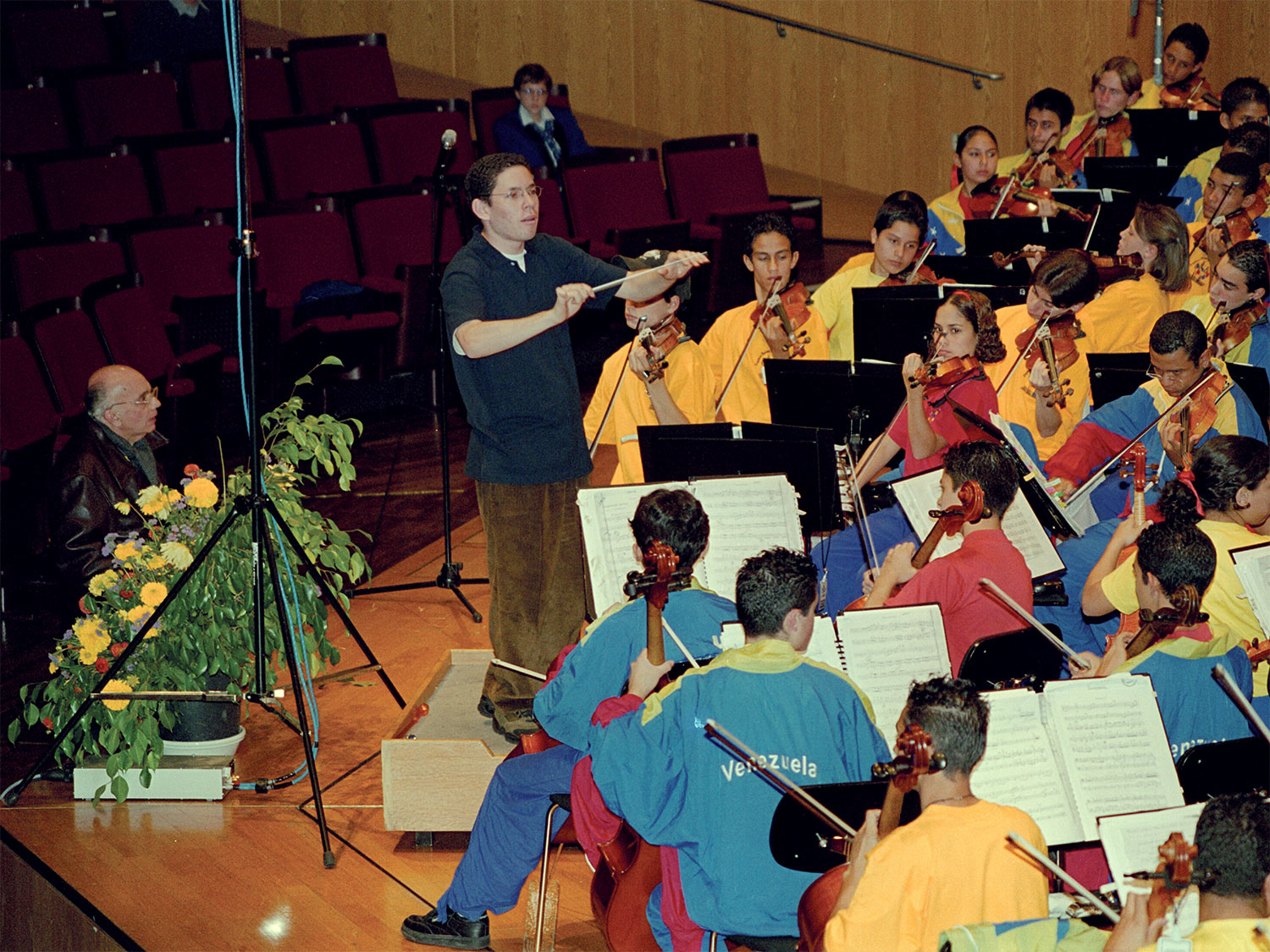
Enjoying the moments before rehearsal with his orchestra friends, young Gustavo’s playful enthusiasm took charge. As the first violinist of the Youth Orchestra of Barquisimeto, Venezuela, the 11-year-old prodigy set down his violin, stepped onto the conducting block and began to imitate the absent conductor. To Gustavo’s delight, his orchestra friends followed, filling the hall with a magical sound. In the heavenly moment, Gustavo closed his eyes and allowed the music to transform him.
Suddenly, the sound unraveled. Quickly opening his eyes, Gustavo saw worried, pale faces staring back at him. His instructor, Maestro Luis Jimenez, had arrived and stood in the back of the hall.
“Oh my God, this is the end of my life as a musician,” said Maestro Gustavo Dudamel, recounting his terror in the hall’s silence. He thought, “I’m done. This is the end.”
Maestro Jimenez slowly approached Gustavo. In a serious tone he said, “You have kind of a talent for conducting.” He then walked to his conducting block and raised his baton to begin the rehearsal.
Later, Gustavo was summoned to the Maestro’s office. Instead of a stern reprimand, Gustavo was offered the introductory position of assistant conductor. This defining moment changed Gustavo’s life forever.
“I have to thank him a lot. I’m ‘here’ because of him.”
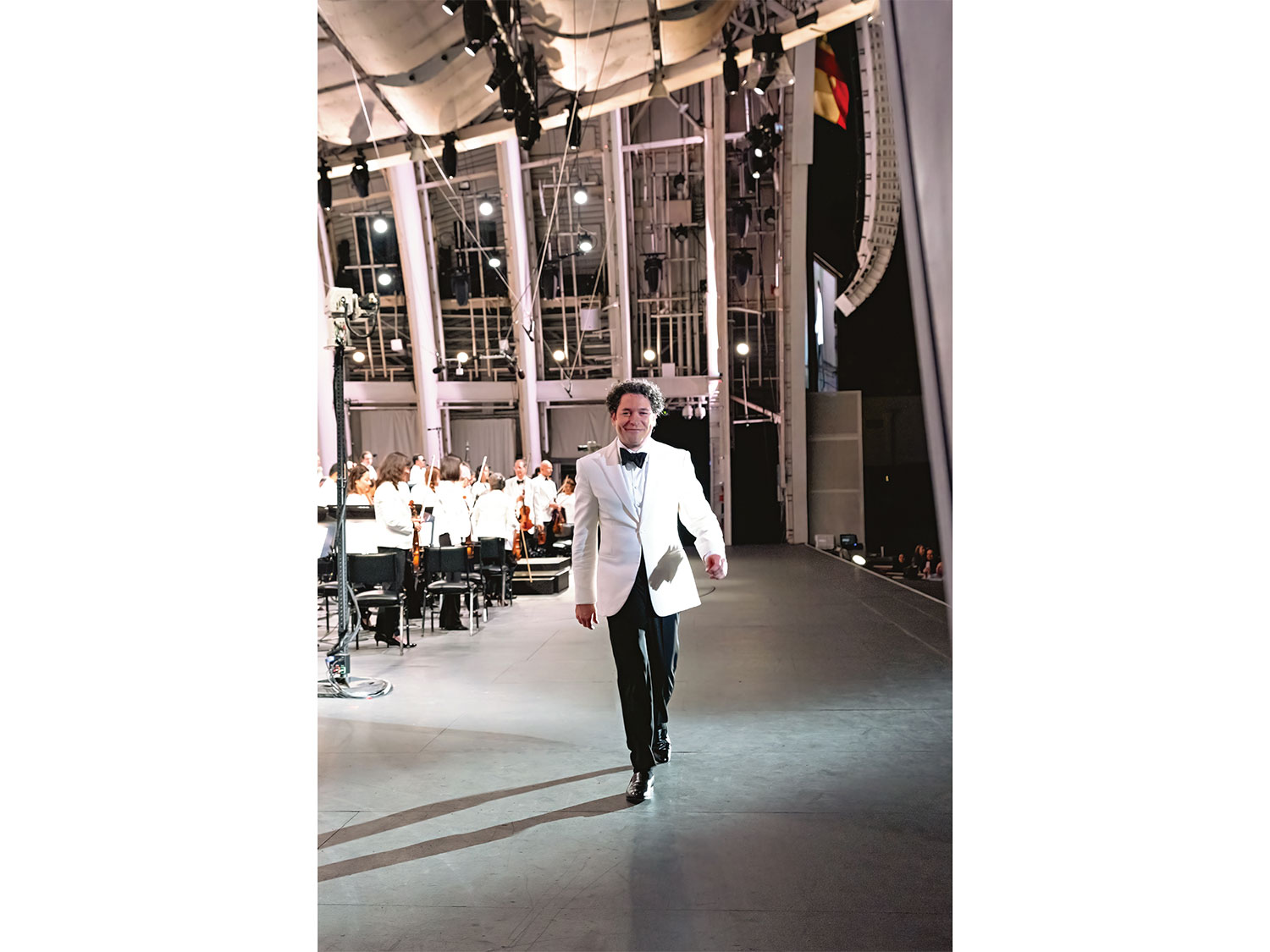
Photo courtesy of L.A. Philharmonic
“Here” is the magnificent Walt Disney Concert Hall in downtown Los Angeles. For the past 17 years, beginning at the age of 27, Maestro Gustavo Dudamel has been the ordained “gift” to Los Angeles, the honored and cherished Music & Artistic Director of the Los Angeles Philharmonic. But soon Los Angeles will be saying, “Gracias, Gustavo!”
His leadership is often described as magical, as he infuses enthusiasm and spontaneous engagement, making classical music feel relevant and alive. With his bold and diverse programming, his dynamic, performative approach and his ability to inspire contemporary works, Maestro Dudamel has captured the world’s heart in classical music. He has not only dramatically increased his audience fan base, but he’s also transformed younger more diverse enthusiasts towards classical music. The New York Times has called him the “superstar conductor” and has praised his talents with helping to make the LA Philharmonic “the most important orchestra in America—period.”
“Under his leadership, we’ve become a model for what a 21st-century orchestra can be: boldly creative, fiercely relevant, and deeply connected to its community,” said Chairman of the Board of the Los Angeles Philharmonic Jason Subotky.
During his extraordinary tenure, he’s energized global audiences, holding additional positions as Music Director of the Paris Opera (2021-2023), Music Director of the Gothenburg Symphony Orchestra of Sweden (2007-2012), and Music Director of the Simón Bolívar Youth Symphony Orchestra of Venezuela (since 1999).
Photos courtesy of L.A. Philharmonic
As a visionary, he’s created many symphonic firsts. He has led orchestra performances at major pop culture events, including the Super Bowl halftime show with Bruno Mars, Beyoncé and Chris Martin. He conducted the LA Philharmonic as it opened the 91st Academy Awards broadcast, and many collaborative performances with artists like Billie Eilish and Coldplay, as well as having been featured in mainstream films and series such as “West Side Story,” “Sesame Street,” and “Mozart in the Jungle.” He’s been awarded eight Grammy Awards and five honorary doctorates in music from highly respected institutions from around the world, including Harvard University. Internationally, he has received Spain’s Gold Medal for Merit in Fine Arts, Chevalier and later Officier of the Ordre des Arts et des Lettres of France, the Queen Sofía Spanish Institute Gold Medal, and is a foreign member of the Royal Swedish Academy of Music.
Accolades aside, what drives this megastar maestro is deeply rooted in his humble beginnings and the transformative power he experienced as a participant in El Sistema of Venezuela. Modeling that system he founded the Youth Orchestra of Los Angeles (YOLA). In partnership with the LA Philharmonic, YOLA today boasts over 1,700 young musicians ages 6-18, who receive free instruments, intensive music training and academic support.
President and Chief Executive Officer Kim Noltemy of the LA Philharmonic noted, “For years, audiences have witnessed this profound and mutual affection between Gustavo and the orchestra, because when Gustavo conducts, what radiates from the stage is pure, shared joy. His deep respect and love for the orchestra are unmistakable in every performance.”
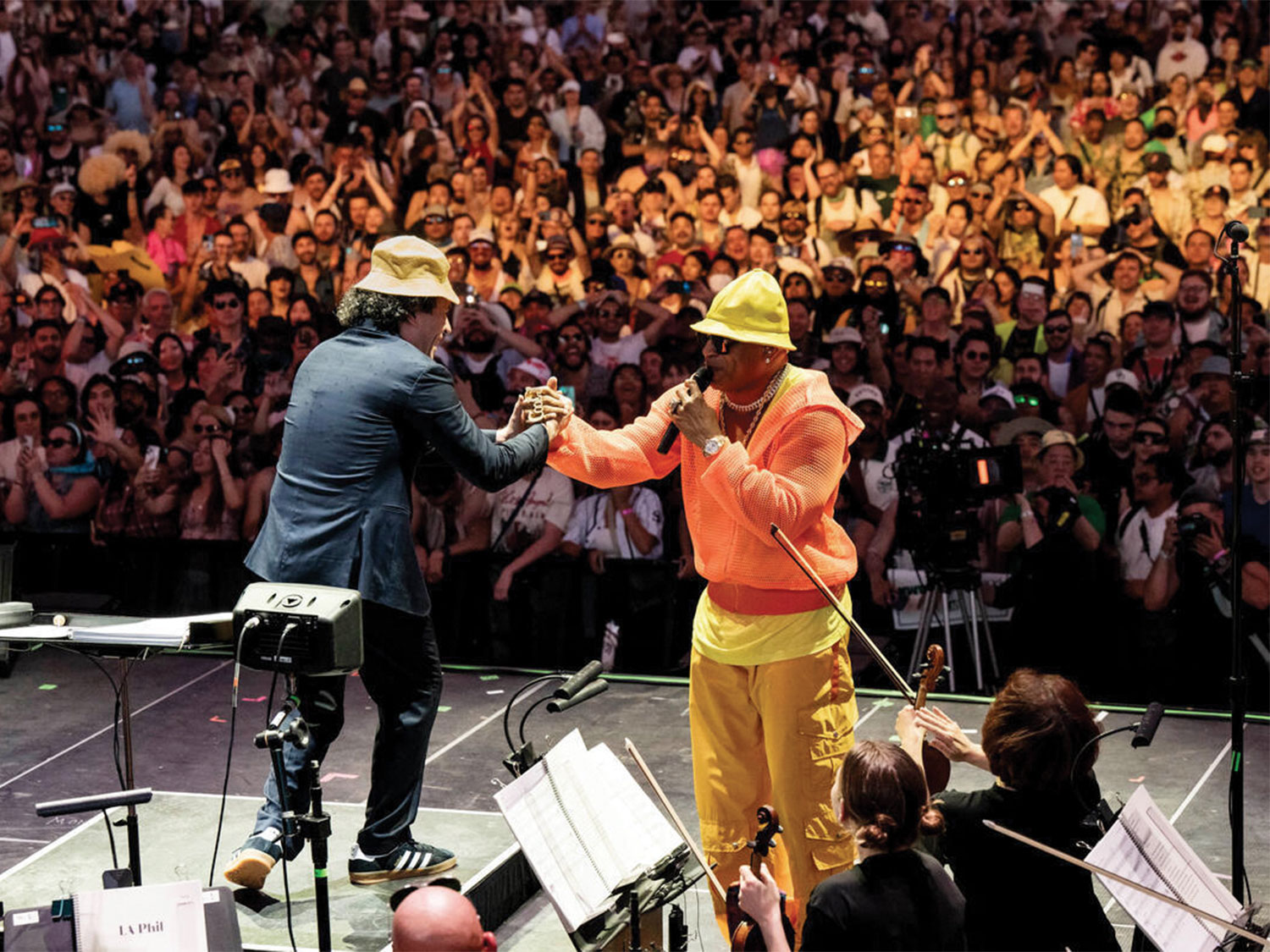
This natural connection with his orchestra, and his innovative thinking and trailblazing collaborations, have inspired audience enthusiasm. This past spring, at Coachella, Maestro Dudamel brought the LA Phil to perform for the first time. He smashed all expectations and records by intermingling works by Bach, Strauss, Wagner and John Williams, with contemporary artists such as LL Cool J, Laufey, Dave Grohl, Zedd and Cynthia Erivo. Gustavo stated in the Los Angeles Times, “This performance ‘represents a journey of making music accessible to everybody.’”
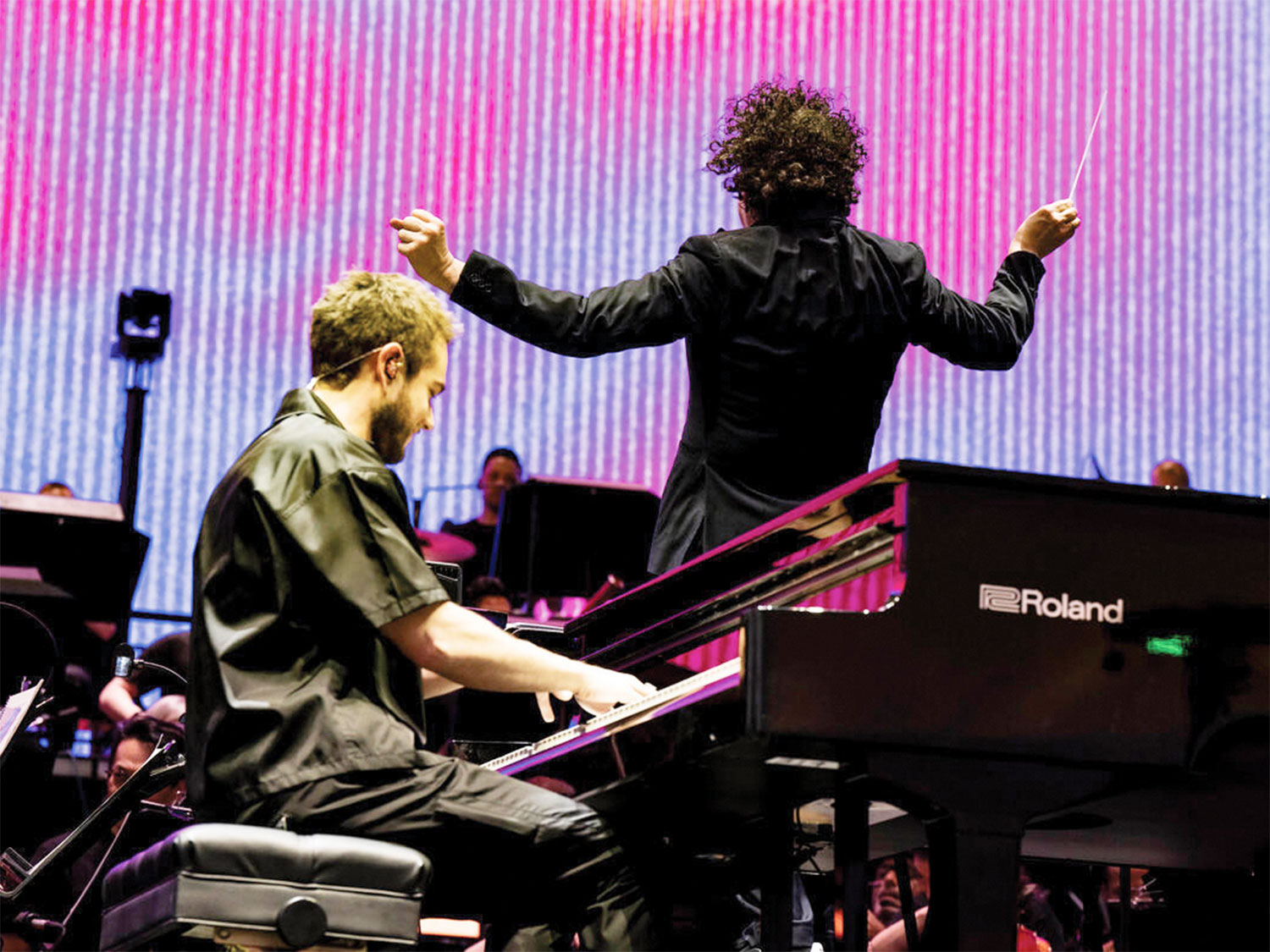
By successfully “crossing over” from classical music into the world’s pop culture, Gustavo Dudamel has ignited awareness, exponentially, of the transformative power of music. His historical Billboard magazine cover story in 2024, the first classical musician ever to be featured, signifies this unprecedented crossover. As he packs his bags for the New York Philharmonic, ending his extraordinary reign in late spring 2026, the Courier was honored with this rare opportunity to gain an intimate understanding of his astonishing, meteoric journey, his wisdom, and how he believes music can be a unifier to help heal the world.
From the calm, carpeted corridor, I opened the Disney Concert Hall’s auditorium door to the thunderous power of the LA Philharmonic and the Los Angeles Master Chorale, led by Maestro Dudamel. Having been invited to peek in on his private rehearsal of a new contemporary composition, I quickly slipped into a back mezzanine seat. The empty hall in its colorful and acoustical grandeur further heightened the mesmerizing moment.
The piece, “Earth Between Oceans,” explores the power of nature through the lens of the four elements: Earth, Air, Fire and Water. Undoubtedly, I had entered during the dramatic Fire section. The robust “wordless choir added a dynamic timbre to the ensemble,” said Ellen Reid, its Pulitzer Prize-winning composer, at the world premiere the following night.
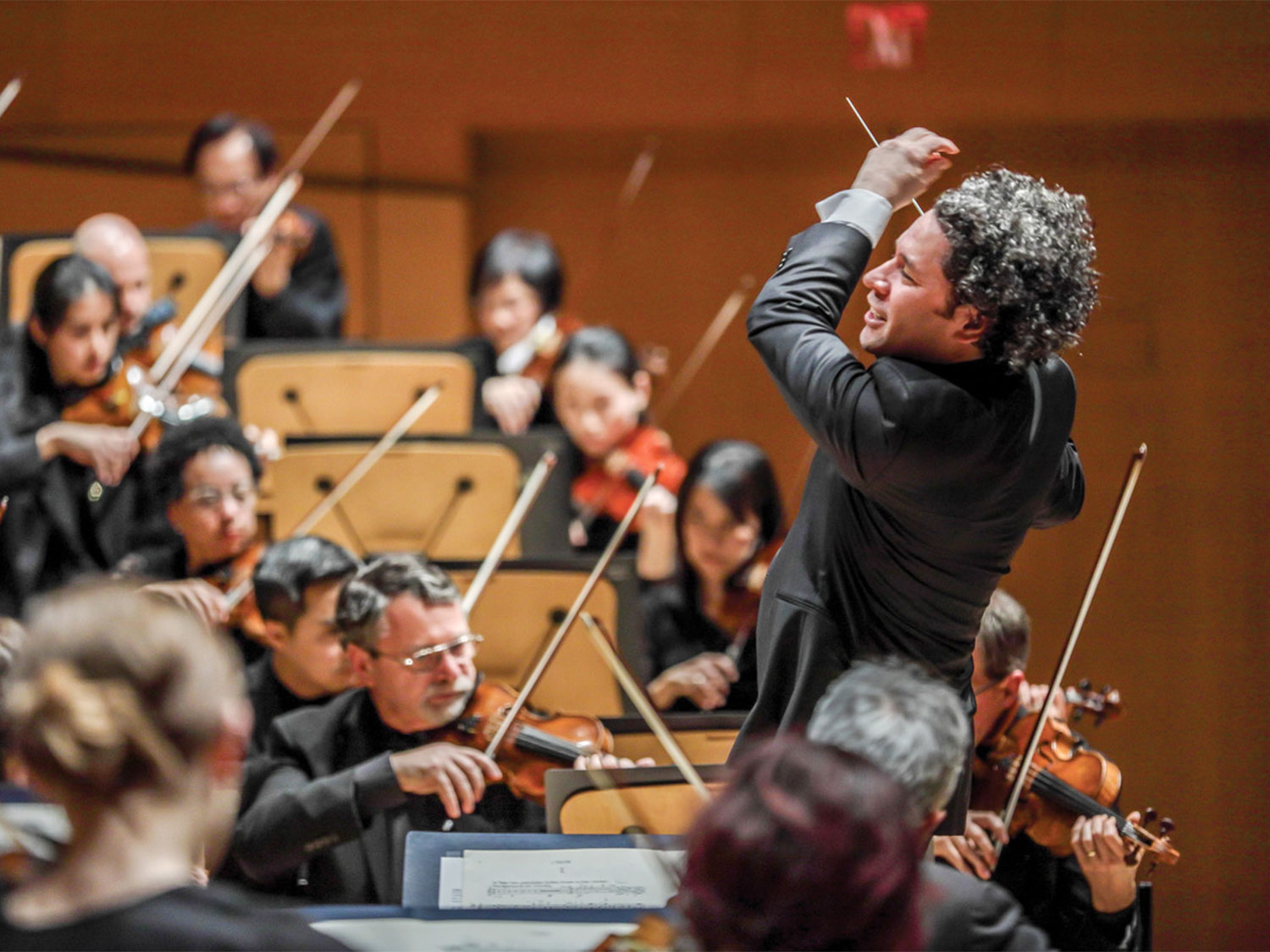
Photo by dustin downing
Suddenly, Gustavo’s large arm gestures silenced the sound. In the quiet, he turned in his conductor’s rehearsal chair and called to Ms. Reid sitting in the orchestra section behind him. They shared words of interpretation. He then swiveled back to his orchestra, lifted his arms, and revisited the refrain. It was extraordinary to watch his process.
“The good thing is that she’s there,” said Gustavo, reflecting on the rehearsal later that afternoon with me in his private office. “But she’s letting me go. She writes the music, and we interpret it. She was very touched about what was happening.”
Ms. Reid had never heard her creation performed live before that afternoon. Neither had Gustavo nor the orchestra.
He continued, “And for me, it’s wonderful. It’s like having Mahler or Beethoven there. ‘Hey, Ludwig, what do think about it? Are we doing well?’” Gustavo chuckled at the thought. “Although they [Mahler and Beethoven] are not present with us, they are present with their music, and you have to really read the music to understand and bring them alive.”
This is one of the benefits of performing new, contemporary compositions.
“It’s like a baby that walks immediately,” said Gustavo. “When we are playing something, we don’t know what is going to happen. [Ms. Reid] has an idea. We have an idea. She’s very talented. I have premiered other pieces by her, and she’s very clear in what she wants. But in that moment when you play something for the first time.” He pauses. “It’s beautiful.”
“Beautiful” is also the way Gustavo describes hearing the sound of live orchestral music for the first time in his life.
Photos courtesy of gustavo dudamel
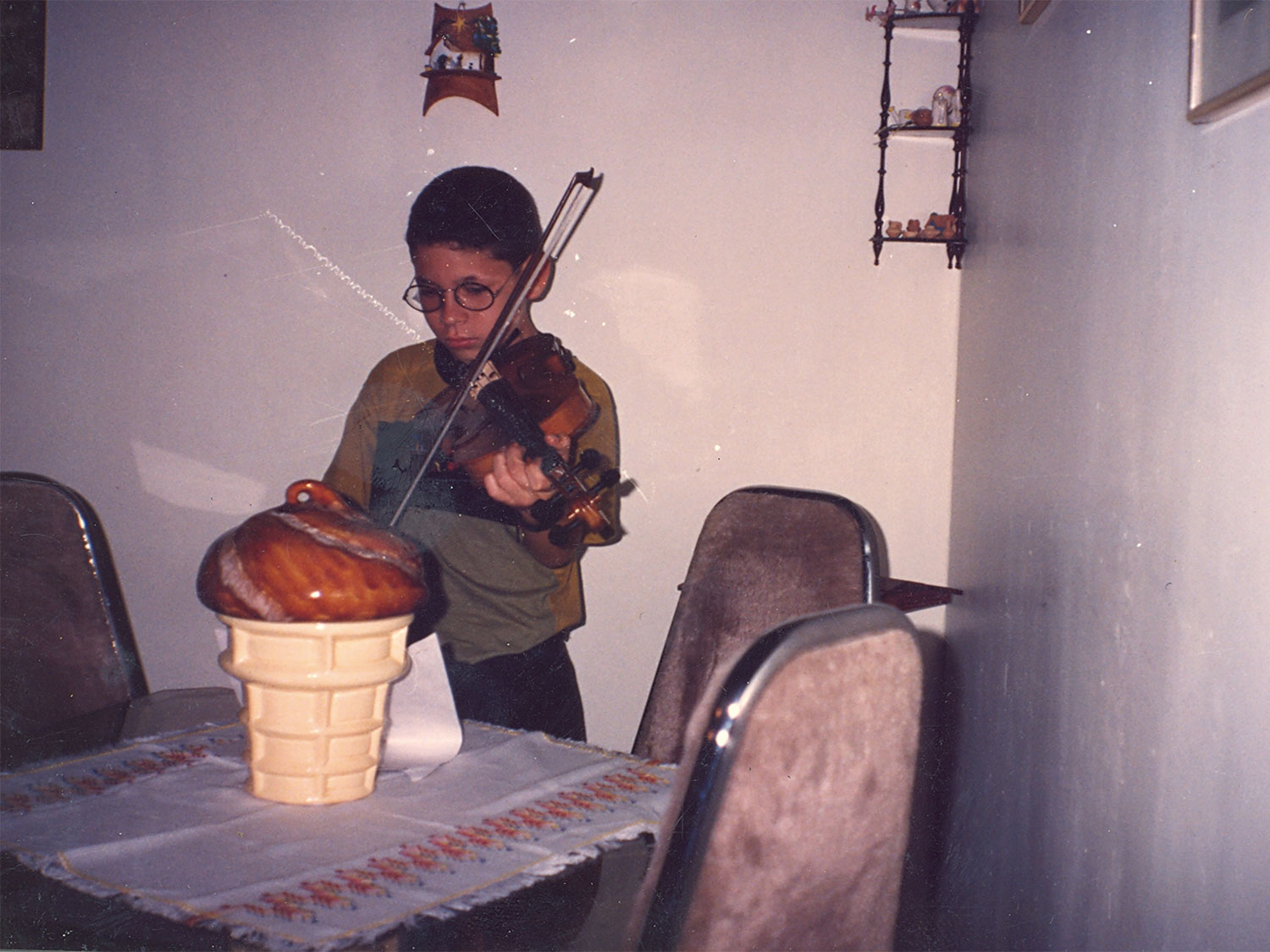
Little Gustavo was 5 years old. It was Rimsky-Korsakov’s Scheherazade, a symphonic suite inspired by the tales of “One Thousand and One Nights,” also known as “The Arabian Nights.” His young father was a trombonist in the youth orchestra.
“I was blown away. It was like, wow! I have the memory of the theater where we were, and the amount of sound that was coming. I was so excited. I was trying to see my father. But I couldn’t see him because I was very little.”
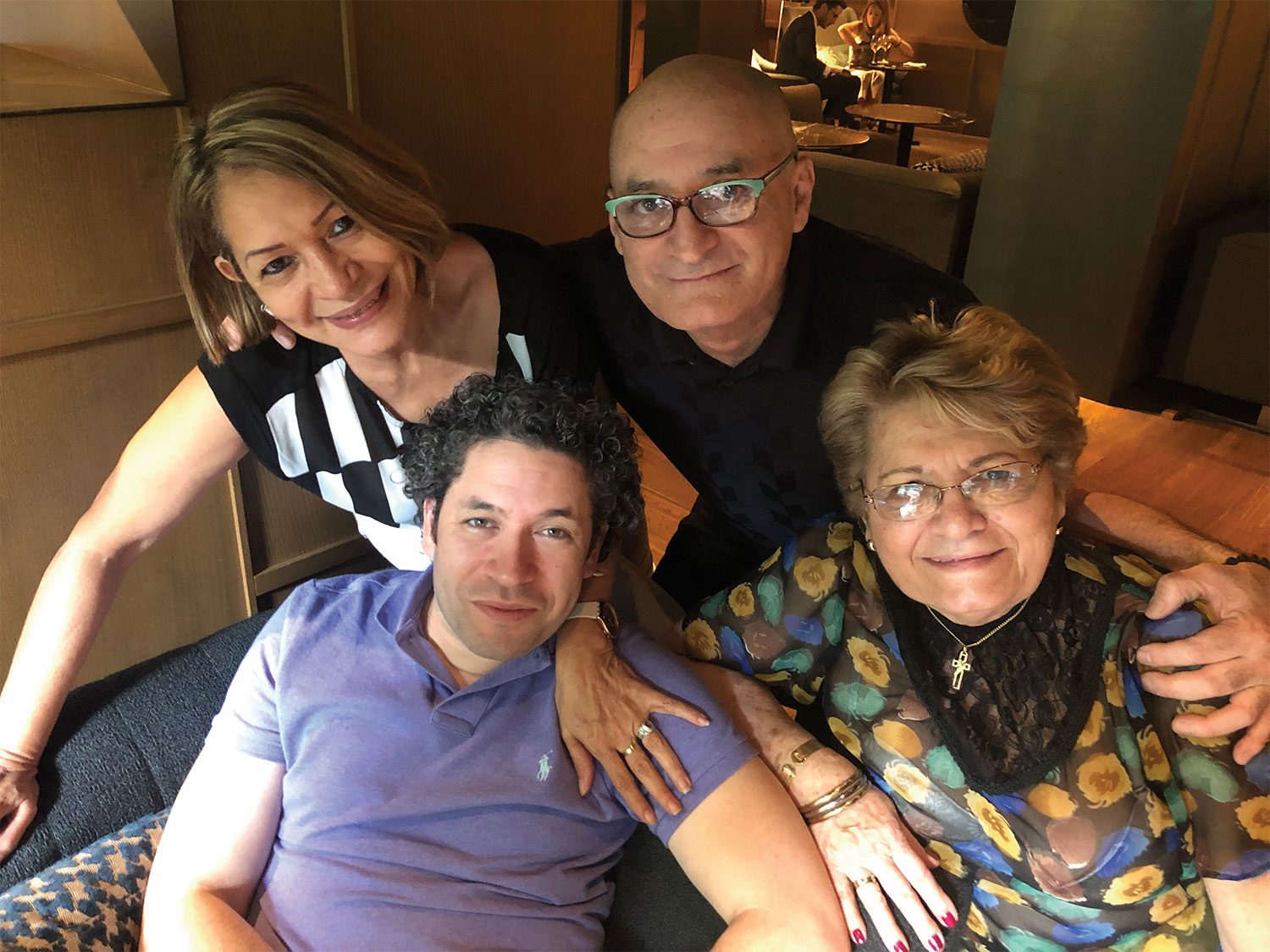
Music is in Gustavo’s blood. His parents met in a folk music group in Barquisimeto at the ages of 15 and 16. Young Solangel Ramirez Viloria, a singer and voice teacher, fell in love with Oscar Dudamel Vasquez, a trombonist and salsa musician. They raised their two sons Roger and Gustavo, in a musical environment, beginning with Latin music, bolero, salsa, and merengue.
Gustavo’s grandmother, Engracia Vasquez de Dudamel, lived with the family when Gustavo was a boy. She has shared stories about him, arranging his toy soldiers in orchestral positions. While the music played on the record, he would conduct their performance. This imaginative play from an early age made conducting feel very natural to him.
But it was the revered Maestro José Antonio Abreu, and his trailblazing work to democratize access to the arts, who lit the fire under Gustavo. While mentoring him toward maestro prominence, Maestro Abreu inspired Gustavo toward a life commitment to social advocacy.
In 1975, Maestro Abreu created a groundbreaking music education program, funded by the Venezuelan government’s social services division, to provide free musical education for all children regardless of their socioeconomic background. Believing music is a universal right, Maestro Abreu felt music education was essential for the well-being of children at risk, providing social inclusion and personal development through shared music making. As music transmits harmony and mutual compassion, he was convinced it could unite communities. Called El Sistema, it grew into a nationwide network of hundreds of music centers reaching hundreds of thousands of children from underprivileged backgrounds. Maestro Gustavo Dudamel is indisputably El Sistema’s most successful alumnus.
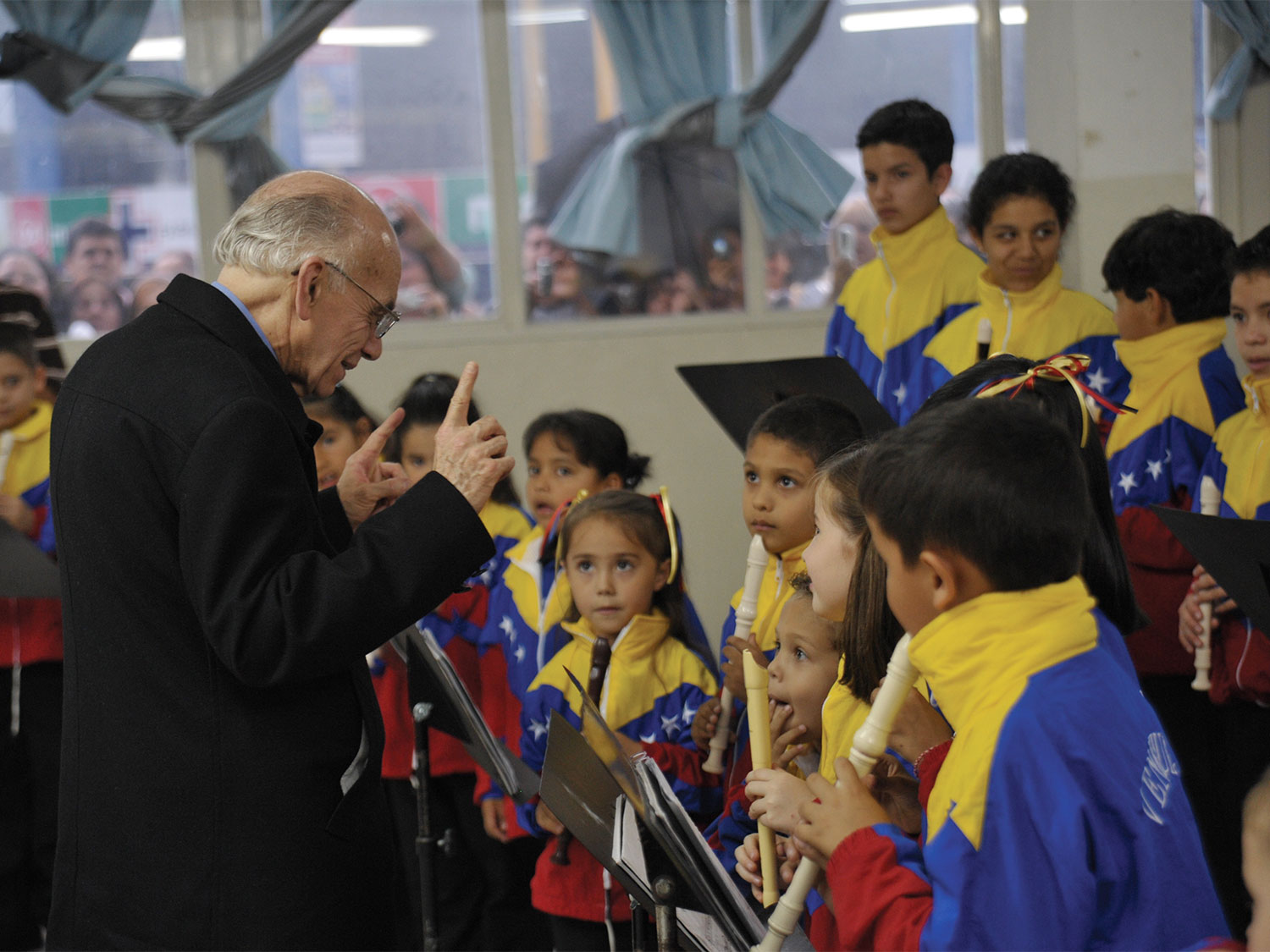
Entering the program as a young boy, Gustavo thoroughly enjoyed making music with his friends. It was his happy place. El Sistema was popular and thriving. At the young age of 12, he was selected as a violinist from all the children in youth orchestras in Venezuela to be in the National Children’s Orchestra. This was his first encounter with Maestro Abreu.
“Of course, he was there all the time supervising the rehearsals. One day he asked me to lead, to show the people how to do it.”
Maestro Abreu recognized Gustavo’s talent and took him under his wing. Soon after, he invited Gustavo on a trip to Caracas, at age 14, to witness his first ballet performance. It was a ballet rehearsal of “Swan Lake.”
“I was sitting there, and he asked me, ‘Do you see the rhythm? … in the body? Do you see the melody?’ I was like, wow, I have to discover that.” “‘Now, where do you feel the harmony? The chords?’ It was amazing because it was the most beautiful natural expression … Maestro Abreu was a genius.”
He was instructing Gustavo to see the orchestra in the movement of the body. At another point, Maestro Abreu used the analogy of a flying bird as a metaphor to help teach the movements of conducting hands.
“He said to me, ‘Your hand is like a bird. You feel all the air in the palm of your hand and there is the dimension of sound. You are taking the sound that is everywhere. Even if you think it’s silent, there is energy. That is harmony and that is sound. And when you are making the movement of the upbeat to start, you are bringing that sound there,” as he gestured lifting his arms in his office. “And this is the way I hold the baton in my hand because it’s the body and the wings. And this is the head,” as he continued to demonstrate.
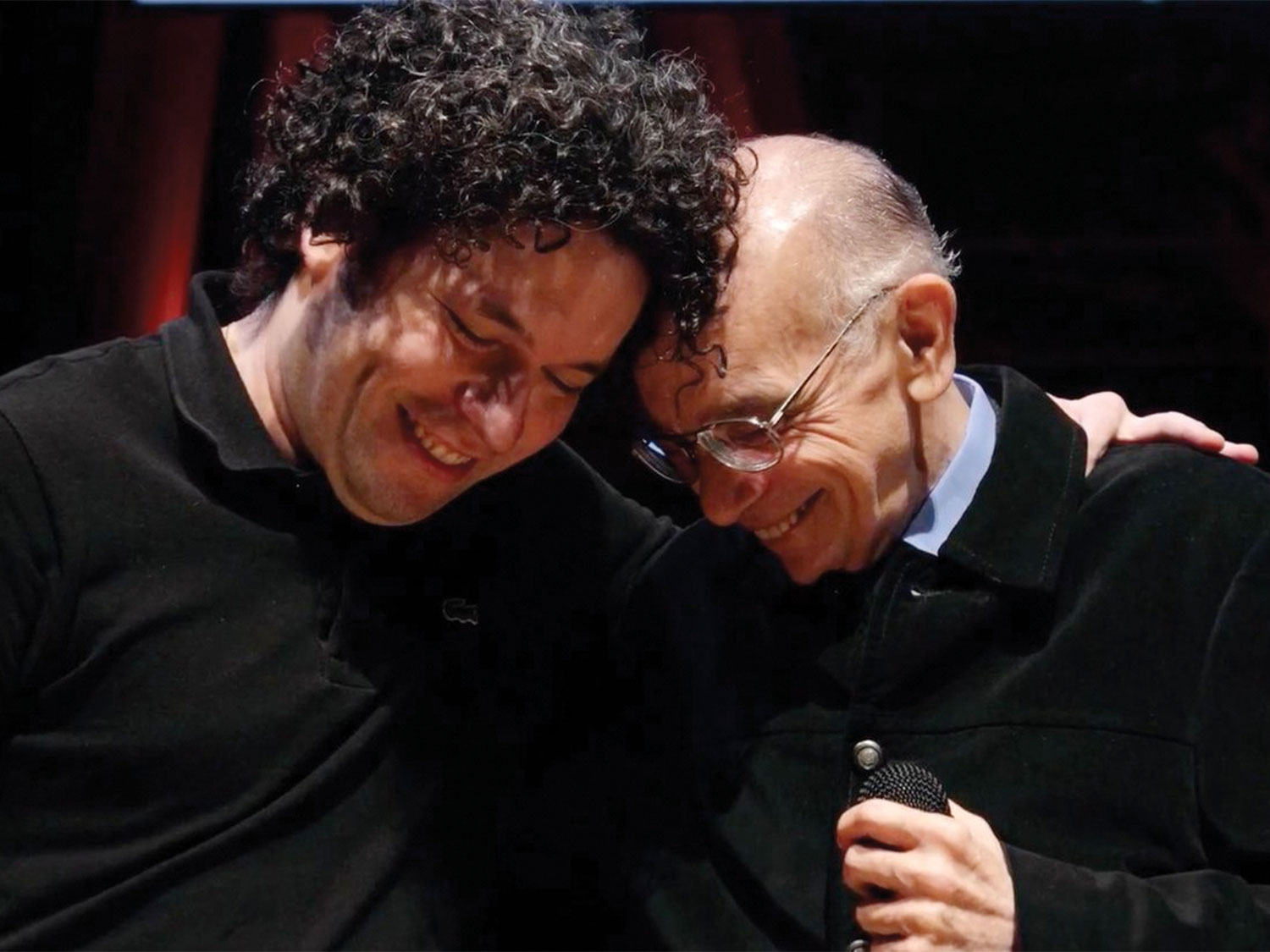
Photos courtesy of el sistema
Maestro Dudamel often conducts major repertoire and signature works like Beethoven and Stravinsky without a music score. He credits Maestro Abreu for this preparation. When asked about his dynamic, performative choreography possibly being memorized, as it pairs seamlessly and harmoniously with the memorized music, Gustavo quickly dismissed the thought.
“No, never. I don’t practice my gestures. I have never practiced my gestures. The thing is, if I prepare everything perfectly, maybe what I have in mind doesn’t go with what the orchestra is expecting. My advice to young conductors is to be flexible, to manage the moment … The process has to be very natural.”
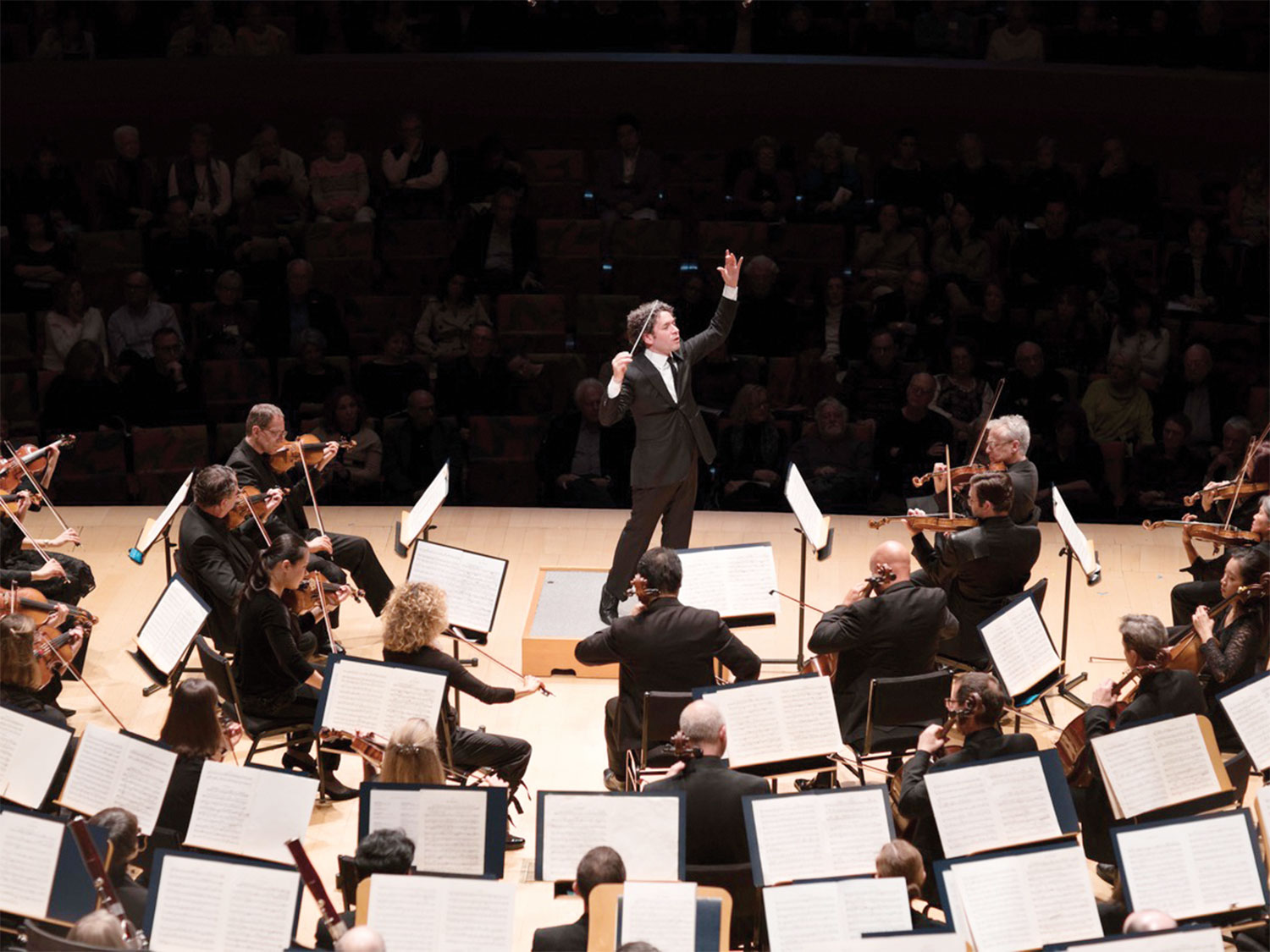
PHoto by Ryan Hunter
Additionally, there’s commentary about Maestro Dudamel’s magic when he performs. It’s referred to as a spiritual connection that transforms him. Gustavo did not deny this interpretation. Instead, he recalled a “very important lady in the arts,” who was the head of the Latin American Festival of Theater in Venezuela and a dear friend of Maestro Abreu. After observing Gustavo’s talent as a young man, she declared that he had “duende,” from Federico García Lorca’s essay, “In Search of Duende.” It explores the concept of artistic spirit, or “magic,” that presents itself through a visceral, spontaneous power.
“She told me I have magic. I thought, OK, I’m possessed or something. But it’s true. There is something that goes naturally with my body, with my soul, what I listen to, and what I feel.”
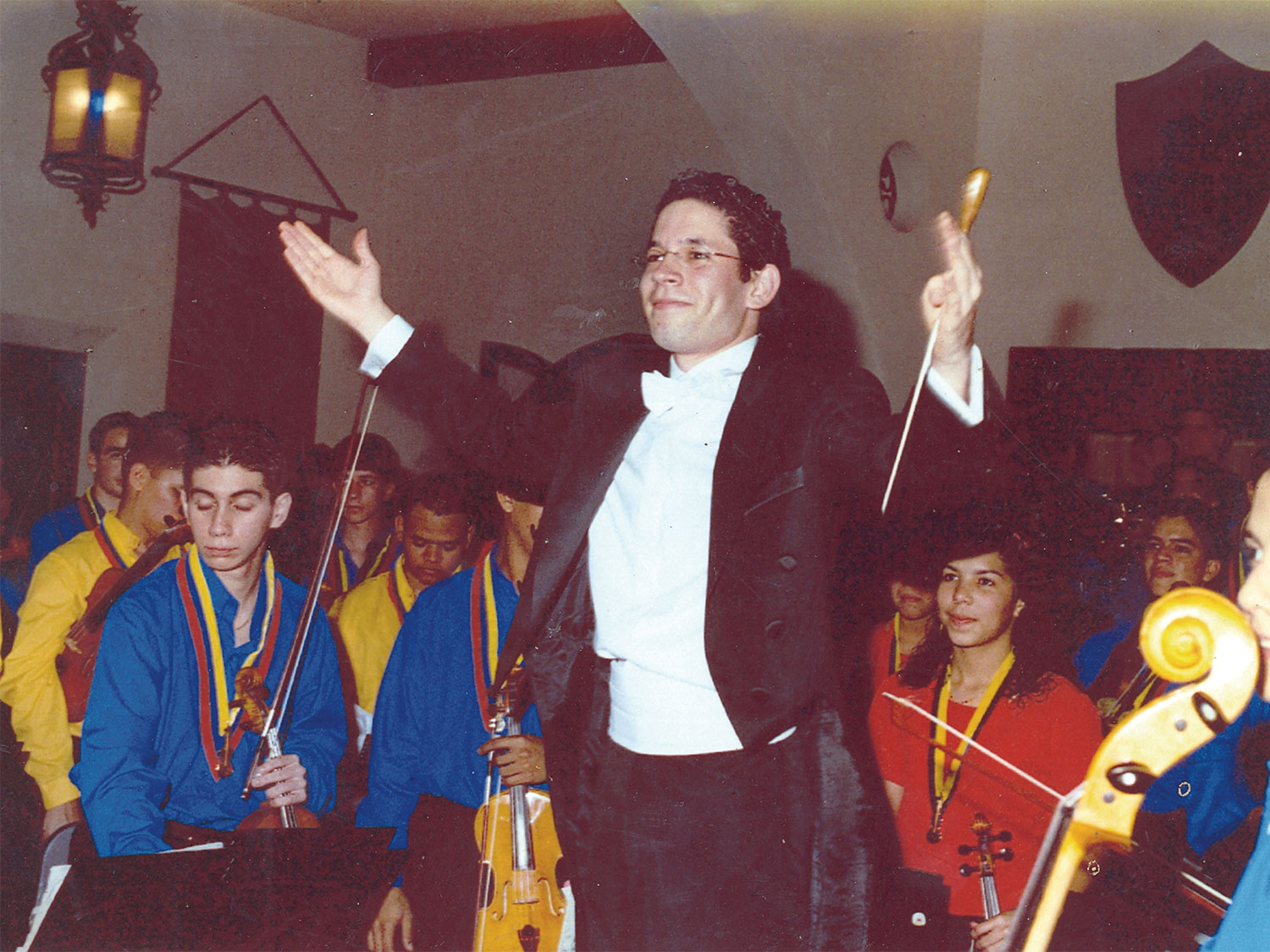
When Gustavo was 18 years old in 1999, he was appointed as the youngest Music Director of the Simón Bolívar Youth Symphony Orchestra of Venezuela. All of the musicians were graduates of the El Sistema program. As the chief conductor, he led the orchestra performing in Venezuela and around the world.
“I had a series of concerts. I remember we played at the U.N. [United Nations].”
Enjoying performing with his friends, he was less motivated to do competitions. But Maestro Abreu had other plans for Gustavo. He felt Gustavo needed competition experience in order for his conducting talents to be seen and recognized internationally.
Years earlier, when he was 11 years old, Gustavo heard a recording of Gustav Mahler’s Fifth Symphony and quickly became a lifelong fan. When the opportunity arose in 2004 for Gustavo, at the age of 23, to enter the prestigious Gustav Mahler Conducting Competition in Bamberg, Germany, Maestro Abreu wanted him to enter. But Gustavo was in Berlin for three months as an assistant conductor to Sir Simon Rattle at the Berlin Philharmonic. Nonetheless, back home in Venezuela, Maestro Abreu filled out the application paperwork.
When Gustavo returned from Berlin, he said, “I told my Maestro I was feeling bad. I need to check with the doctor. I was trying to avoid going back to Germany.”
But Maestro Abreu pressed. It was to be the first time that Gustavo would be leading an internationally acclaimed orchestra as a conductor, the Bamberg Symphony Orchestra. After two weeks in Venezuela, Gustavo acquiesced.
“I never pushed myself to say, I’ve got to do this. I got to win. It’s not my personality. I went there to enjoy, to experience the beautiful moment of knowing a wonderful orchestra, and knowing great people.”
The outcome dramatically changed Gustavo’s career trajectory.
“I passed the first round; my name was there. The second round, I said, well, this looks serious; let’s keep going. Then third round, then semifinals, then I’m a finalist. And it was very natural. I never pushed myself, saying I’ve got to win. But I felt that from my fellow competitors.”
Gustavo won and the international community took note. One of the esteemed judges in Bamberg was, at that time, the current Music Director of the Los Angeles Philharmonic, Maestro Esa-Pekka Salonen. In 2027, he will be returning to the LA Philharmonic as Creative Director, bookending Gustavo Dudamel’s tenure.
Maestro Salonen shared, “When I saw him at the Gustav Mahler competition, it was stunning how naturally he connected with the orchestra and how effortlessly music flowed from him. He stepped in front of the Bamberg Orchestra, conducting a professional orchestra for the first time, Symphony No. 5 by Mahler, which is notoriously difficult to conduct, and it just flowed. The musicians [a hundred all older than him] accepted the fact that there was this young Venezuelan guy in front of them, guiding them, who didn’t speak much English. It just lined up beautifully. I thought this kind of talent doesn’t come across every year. It’s more like a generational thing.”
Maestro Salonen quickly placed a call to the CEO Deborah Borda, requesting an invitation for this “conducting animal.” Soon after, Gustavo arrived in Los Angeles for the first time at age 24. The pressure was on, but Maestro Abreu had prepared him.
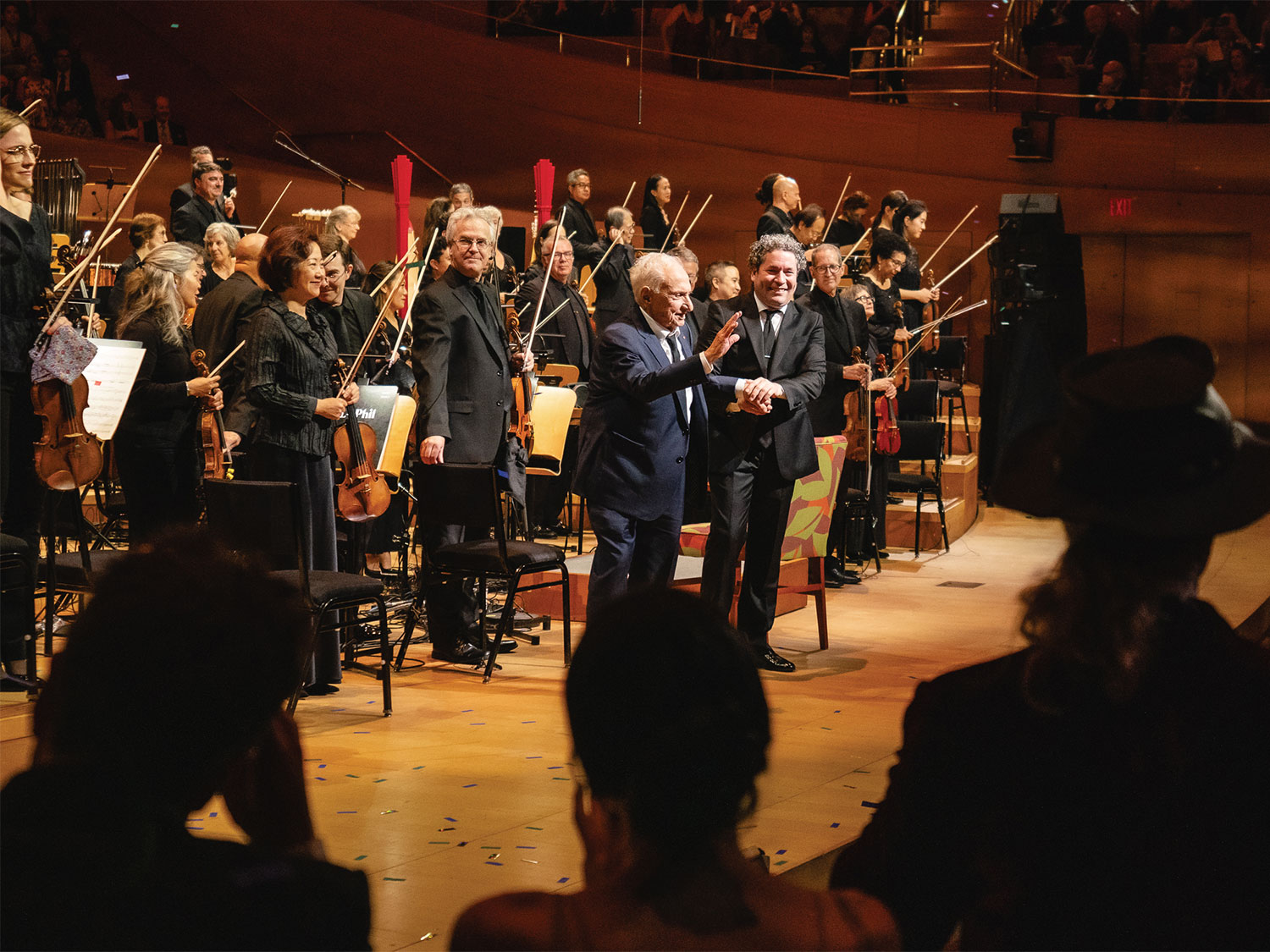
Gustavo explained, “He made me play in the orchestra, to watch the conductors, and to feel what the musicians feel to be conducted. The work of conducting is not only making the orchestra sound good; it’s making the orchestra feel good … Remember that we are creating a sound together. We have the notes; we have the music composed by the geniuses of Beethoven or Mahler, all of them. But we have to reproduce that [sound]. And that is a feeling, a metaphysical process. [The conductor] has to create an environment where it is healthy to create beauty.”
For him, the key is about inspiring and motivating the orchestra, adding, “I’m no one without the musicians because my instrument doesn’t sound.”
“You know how many times these musicians play Beethoven’s Fifth Symphony with so many conductors? What can be different in that moment? That is the secret. The secret is how you don’t change things. You try to enhance the moments and the spirit of everybody.”
That first visit to Los Angeles could have been overwhelming for Gustavo. He was coming from conducting a youth orchestra in Venezuela, and stepping onto the platform to lead one of the top orchestras in the world.
“It was an instant connection … I was conducting them and the interaction was, at the highest level, artistically friendly. The sharing of my ideas and how they were taking those ideas and making a sound from my ideas felt natural.”
“What I find maybe most amazing about him is that, after all these years of fame and success and adulation, he’s still an idealist. He believes in the importance of music as a social force, and that’s really impressive.”
– Maestro Esa-Pekka Salonen
His United States conducting debut with the Los Angeles Philharmonic at the Hollywood Bowl in September 2005 was met with immediate and overwhelming success. More performances with demanding repertoires at the Walt Disney Concert Hall followed. His graceful and natural strength empowered the enthusiasm, reflecting the genuine admiration from the orchestra and his “charismatic power” with the audiences. The Los Angeles Philharmonic did not waste time. He was appointed Music & Artistic Director, succeeding Maestro Esa-Pekka Salonen, in October 2009 at the age of 27.
In 2007, before Gustavo formally took on his position as Artistic Director, he launched the YOLA program, directly inspired by his own formative experiences with El Sistema. With the dual goal of developing musical proficiency and fostering social change in diverse, underserved communities, it became a key component in negotiations with the LA Philharmonic’s leadership. As they enthusiastically embraced this concept, YOLA has become not only Gustavo’s signature project but also a foundational pillar of the LA Philharmonic’s mission. Together, they erected the Judith and Thomas L. Beckman YOLA Center in 2021, designed by Frank Gehry, located in Inglewood, as YOLA’s first permanent home.
“When you give an opportunity to a young child that is not in the environment of having opportunities, you are not changing the life of one person; you are changing the life of all that surrounds this kid … It’s a lot of circles: his family, his neighborhood, his community. Everything changes. When they see a kid walking with an instrument, they feel proud … This is the philosophy of YOLA. This is the philosophy of El Sistema. They are transforming their lives and the lives of the people that surround them.”
It’s also about one’s identity.
“Mother Teresa of Calcutta said the worst thing about being poor is to be no one. And what a beautiful thing when you give a child an instrument. You are giving them an identity. You are giving them a place in society with the most sublime expression of humankind. That is art.”
Gustavo further explained, “If we look pragmatically and we open our mind and our soul, what we see are people producing beauty. Whoever you are, whatever you think, wherever you come from, you are united in that moment because you are sharing energy at the same time. What a beautiful thing. This is what happens on stage.”
He believes it’s similar to a violin and a trombone, a flute and a tuba. They all come together, and there is harmony.
“I think the world right now is not in harmony. It’s in a cacophony. It’s noisy. But noisy in cacophony is also harmony. We [need to] really open our ears, open our souls, open our minds. We will see the beautiful chords that are inside. But we need more of this.”
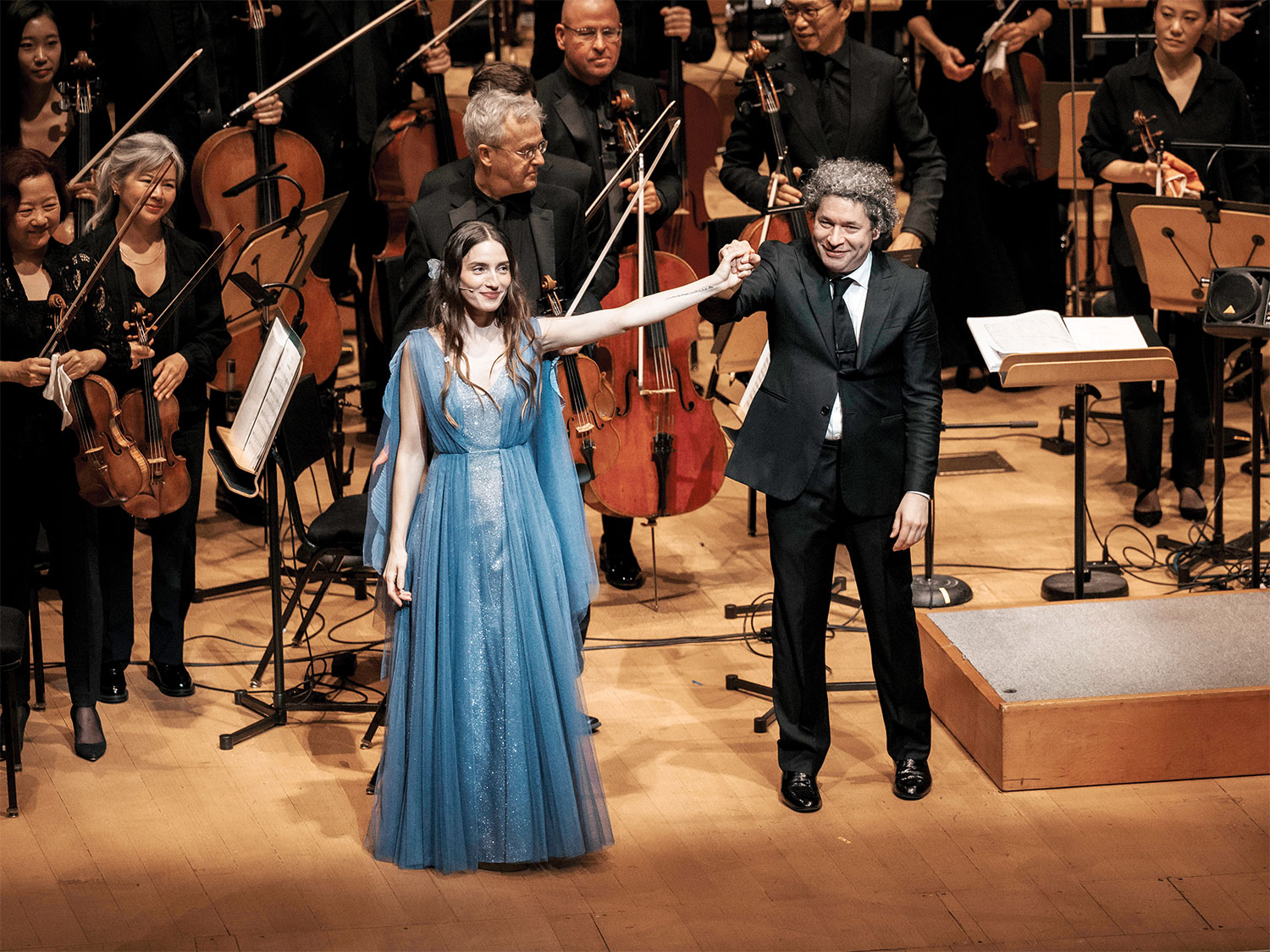
This is what connected Gustavo to the love of his life, his wife, actress and director, María Valverde. They met while working on the film, “The Liberator.” She was the star; he composed the film’s soundtrack. Years later, their friendship developed into a romance, and in 2017 they were married in a private ceremony.
From the very beginning, they shared “beautiful, deep talks about art, about the concept of ‘viendo la belleza del arte, looking at the beauty of art.’” He expounded, “This concept goes beyond what we can understand about art. But by opening the paths for opportunity, the younger generations can contemplate, share, work together and understand that community connections create harmony.”
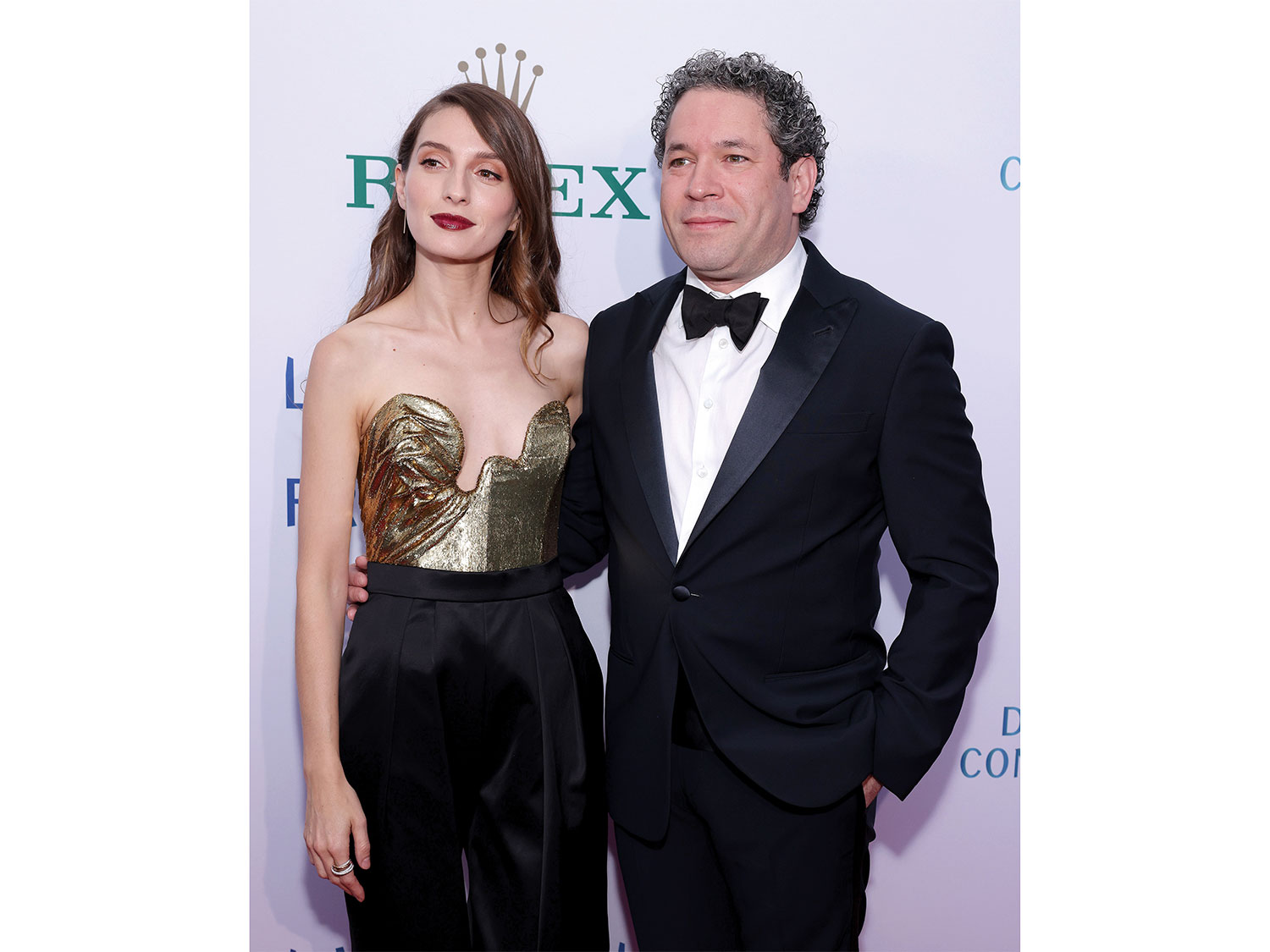
The Dudamel Foundation, which María co-chairs, instills the belief that art and music are fundamental human rights. Capable of fostering a more just, peaceful and inclusive society, music is a universal language that transcends barriers and speaks directly to the soul. Their foundation, which is a part of a global movement, not only aims to give every child the chance to fulfill personal dreams through music; it also sees music as the catalyst for societal transformation, inclusion, empowerment and lasting change.
“What I find maybe most amazing about him is that, after all these years of fame and success and adulation, he’s still an idealist. He believes in the importance of music as a social force, and that’s really impressive,” said Maestro Salonen.
Our time together was evaporating. We ventured toward his bookshelves, and I spotted his first Grammy, for Best Orchestra Performance in 2011, resting prominently as well as his most recent Grammy, one of three won in 2025, awarded for his conducting of the LA Philharmonic. There was a photo of him giving a speech at the White House honoring his friend José Andrés accepting the Medal of Freedom, and other prizes and awards from world leaders such as the President of Chile, and the President of France.
He grabbed a small, weathered book off the shelf. “This was my Maestro’s, his agenda book from 1978,” a significant treasure from which Maestro Dudamel has modeled his life’s mission. He began to thumb through the pages of his heirloom. “See, he wrote, ‘This is done. This is what I have to do,’” pointing to the Spanish multicolored, handwritten entries. He took a moment, reading, clearly moved.
“Under his leadership, we’ve become a model for what a 21st-century orchestra can be: boldly creative, fiercely relevant, and deeply connected to its community.” – Jason Subotky, Chairman of the Board of the Los Angeles Philharmonic
There were other memorabilia from some of his trailblazing concerts, which begged the question about future music collaborations. He offered that he has many.
“I was with Jimmy Page, of Led Zeppelin, the other day. It would be a dream for me to do something with him. Radiohead is a group that I admire and I love. And many Latin artists I would love to work with. That was my home. I was listening from salsa, to rock, to classical. There was no border or a wall that separated music … Music is one, with different styles. It’s an expression of humans. That’s it.”
Which music does he choose when he is with María? He chuckled, “A lot of music.” Then he changed the direction of the question. “Family for me is the most important thing. And that is what provides me inspiration. I think of María, my son Martin, my parents …” as he grabbed a photo of his son.
“He’s a teenager now. He’s wonderful. I love to go with him to eat and talk. I learn a lot. I think every time is my favorite when I’m sharing it with him.”
Born and raised in Los Angeles, Martin lives in Madrid. Gustavo confirmed it is his home as well.
“Yes, Madrid and Los Angeles.” His answer opened the door. Is he really not saying goodbye?
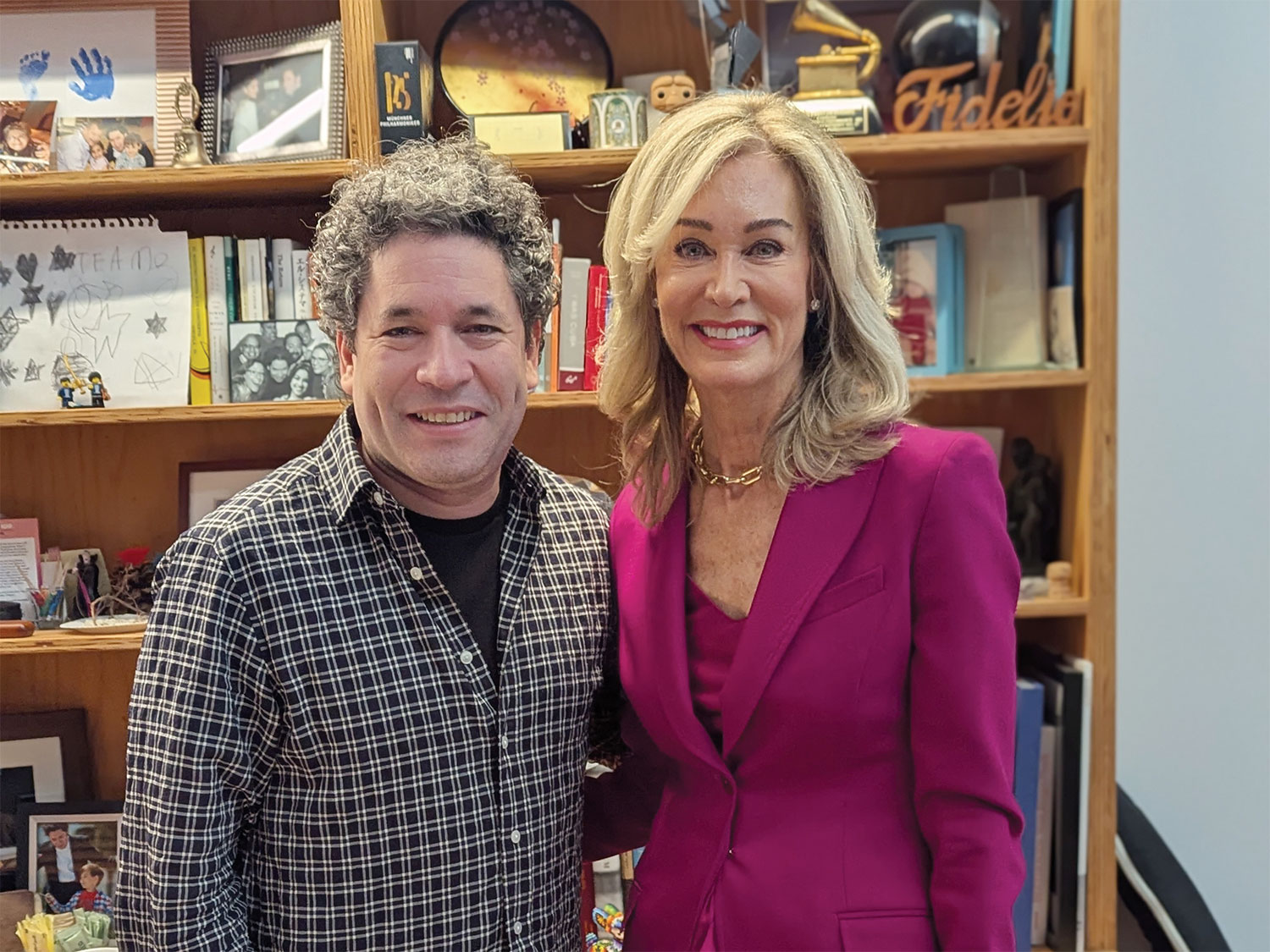
Photo courtesy of L.A. Philharmonic
Gustavo has said, “When a finale is approaching, you can feel it. Whether an orchestral piece concludes with a bang or a whimper, its ending is rarely ambiguous .… There’s only one thing a final movement, third act, and proper goodbye will always have in common—they are never easy to get right.”
He has referred to Los Angeles as “home” in the media. He has also shared his intentions to continue to perform with the LA Phil in some capacity each year going forward.
“I’d like to see this as Gustavo not leaving, just changing the nature of his role in the life of the LA Philharmonic. He will be coming back. It will be everybody’s highest priority to see him back in LA often. It’s not a farewell; it’s just a transition to another role. This is a relationship that will keep growing and deepening. I know Gustavo is going to be coming back as long as he’s around. And that thought gives me a lot of joy … Gustavo feels like family to me. We are very close. It’s a great relationship, and I’m very, very proud of it,” shared Maestro Esa-Pekka Salonen.
After 17 years of the Gustavo Dudamel era, he leaves a legacy of purposeful, transformational, artistic leadership, explosive growth and impactful community engagement, and a prestigiously historic elevation of the LA Philharmonic’s international profile. With more than 50% of the orchestra members coming from the Dudamel era, his visionary, risk-taking approach and deep connections with the musicians will ensure his influence will resonate in Los Angeles for decades to come.
“We are closing a chapter, and we are opening a new chapter. It’s very important for our institution to evolve and to be flexible to new things. But it’s beautiful to see that we are closing a chapter in such a beautiful state. It’s working perfectly … As I told the orchestra, they are the most important [part]. Whoever is at the podium, that is OK. In the end, it’s the LA Philharmonic. And that is why I’m so happy and proud of being part of this family.”
Gustavo has been having these discussions with his musicians during his orchestra rehearsals.
“We talked about how this time has transformed us. It’s an evolution that is very powerful. This relation will never end.”
Still, it’s hard to close the chapter. Maestro Dudamel offered a Colombian poet who described it best.
“A century in an instant,” he said. “Everything is so beautiful and intense that a hundred years passes in an instant … It’s what I feel. It has been 20 years coming regularly to Los Angeles. It feels like this year. It was yesterday, one hour ago. It happened because of love, a century in an instant … Love for the people of Los Angeles, love for the orchestra, love to all of these communities. It’s their generosity … I’m so grateful.”