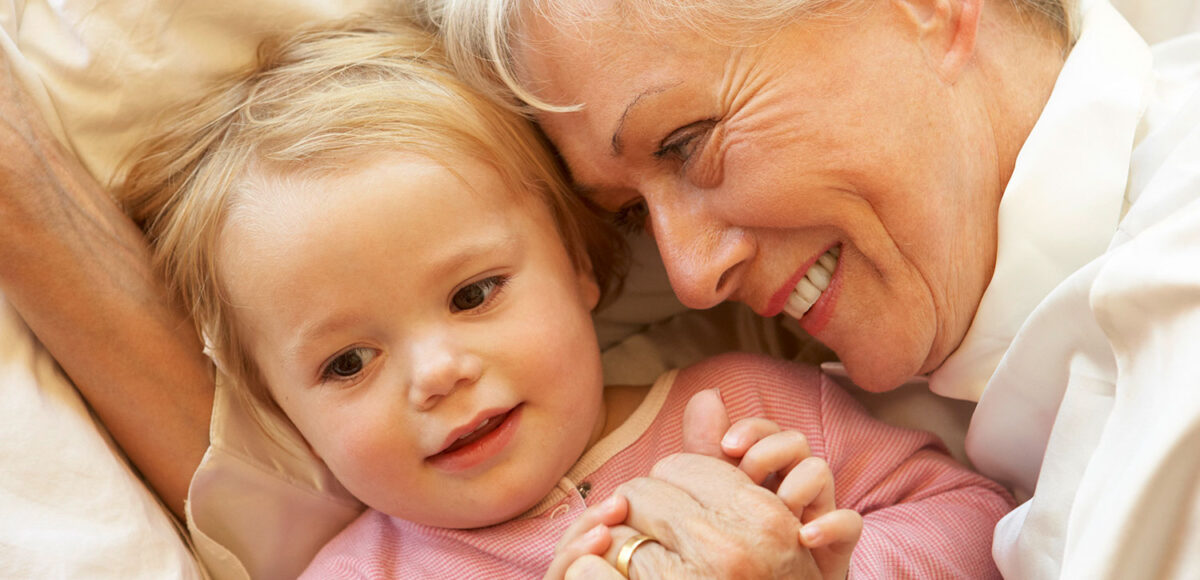

A new study has shown what occurs when grandmothers interact with their grandchildren, scientifically validating what many have long felt intuitively. The grandmother-grandchild bond operates on a deeply connected and profoundly different level compared to other relationships.
Anthropologist and neuroscientist James Rilling and his colleagues at Emory University used functional magnetic resonance imaging (fMRI) to capture real-time brain activity by measuring blood flow changes. Thus, they were able to peer directly into the minds of grandmothers as they processed images of family members and strangers.
Fifty grandmothers volunteered to be placed inside an fMRI scanner where they viewed a series of photographs in four categories: images of their grandchildren, unknown children of similar ages, their adult children (the same sex as the grandchild), and unfamiliar adults.
As grandmothers gazed at photos of their grandchildren, the scientists observed robust activation in areas associated with emotional empathy. These neural networks enable us to literally feel what another person is experiencing.
When a grandchild experiences joy, the grandmother’s brain lights up in ways that mirror that happiness, and she feels the same delight. When a grandchild is in distress, the grandmother’s neural pathways fire with corresponding concern. This pattern of activation suggests that grandmothers are neurologically wired to experience their grandchildren’s emotions as if they were their own.
When grandmothers viewed images of their adult children, something different happened. Rather than activating those same emotional empathy regions, these encounters triggered neural networks associated with cognitive empathy. These are our brain regions involved in understanding others’ thoughts, intentions, and mental states rather than directly sharing their emotions. It’s the neural machinery we engage when we’re trying to figure out why someone feels a certain way or what they might be thinking, rather than automatically mirroring their emotional state.
These findings suggest that while most grandmothers remain deeply attached to their adult children, their brains process these relationships through a more cognitive lens, understanding rather than directly experiencing their adult children’s emotional states.
When grandmothers viewed images of unknown children of similar ages to their grandchildren, as well as unfamiliar adults, their brains showed relatively little activation in either emotional or cognitive empathy regions. While grandmothers often feel general warmth toward children in general, the intense empathetic responses appear to be more easily triggered by their own children and grandchildren.
These findings suggest that grandmothers’ brains have been specifically designed to recognize and respond to their own family members with remarkable precision and intensity. Most likely, thousands of years of evolution have created this intimate neurobiological connection.
Unlike most mammals, human females often live for decades beyond their childbearing years. “The grandmother hypothesis,” put forward by anthropologist Kristen Hawkes, offers an explanation for this evolutionary puzzle. According to this theory, grandmothers who invested in their grandchildren’s welfare provided significant survival advantages to their families, leading to the evolution of extended human lifespan and the unique role of grandmothers in human societies.
Studies spanning continents and cultures have validated this hypothesis showing that grandmothers’ involvement correlates with improved outcomes for their grandchildren: better nutritional status, more stable and nurturing household environments, enhanced educational opportunities, and ultimately, higher survival rates into adulthood.
Research has also demonstrated that active, engaged grandmothers enable their daughters to have children more frequently and at younger ages, while also increasing the likelihood that these grandchildren will themselves survive to reproductive age and continue the family legacy. These factors create a powerful evolutionary advantage that has shaped human family structures across thousands of millennia.
In our contemporary world, where life expectancy continues to increase and medical advances enable people to remain healthy and active well into their later years, the potential impact of grandmothers is growing. Today’s grandmothers often enjoy decades of healthy, engaged involvement in their families’ lives, bringing wisdom, emotional stability, and financial support that can profoundly influence future generations.
Although many modern families are separated by geography, this research offers tremendous hope. The neural activation patterns observed in the study occurred in response to mere photographs of grandchildren, suggesting that visual connection alone can trigger these powerful connections.
Photo sharing through social media and messaging apps enables grandparents to witness and emotionally participate in their grandchildren’s daily lives and milestones despite the distance. Video calls through platforms like Zoom and FaceTime allow for face-to-face conversations that can also activate those crucial neural pathways and foster and nourish this special connection.
This important and heartwarming study reminds us that the special role of grandmothers appears hardwired in our brains to optimize human potential. Rather than viewing grandparents as peripheral figures whose primary value lies in occasional babysitting, hosting holiday gatherings, or funding education, we might better understand them as essential, unique components of healthy family systems occupying a very special evolutionary role. We are wise as individuals and a society to respect, nurture and support the vital role of grandmothers.