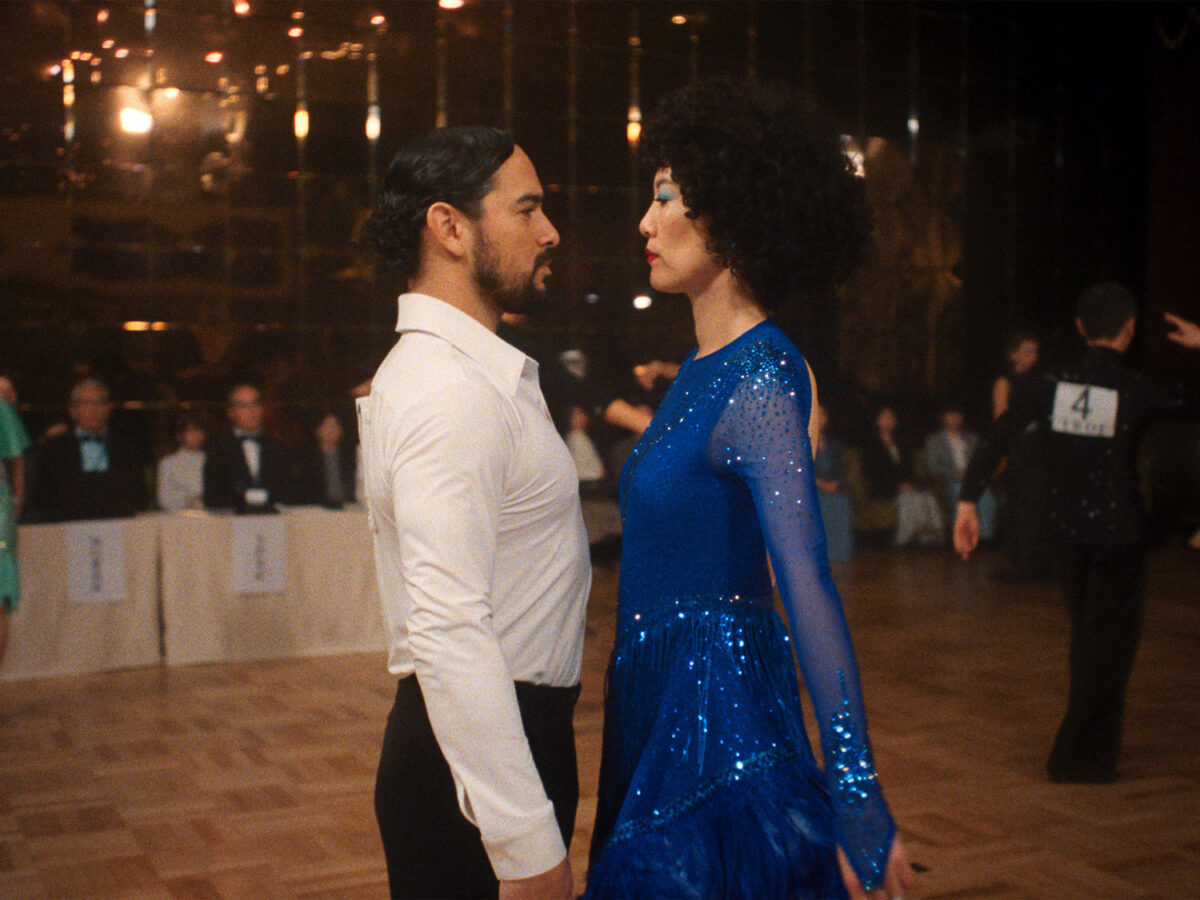
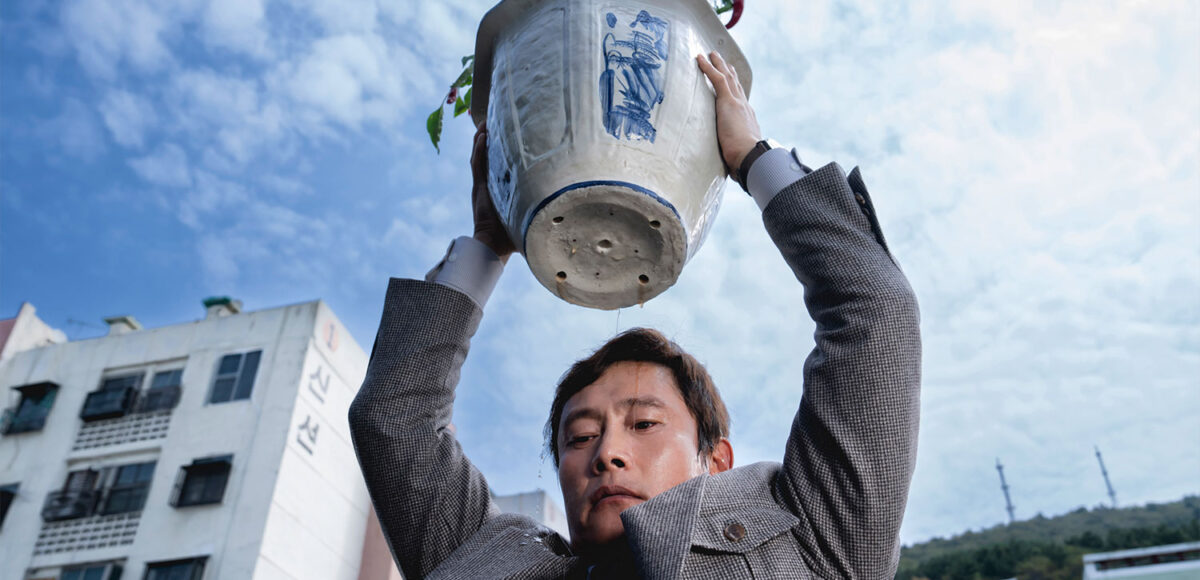

“No Other Choice,” Park Chan-wook’s sly send-up of corporate culture, is a clever reworking of Donald Westlake’s novel “Ax,” one adapted previously by French director Costa-Gavras. Both his wife and son are producers on this film, and Chan-wook dedicates it to him.
Man-su is living the good life with his lovely wife Miri, two children and two golden retrievers in a bucolic suburb in a custom home with all the amenities. He’s earned it. Working for one of the leading paper factories in the country, he’s good at his job, one he’s held for almost 25 years. He’s the very picture of self-satisfaction as he fires up his Weber Grill to barbecue the eel that has been sent to him in appreciation from his company. Certainly he is spending above his means, but he’s not worried. The eel was a symbol of the esteem in which he’s held and will, he is sure, result in a promotion and raise. Company loyalty is something he can count on— until he can’t. Called into the office, with a large group of other staff, he is told that their company is being merged with another and he is among many being made redundant. Not to fear, he is told. With his ability, experience, Japanese language skills and their self-help seminars, he should find a job in no time … or at least within three months. After all, he was, at one time, Pulp Man of the Year.
But this is no mere temporary layoff; paper companies across the country are consolidating and Man-su is still unemployed after many months. It’s not just the lack of money, but the loss of face. Overdue bills are piling up and they are behind on their mortgage. So sure that he would be back at work in no time, he continued spending and living a high life that they can no longer afford. His wife has realized that they are in a hole and has taken a job, and by doing so has seemingly announced their loss of status to the rest of the world, or at least to their social set. Still, Man-su will not retrench or retreat. What he needs is a new plan.
There are very few available jobs after all the company mergers and Man-su has graphed out where they are and against whom he might be competing. Of the dozen or so men who are out of work, he has determined that only two or three would be his direct competitors. How can he stand out against them? How can he get the job that might go to one of them instead? Man-su is a realist. Reviewing their skills and comparing them against his own, they would probably be higher on the ladder. The odds are stacked against him and that, in itself, calls for drastic action. He will eliminate the competition, literally and figuratively.
He is adept at mapping out the competition, where they live and what their weaknesses might be. He knows where to find his rivals but dispatching them efficiently without leaving clues is not his strong suit.
Most of the humor in this film is derived from Man-su’s attempts to kill his rivals. It must be said that he does get better at it the more he tries. But this is only one of the tools that director Park Chan-wook uses to highlight the ills of society. Unlike corporate America, the working man in Korea, much like the “company man” of Japan, has come to expect the same loyalty from their employers as they have given to them. Company men like Man-su, protective and loyal to the men (it is almost always men) they supervise, were always led to believe that there would be a pay off. The pay-off they were expecting has become a kiss-off at the end of the road. At the same time, Chan-wook is poking fun at the Korean version of American-style consumerism, spending and debt accumulation. Man-su’s superficiality is underscored by his wife’s willingness to live a simpler life, one they can afford. She is Chan-wook’s heroine, willing to step back from her position in society and work, protect her children and loyally stand by her man.
Especially pointed is a scene in which American businessmen arrive at the factory to judge its suitability as a target. Their dismissive attitude towards the workers is a harbinger of things to come, highlighting the disconnect between honor and profit that will soon take place.
The characters are well drawn; that their development is sadly lacking, in most cases, is a deliberate choice. That no one learns anything from their actions is the point. The writing is sharp, with contributions from Chan-wook, Lee Kyoung-mi, Don McKellar and Jahye Lee. It is significant to note that both Chan-wook and McKellar, creators of the HBO television series “The Sympathizer,” were expelled from the WGA for continuing to write for that series during the strike in 2023. As a Korean film, the sanctions were not applicable.
The acting is uniformly good. Lee Byung-hun as Man-su becomes more finely tuned in his actions as he “matures” into a more adept murderer. Son Ye-jin, Miri, is the very picture of a helpful wife, supportive but worried, only slightly, as she sees her husband edge closer to mania and become more secretive. The first target of Man-su’s plot, Bummo (Lee Sung-min), much like Man-su, has been living above his means and has taken to drink; his wife Ara (Yeom Hye- ran) has reached her limit with him. He has become a weight around her neck and, whether inadvertently or deliberately, she aids Man-su against her husband.
There is no argument that “No Other Choice” is darkly humorous. The ending is a killer, so to speak, but not literally. It is a payoff that makes the bloated 2½ hour run time worthwhile. The problem is that in each setup, it takes too long to get to the payoff, making the film drag. My enthusiasm would have been greater if “No Other Choice” had been 90 minutes long.
In Korean with English subtitles.
Opening Dec. 25 at the AMC Grove 14 and the AMC Century City 15. Opening wide Jan. 2.
Neely Swanson spent most of her professional career in the television industry, almost all of it working for David E. Kelley. In her last full-time position as Executive Vice President of Development, she reviewed writer submissions and targeted content for adaptation. As she has often said, she did book reports for a living. For several years she was a freelance writer for “Written By,” the magazine of the WGA West, and was adjunct faculty at USC in the writing division of the School of Cinematic Arts. Neely has been writing film and television reviews for the “Easy Reader” for more than 10 years. Her past reviews can be read on Rotten Tomatoes where she is a tomatometer-approved critic.