
For me, the tentpole of the summer was going to be Christopher Nolan’s “The Odyssey.” Epic in all ways, the story of “The Odyssey” (along with “The Iliad”) was the first blockbuster in Western literature. Written as an epic poem by Homer, most of us read either abridged versions in high school or encountered his most famous tales through Edith Hamilton’s “Mythology.” Her easily absorbed tales introduced us to the gods of Ancient Greece, the Trojan Horse, the Cyclops, the Sirens, Circe and others. Many have tried to capture the stories but were stymied by a combination of poor visual effects, wandering storytelling, and dreadful acting in the infamous Sword and Sandal movies that told tales of Roman and Greek heroes all starring bodybuilders. Steve Reeves, anyone?
“The Odyssey” is a story told primarily in chapters, and this is the approach taken by Nolan. In his retelling, Odysseus, King of Ithaca, is first seen recruiting soldiers for war against the Trojans. Helen, wife of King Menelaus, was stolen from him by Paris and spirited off to Troy. Agamemnon, brother of Menelaus and the most powerful king of the Greek nation states, has declared war on Troy, a war that will last 10 years. Go to the back of the class if you’ve never heard of the Trojan Horse. The Trojans, who have successfully fought off the Greeks for many years, are sequestered behind impenetrable walls. When a beautiful statue of a horse is found on the beach, the Trojans pull it into their fortress. Late at night, Odysseus and his men, hidden within the horse, let themselves down, kill the guards and open the gates to their waiting army. The war is over and the Greeks return home, but not without trouble.
After many, many years, Odysseus and his men have wandered the sea, lost. Although Odysseus was under the protection of the goddess Athena, they managed to enrage many of the other gods, foremost among them Zeus and Poseidon. Odysseus and his men are constantly blown off course encountering challenge after challenge, first meeting a giant Cyclops who likes nothing better than a Greek sailor for breakfast. Even more daunting than the Cyclops will be Circe, the Sirens, and an angry Poseidon.
Penelope, the wife of Odysseus, and Telemachus, the son he has never seen, are battling the suitors who have taken over the castle and are demanding that she marry one of them because they are certain Odysseus is dead and a kingdom without a king is a dangerous place. Despite evidence to the contrary, she and the now grown Telemachus still believe he is coming back.
But this isn’t meant to be a literature lesson, just a primer so you’ll be able to follow some of the action because Nolan has, wrongfully, assumed you will all be up on your Greek mythology.
This is a lushly filmed, action-packed adventure that spares nothing on production values. Cinematographer Hoyte van Hoytema, an Oscar winner for “Oppenheimer,” shooting with an IMAX camera, has captured the beauty of the Mediterranean settings, the sharp edges of the craggy mountains, the danger of roiling seas, the grandeur of the palaces and squalor of the isolated fortresses. The fight scenes, whether a war against soldiers or defense against monsters, come alive and the dangers of the voyage are skillfully and artfully rendered. Van Hoytema lets us see the grit under fingernails and white spume of the waves.
Nolan spared no expense filming on location and production designer Ruth de Jong produced very realistic period sets. Ellen Mirojnick, costume designer, contributed as much as any of the creative crew in portraying character. Penelope’s grace and grandeur are heightened by her flowing gowns. Odysseus, young and aged, is marked in time by the style and essence of his costumes.
In many instances, the flaws in some of the storytelling and the performances of a few of the actors keep this production from being as great as it should be. Where Nolan excelled was in the way he chose to tell the story. “The Odyssey” is a tale best told in chapters, something that has bedeviled other filmmakers in the past. Winning the Trojan War was the end of “The Iliad” and the starting point for Odysseus’s long voyage home with his men, most of whom will not make it back. Encountering the Cyclops, CGI that exceeded my expectations given all the failed attempts by others in the past, was the launch pad for revealing the missteps of the sailors and the influence of the gods on both their successes and failures.
As the men sail the seas in search of food and water, Nolan returns to Ithaca where Penelope is guiding her son and deceiving the suitors who have taken over the castle. She has promised to choose a new husband when she finishes the tapestry she is weaving, a never-ending task because she unravels her work every evening. Leading the suitors and the purveyor of evil and danger is Antinous, chosen originally by Odysseus to watch over his family. It is, however, the blind Eumaeus whose other senses are sharp enough to detect and protect the dangers surrounding the royal family.
Much of Odysseus’ later story is told in flashback to Calypso the lover who has held him captive using the seductive lotus blossom to both dull and heighten his senses. Now an old man, having been gone from Ithaca for more than 20 years, he tries to recall the episodes of his life to her. Many chapters follow, most very interesting and filmed dramatically enough that the visuals take over for the deficits in the script. And deficits there are. Most effective when fully engaged in action, Nolan has written some of the most puerile dialogue imaginable. Action sequences or personal moments are stopped dead. Hearing Telemachus address Penelope as Mom or refer to Odysseus as Dad is jarring in or out of context. At one point Odysseus states “I have other stuff to do.” Other stuff? Really? I’m not expecting poetry but surely Homer deserves better. This is Homer of Greek mythology, not Homer Simpson.
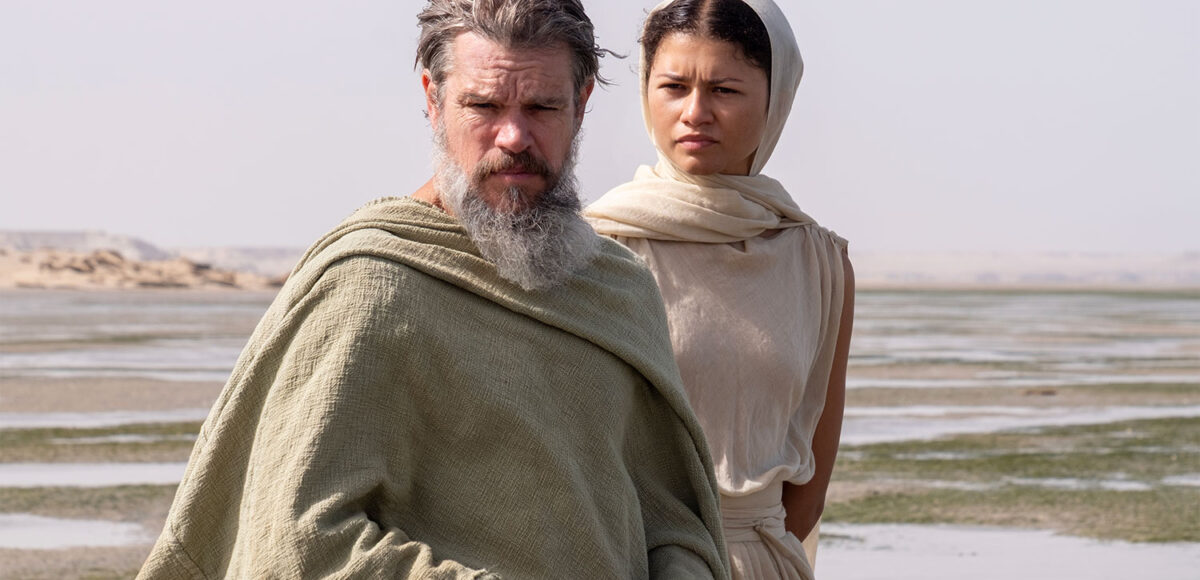
Worse, some of the actors have difficulty delivering sentiment. Even Matt Damon, an excellent and convincing Odysseus, is sometimes felled by the blandly modern words he is occasionally given. Tom Holland, a wooden Telemachus, has difficulty finding the substance of his character. Poor Zendaya is Athena, something that is little acknowledged and underutilized. Charlize Theron as the soothing Calypso is used only as a narrative tool. Notably, John Leguizamo as the blind Eumaeus was able to take the almost laughable dialogue and return it with meaning. Anne Hathaway as Penelope fares well, even when delivering the occasional anachronistic line she pulls us into her character. Best of them all is Samantha Morton as the seemingly benign Circe whose powers overwhelm Odysseus’s band of intrepid sailors who ignore the rules of Zeus, much to their detriment. She is subtle, projecting vulnerability while exploiting the weaknesses of those who come and rarely return.
Christopher Nolan has no difficulty in visualizing this story. There is a reason why this masterpiece has lasted more than 2,500 years; it is eternal. The film itself is dazzling, I just expected more from a master storyteller like Nolan. I wasn’t expecting poetry but I certainly wasn’t expecting “stuff.” Mercifully, there is only one use of the “F-word.”
See this one on the largest screen possible; the visual artistry will make you glad you did.
Opening wide July 17
Neely Swanson spent most of her professional career in the television industry, almost all of it working for David E. Kelley. In her last full-time position as Executive Vice President of Development, she reviewed writer submissions and targeted content for adaptation. As she has often said, she did book reports for a living. For several years she was a freelance writer for “Written By,” the magazine of the WGA West, and was adjunct faculty at USC in the writing division of the School of Cinematic Arts. Neely has been writing film and television reviews for the “Easy Reader” for more than 10 years. Her past reviews can be read on Rotten Tomatoes where she is a tomatometer-approved critic.