
Sirāt is the razor-sharp bridge that divides hell and heaven, a bridge that all must traverse at some point in life, sometimes repeatedly. It is a particularly meaningful title for Oliver Laxe’s film of depth, humor and tragedy, who has stated that the word describes a path of two dimensions—the physical and spiritual. A question that he asks of his audience is whether man is capable of change or are we condemned to repeat the same mistakes over and over. Can we, he wonders, truly embrace life if we have not come to terms with death?
“Sirāt” is as full of life as it is of death; of the found and the lost. Luis is a father who has ventured into the unforgiving Moroccan desert with his young son Esteban. The pulsing bass of the subwoofers, the scantily clothed hordes, heads and bodies shaking, sweating and dancing in ecstasy in the relentless heat announces that he has found his destination. They are searching for his daughter and Estaban’s sister, Mar, who disappeared months ago into the black hole of rave culture. Determined to find her, they pass out flyers with her picture without result. Seemingly in the middle of nowhere, far from any urban areas, a battalion of army vehicles arrives to evacuate the ravers from riots that are taking place elsewhere in the country.
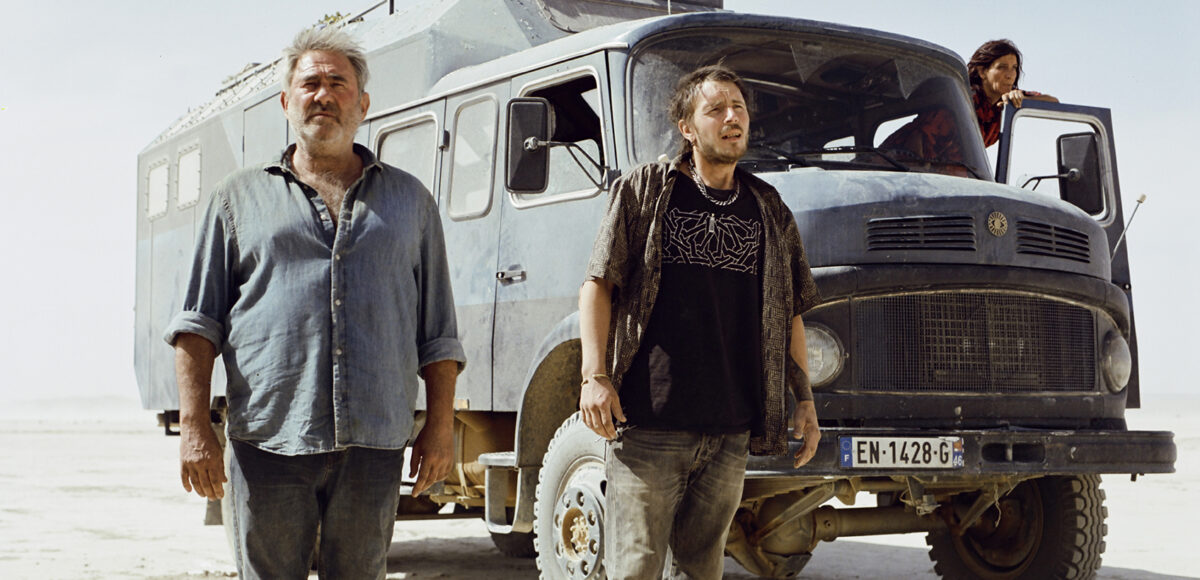
An intrepid crew of outcasts decides to flee and continue on to the next rave, alleged to be in Mauritania, to the south of Morocco. Luis, in his ill-equipped car with his son and their dog, is determined to follow them despite their warnings. The terrain will be punishing, at times over rocks and treacherously narrow unpaved paths. The professional ravers drive two ancient, well-broken-in massive Land Cruisers, large enough to sleep in and still carry all their living necessities. Luis will not be dissuaded. He has bonded with this group of international (French, English and Spanish) misfits: Josh, Stef and Jade, tatted and equal to the men, one-legged Tonin and Bigui, jolly, profane and missing part of one arm. Like camp followers, this intrepid group goes on instinct, not maps, to follow their dreams. Exiled from mainstream society, they find beauty that others overlook.
Luis is Laxe’s everyman. Like most of us, he lives an ordinary, anonymous life and, like most of us, he keeps life at arm’s distance, comforted in the lack of challenge, startled when confronted by something outside his norm. This is exactly what happens to him on the road trip he’s chosen, one he hopes will bring him to his daughter. Instead, he is confronted head-on by life and death, changing him immeasurably both for good and bad. This band of merry ravers lives life as it comes, facing its challenges and asking nothing more than continued adventures. Unrooted, unprepared, they relish this arduous journey not just for the goal at the end but for the unexpected that they face on their way. Luis, for whom his son and daughter are everything, has taken this trip not to bring his daughter back but to connect, to see her again. With his daughter’s disappearance, his world has been thrown off its axis. He is perplexed by this motley group. Do they not have families who miss them? They are as puzzled by him as he is of them. Of course, they have family; it is their cherished family with whom they live and travel every day. Family is not who you are born to, it is who you choose. They are the people St. Francis was thinking about when he said, “Grace is found especially among the excluded.” They are the very embodiment of the Beatitudes: “Blessed are the meek, for they will inherit the earth; Blessed are the merciful, for they will be shown mercy; and “Blessed are those who mourn, for they shall be comforted.”
The tone of “Sirāt” is its strength because starting off as a careless, happy, almost joyous road trip, an adventure to add to the many they have already experienced, it changes abruptly, a jagged chasm opened by an unexpected 7.5 earthquake, making us understand that how one confronts death is deeper and more fundamental to living than how one faces and lives life.
The cinematography by Mauro Herce sets the screen on fire. The Moroccan desert with its terracotta plateaus rising from the flat, beige Sahara, wisps of heat rising from the flat surfaces disturbed only by the gyrating bodies communing with the thumping bass of the loudspeakers is visceral imagery. The relentless danger from the unpaved roads followed by the intrepid family of voyagers is in direct contrast to Herce’s beautiful mountain backdrops that belie the dangers of the road. His photography of the rocky terrain is such that you feel the sting of their sharp edges. His color palette is as intense at times as it is muted at others. Herce has made the relentless landscape a character as important as the humans traversing it.
Kangding Ray’s score is immersive. As important to the film as the photography, he transitions seamlessly from the thumping boom of the rave’s techno beat to soothing, almost spiritual background music as they head off down the road until it disintegrates into cacophony as they face increasing obstacles along the way. He won the Soundtrack Award at Cannes for his score.
The actors, the majority of whom have only one credit on a television news series called “Arte Journal” in 1998, inhabited this movie and draw you into this heart of darkness with their amazing depth and focus. Working together as a cohesive unit, a bond that must have been shared before, the ravers are Stefania Gadda as Steff, Joshua Liam Hererson as Josh, Jade Oukid as Jade, the extraordinary one-armed Richard “Bigui” Bellamy as Bigui, the mesmerizing anchor of the group, and their graceful, peg-legged leader Tonin Janvier as Tonin. Bruno Nuñez Arjona plays young Esteban with wide-eyed wonder and the adolescent penchant towards danger.
The main reason, if any other were needed, to see this or any other movie is its star, Sergi López, an internationally acclaimed Spanish actor with credits that range from del Toro’s masterpiece “Pan’s Labyrinth” to his César-winning role in “A Friend Like Harry.” Whether playing heroes, villains or anything in between, his malleable face expresses longing, fear, hope, tragedy and the will to live. Both his sense of defeat and his will to continue are written not just on his face or in his voice but in his body and whole being. For me, López is an actor that I will watch regardless of the material, and he has always surprised me, that rare actor who is as effective in French and English as he is in his native Spanish. He elevates the material and this is even the case when the underlying story was already close to perfection.
Director/writer Oliver Laxe, collaborating with writer Santiago Fillol, winner of the 2025 Jury Prize at Cannes, has given us a story that is as universal as it is specific, bringing all the elements, photography, music and acting, together in a cohesive whole that will have you reeling. Submitted by Spain for awards consideration, it has been nominated for both an Academy Award and an Independent Spirit for Best International Film.
In Spanish, French and English with English subtitles.
Opening Feb. 6 at the Landmark’s Nuart Theatre.
Neely Swanson spent most of her professional career in the television industry, almost all of it working for David E. Kelley. In her last full-time position as Executive Vice President of Development, she reviewed writer submissions and targeted content for adaptation. As she has often said, she did book reports for a living. For several years she was a freelance writer for “Written By,” the magazine of the WGA West, and was adjunct faculty at USC in the writing division of the School of Cinematic Arts. Neely has been writing film and television reviews for the “Easy Reader” for more than 10 years. Her past reviews can be read on Rotten Tomatoes where she is a tomatometer-approved critic.