
The camera pans over a still river dividing the banks of verdant, pristine woods. A voiceover narration gently, sonorously, gives context to this location, the home of young Lionel who lives there with his mother and father. It is the kind of one-room shack poverty existence in the back woods of Kentucky where the dwellers focus on what they have and not what they don’t. Young Lionel has perfect pitch and the gift of voice, one that is recognized in the church that is so fundamental to their existence. Offered a scholarship to the Boston Conservatory of Music, Lionel knew it was his destiny, even if his parents had never, and would never leave the confines of their meager farm and church.
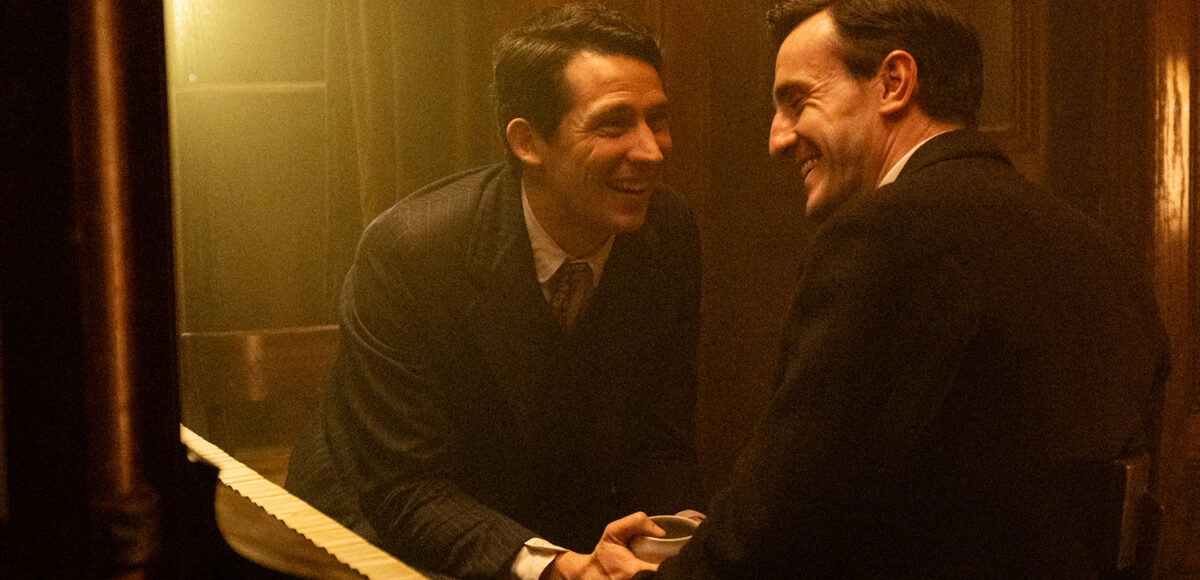
Lionel, so unworldly in such a sophisticated city, has the talent to transcend boundaries meant to contain him. It is in a bar that he encounters David, sitting at the piano playing a folk song Lionel knows by heart. Lionel introduces him to songs of the past, songs sung on porches of the shacks he knows so well, and David is entranced. Their studies will separate them, as will World War I, until the music brings them back together. Returning to Boston, David seeks him out with a special proposal. About to begin a job at Bowdoin College, he has been given a grant to record the ethnic and folk music prevalent in the backwoods “hollers” and valleys of Maine. Equipped with wax cylinders for recording on a modified phonograph, they will hike through the wilderness looking for tiny enclaves where the ancient music still exists. Town after town, isolated shack after isolated shack, they find their music in all ways imaginable but especially personally. Most poignantly, it is not only a love song to our musical heritage but also one that will bind them together. Their love is pure and true and rife with difficulties. Lionel’s bubble of eternity is too soon burst. David must return to the college and there is no room for Lionel. David exhorts his lover to see the wider world. His talent is bigger and needs a wider stage. He should see America, see Europe, go where his singing will take him.
Sadly, reluctantly, Lionel returns to Boston. Made braver by David, he performs in Europe as his fame opens more opportunities for him. It seems rather hollow without David; he writes often without return acknowledgment. Lionel feels his life and future were bound inextricably to David and the box of cylinders. That they have disappeared is a mystery that will haunt him as his life view grows ever larger and his fame as an academic spreads.
Taking a chapter from the life of father and son ethnomusicologists John and Alan Lomax, writer Ben Shattuck centers this love story around the quiet joy of ethnic song collecting, a harvest, so to speak, of the bones on which this country was built. Folk songs, passed down through generations, are history and Lomax Sr. saw, early on, their value and how they were gradually disappearing. It took many years before academia caught up to him, and by then he had introduced his son Alan to song harvesting. Alan would eventually be commissioned by the Library of Congress to scour the countryside and record the folk songs of the relatively uncharted hills and valleys from Mississippi to Michigan. His archive and that of his father are still stored in the Library of Congress. Many of those recordings and archival photographs were featured in the Ken Burns Country Music documentary series on PBS.
“The History of Sound” is not a “Brokeback Mountain” of country music. It is an ode to love in all its permutations. It is love found, love lost and love that endures, tied up in the notes and melodies of songs discovered where least expected.
Seamlessly directed by Oliver Hermanus, the film is gifted with amazing actors. Josh O’Connor is a conflicted David, knowing where he must go but longing to go somewhere else. Chris Cooper plays the older Lionel, contributing early voiceover narration. His eyes betray a man who has lived a full, interesting life, but one that is dominated by the giant hole of what could have been. Paul Mescal was the perfect Lionel: hesitant and sure, innocent and world-weary. He makes all the joys and heartaches, the choices both good and bad, believable; his winning smile often tempered by his sad eyes.
The cinematography is extraordinary. Alexander Dynan filmed everything elegantly from the Kentucky of Lionel’s youth where the poverty of existence was tempered by the physical beauty of the hills and waterways that were free to all. The countryside of Maine where songs were recorded and lives were valued is otherworldly in color and depth. The variety of locations, from Italy to England and back to the East Coast, are painted as you would imagine them. The cinematography makes all the locations valuable characters in this film.
“The History of Sound” is not a fast-paced movie; it glides smoothly and is over all too soon. It is reminiscent of times gone by, times we are too young to remember, and of the varied aspects of love in which the physical is not the most important. But also this is a reminder that hearing is not the same as listening, whether to a sound or to your heart.
Now playing at the AMC Century City 15
Neely Swanson spent most of her professional career in the television industry, almost all of it working for David E. Kelley. In her last full-time position as Executive Vice President of Development, she reviewed writer submissions and targeted content for adaptation. As she has often said, she did book reports for a living. For several years she was a freelance writer for “Written By,” the magazine of the WGA West, and was adjunct faculty at USC in the writing division of the School of Cinematic Arts. Neely has been writing film and television reviews for the “Easy Reader” for more than 10 years. Her past reviews can be read on Rotten Tomatoes where she is a tomatometer-approved critic.