Beverly Hills Conducting Audit of Residential Trash Bins

Beginning this month, Beverly Hills residents’ trash bins will be audited to ensure that they are in compliance with state law.

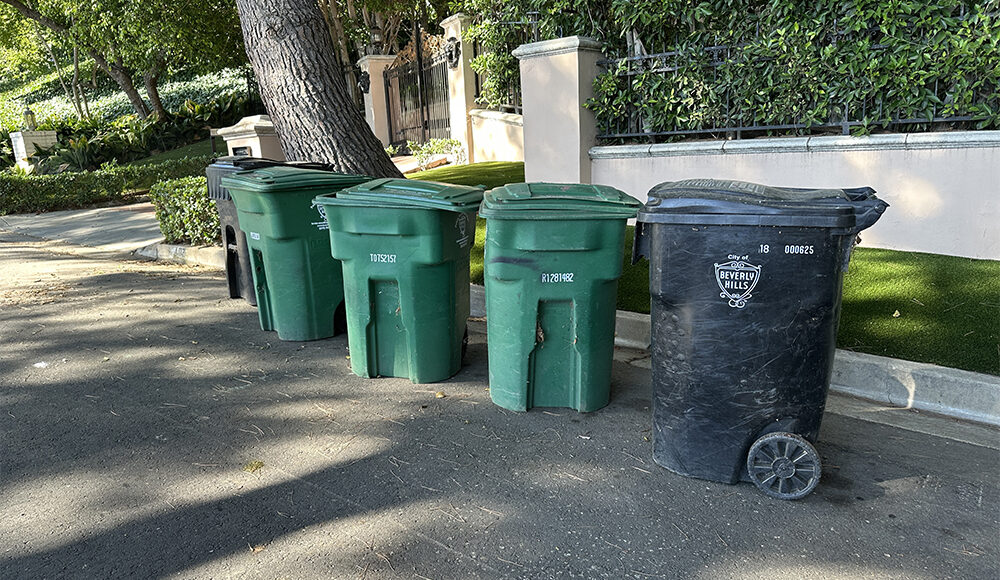
According to the city, the audit will entail a glance into waste containers to check that trash is in the correct bin. Bins may then receive tags reading “Oops” for incorrectly sorted trash and “Good job” for correctly sorted trash.

The audit is underway as a result of Senate Bill 1383, which went into effect in 2022. SB 1383 is a state effort to reduce methane gases at landfills.

“It’s a greenhouse emission reduction that the state is trying to accomplish with this regulation,” Beverly Hills Solid Waste Manager Colonel Burnley told the Courier. “This is not unique to Beverly Hills. Every city in the state of California that falls under SB 1383 is required to do it. So, we’re just doing our part.”

One of the primary objectives of the effort is to separate organic waste — particularly food waste — from other trash. Food waste should be put in green bins, not black or blue bins. Green bins can also hold coffee filters, flowers and herbs, yard waste, bones from meat and 100% plant-fiber based food-soiled paper.

According to Burnley, messages about the effort began going out to the community in December 2021. It was initially rolled out to single-family properties, then multi-family properties. The audit is the next phase of the plan.

All bins will not be audited; rather, the city will audit random samples from each of its approximately 35 trash routes.

“We’re not being invasive —opening up their trash, going through bags—we just flip the lid, look at that was at the top of the container,” Burnley said. “This first round is just more of a surface level audit.”

The audit will last for several more weeks, and a second audit will  likely be conducted early next year. Burnley expects to send educational mailers in the intervening months.

The city is not issuing tickets or other penalties at this time.

“Our goal is compliance, not to penalize people,” Burnley said. “A lot of times people just don’t know, or they need the proper tools to help them. So, we’re starting off with education, a nudge and push, so fines and penalties are not part of this process.”

More information can be found on the city’s website.