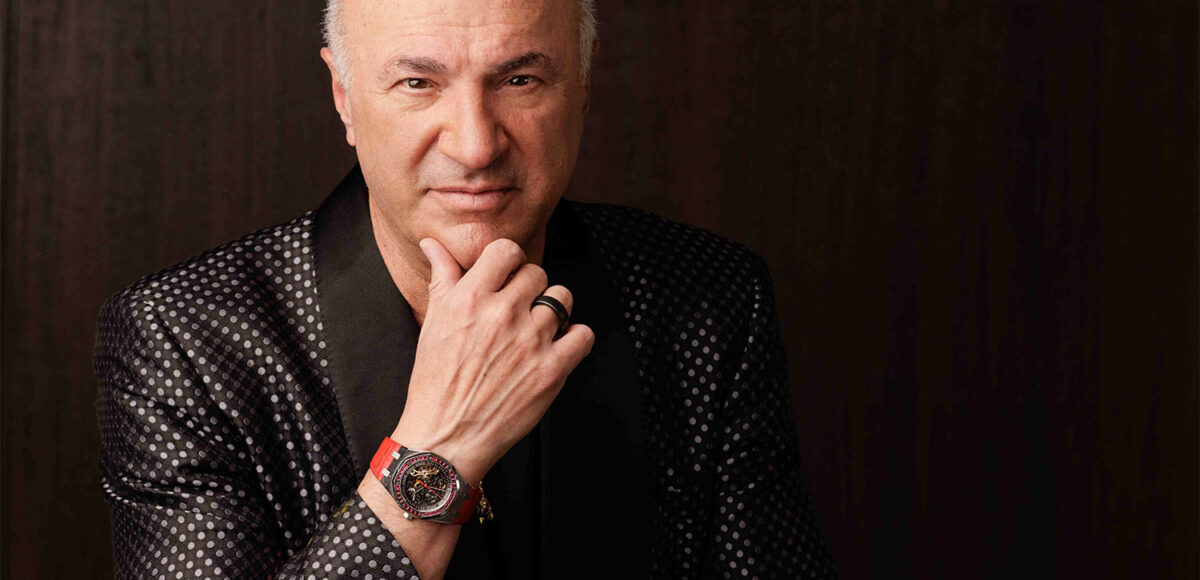
You think you’re special because you can hit a ball? You’re a callow little hustler, Marty. You’re a line item on my balance sheet, and right now, you’re in the red,” says the villainous Milton Rockwell character, artfully portrayed by Kevin O’Leary in the Academy Award-nominated feature film “Marty Supreme.” It’s a line that echoes the cold, harsh style Kevin has perfected on the Emmy-winning reality television show, “Shark Tank.” Referred to as the show’s definitive “breakout star,” he is rarely seen out of his signature uniform, a bespoke suit reflecting discipline, sophistication, and success. Yet one must wonder: Does his merciless attitude reflect the real Kevin O’Leary or is it simply one layer of his clever, personified brand?
The answer is as multifaceted as Kevin himself. Like other wildly successful individuals who have made a mark across a range of disciplines, Kevin’s persona is an amalgam of life experiences, lessons learned and a unique dose of self-confidence that set him on his path from an early age.
“Shark Tank’s” broader global franchise, comprising 54 countries, now in its 17th season, has reached a staggering audience of over 100 million viewers. Kevin sits at the entrance between hopeful entrepreneurs and life-changing capital. He calls himself “Shark Tank’s American Dream Ambassador,” often ripping apart inventors’ balance sheets, or demeaning them with blunt putdowns. However, it’s his formidable track record that lends those bites their sharpened edge.
Kevin first rose to prominence when the educational software company he co-founded, The Learning Company, was acquired by Mattel in a landmark $4.2 billion deal in 1999. Today, he is one of the most seasoned leaders in the entrepreneurial space.

Photo by Sarah Orbanic
As a prolific and quick-witted commentator, policy debater and bestselling author, Kevin has mastered the modern “omnipresence” strategy. With over 11 million followers across Instagram, YouTube, and TikTok, he speaks directly to the investor class whose wealth is derived from the capital markets. While his opinions can be polarizing, he is a sought-after expert for his ability to view world events and politics through the lens of capital flow.
Critics contend that his honesty veers into unnecessary verbal attacks. “You’re dead to me” or “Take it behind the barn and shoot it” are examples of him choosing a jagged performative edge over empathy. Do his audiences relish the predictability of the impending pain? Or, perhaps, by hating Kevin for his actions, fans find a way to feel better about themselves.
Whatever the reasoning behind the success, Kevin is a branding genius. He understood early on that humans are biologically attracted to conflict and catharsis. By leaning in to rebranding “meanness” as “honest truth-telling,” his brand didn’t just stick, it thrived. His popularity is unmistakably profound.
The biting irony is that he delivers verbal blows while meticulously polishing his somewhat ironic “Mr. Wonderful” brand. He lectures globally, advising industries, corporations, and universities on capital markets, and the intersection of global policy and business. At the heart of his operations is his “Something Wonderful” platform, which consolidates his “Shark Tank” investments into a unified support system for founders. His portfolio also includes WonderCare, an insurance provider, and his latest ambitious move, the massive Wonder Valley AI infrastructure project.
Additionally, his life experience has granted him the ultimate luxury: the ability to buy, market, and curate the finest the world has to offer. As a collector of “pièce unique” timepieces, vintage guitars, and investment-grade wines to name a few, Kevin has dominated the alternative asset category, earning the reputation for expertise that commands extraordinary respect.
I had the opportunity to sit down with Kevin at The Maybourne Beverly Hills, which has been his “home away from home” while filming “Shark Tank” in Los Angeles. Having studied the many layers of this brilliant, complicated, and deeply respected mogul, I wanted to peel back the “Mr. Wonderful” persona to better understand the machinery of his ambition and what truly makes this extraordinary man tick.
The lobby bar door swings open and Kevin’s entourage enters including friends, business partners and accoutrements. Kevin and his beautiful wife, Linda, quickly follow. As a large blue Tiffany & Co. box is placed center stage on the bar, everyone’s eyes focus on it as if the Crown Jewels were hidden inside.
In a flurry, Kevin lifts the lid and reveals his latest prized possession, a custom necklace built around a 1-of-1 Dual Logoman autograph card, signed by Michael Jordan and Kobe Bryant. Tiffany & Co. had mounted it in a heavy white‑gold frame and hung it from an oversized Tiffany HardWear‑style chain. Set with roughly 100 carats of Tiffany diamonds and 10 carats of rubies, the necklace weighs 2.2 pounds.
Kevin, with his two partners, bought the card in August of 2025 at a Heritage Auction for just under $13 million. He explains the entire piece is valued today at an impressive $20 million.
“Cards like this are indexed online based on the sales every night of cards similar to them,” Kevin offers. “Some cards go down, by the way. If an athlete gets into some scandal or something … But Kobe’s gone. He signed that card, and so I bought it.”
Kevin had the brilliant idea of enhancing its uniqueness with the help of Tiffany & Co.
“They’re not just any diamonds. They’re Tiffany diamonds … I pitched it to Nicole Weiss (Global Head of High Jewelry). She said, ‘We love it. LVMH loves it. Let’s do it.’”
Within two weeks, it was designed and completed using 3D robotics.
“I have an attitude that I want to do extraordinary things,” Kevin shares during the interview. “How many people get to act in an Academy Award-nominated movie?”
It’s highly unusual. Even his agents at United Talent Agency were against him reading for the role.
“They said to me, ‘We’re very scared that you’re going to s–t the bed. You don’t know what you are doing. We’ve got a fantastic business with you. Why take a risk?’ I said, ‘I have to try it.’”
“I didn’t know what I was getting myself into, and that was what was attractive about it. If you step out of your comfort zone, you exercise the most important muscle in your body, your brain.”
Kevin thoroughly enjoyed the experience, especially when it came to working with Timothée Chalamet. Now, Kevin’s entertaining new offers and hopes to do one motion picture a year.
“The trouble is I’ve started at the top. The number one production company, the number one director, the number one actor in the world. Where do I go from here?”
Origin Story
Terence Thomas Kevin O’Leary arrived on a warm July 9th day in 1954 in Montreal, Quebec, Canada. He was the first of two sons to Georgette Bookalam of Lebanese descent and Irish-born Terry O’Leary. Working in her family’s clothing business, Georgette had met and married Terry, a salesman. Unfortunately, the marriage struggled, mostly due to Terry’s drinking problem. They divorced when Kevin was 7. Soon afterwards, Terry passed away.
During this difficult time, Kevin was also challenged and traumatized by dyslexia. He felt ashamed in the classroom, unable to do what his fellow 6-year-olds could do.
Worried, Georgette brought Kevin to see two experts on dyslexia at Montreal Children’s Hospital. They reframed Kevin’s thinking, convincing him he had a superpower. He took the lesson to heart.
“I thought, ‘Why am I being ashamed? Why don’t I simply challenge these kids who are laughing at me?’ I said, ‘Watch this. I can read this book in a mirror. Can you do it?’ And they said, ‘How’d you do that?’ I said, ‘Well I have superpowers.’ And they’d go, ‘Whoa, that’s crazy.’”
Kevin feels dyslexia and that period in his life taught him how to deal with adversity, and the need to be independent.
A few years later, Georgette married George Kanawaty, an Egyptian who worked for the United Nations as an international civil servant. The family moved to Champaign-Urbana, Illinois, where George completed his doctorate in business.
Dr. Kanawaty, today a man in his early 90s recalls, “I remember when we lived in Champaign-Urbana. We had rented a house on a golf course. Kevin was 8 years old. On his own initiative, he went and set a table near the 11th or 12th hole selling cold Kool-Aid drinks to golfers at $1 a drink. The entrepreneurial talent showed up at that young age.”
The family moved internationally throughout Kevin’s childhood.
“I had a wonderful life that he provided,” shares Kevin. “I’ve lived in Cambodia, Tunisia, Ethiopia, Cyprus, Switzerland, Germany, France, Japan … I have a really interesting view of the world today and friends all over the world.”
Kevin’s global upbringing laid the groundwork for his success, but it was a summer job in Canada that provided one of his most vital lessons. While scooping ice cream to impress a girl, Kevin ran into a tough reality: the power of the owner. When he refused to do menial work for the business owner, he was instantly fired. The experience became a revelation; the world is divided into two camps, those who own and those who serve. He decided right then that he would always be the one in charge.

bottom left: Kevin and his mother, Georgette at his Master’s degree graduation
Photos courtesy of kevin o’leary
Right: Kevin o’leary displaying his signature sense of style and talent on guitar
Photo by sarah orbanic
Practicality Over Passion
Another foundational lesson came from his mother. A quiet and disciplined investor despite their middle-class environment, Georgette offered “tough love” with respect to financial support as soon as Kevin graduated high school. Kevin funded his college education with loans and part-time work.
His stepfather, George, guided with brutal honesty, and offered another key lesson. He told Kevin that he would starve if he pursued his dream of becoming a professional photographer. Convincing him to choose practicality over passion, George pushed Kevin to attend business school. George suggested that Kevin support his passions by building a money-making empire that funds them. Recognizing the wisdom in this, Kevin wasted no time making it a reality.
“I always gut check before I open my mouth, ‘Is this the truth, what I’m about to speak?’”
Back in the Maybourne, after modeling his one-of-a-kind “bling” necklace and passing it around for everyone to try on in The Maybourne Bar, Kevin grabs one of his high‑end, rare and consciously curated guitars that was brought to our interview. Finding a comfortable chair, Kevin begins to serenade us.
“You realize, as your career advances, the only thing that matters is your reputation. People don’t have to like you or agree with you, but they have to respect you.”
An example was Kevin’s working relationship with Steve Jobs. It was built on respect.
“I did all of his educational software. He was not a nice guy, but he was a genius for what he built.”
Kevin’s The Learning Company was a major third-party publisher of educational titles such as Reader Rabbit and ClueFinders for Apple II, and later the Mac. It helped to cement Apple computers in schools.
“We would fight a lot, but he would always say to me, ‘Look, are we making a ton of money together? Then shut up and just do what I say.’ I would say, ‘OK, Steve, that’s fine.’”
Signal vs. Noise
He credits Steve Jobs for teaching him an extremely valuable working philosophy, the concept of signal vs. noise. It’s a mental model used to separate meaningful information called the signal, from the noise, which is random, distracting, irrelevant information. The term originated in the field of radio engineering and electronic communication during the early 20th century.
Kevin believes “There are three things you have to do every day, and that’s the signal. Everything that stops you from doing those three things is the noise. The ratio has to be 80%-20%. I’ve only met one guy in the world who’s 100% signal, that’s Elon Musk. He’s an unusual dude, a little eclectic, but he’s 100% signal. Look at what he’s achieved.”
Kevin believes that working outside of one’s comfort zone is very important in advancing. As he regularly addresses audiences in different industries all over the world, it forces him to prepare and discover new concepts of value.

Photo by sarah orbanic
“I enjoy criticizing policy. When I see stupid policy from stupid politicians, I call it out. I’m not against the person. It’s just their policies are stupid, and it’s going to hurt people. I’m the only person you know that gets to work on every outlet in the media, the left, the right, the middle. I mean, the same day I’m on Fox News, I’m on CNN at night.”
Kevin has been criticized for going too far. When pressed, he admits, “I might have been better saying it a different way. That’s happened before, but I always gut check before I open my mouth, ‘Is this the truth, what I’m about to speak?’”
But sometimes it can be hurtful and he admits that his adult children worry about the negative comments from some of his followers.
“Which one of the 11 million are you worried about?” Kevin asks his children. “The lesson I get to teach is you can’t make everybody like you. It’s impossible. When I read a three-paragraph diatribe of utter hatred and not policy disagreement, just how much I hate you, I think to myself … What an utter waste of their time. What is their signal-to-noise ratio?”
Citing his children’s feelings on this issue illustrates just how sacred family is to Kevin. As the author of “Cold Hard Truth on Family, Kids and Money,” he views the family with financial pragmatism similar to running a business, requiring discipline, transparency and boundaries. Yet, the irony is hard to miss. While Kevin insists that emotions are bad for business, he is clearly driven by a deep emotional attachment to his own family.
Family Before Fortune
Kevin carries two phones, one exclusively for Linda and his two adult children, Trevor and Savannah. He has stated that if the family phone rings, he answers it immediately, even if he’s in the middle of a television taping or a high-level board meeting. Savannah, in interviews, has described him as a “softy” who loves to cook and play guitar.
Forty-plus years earlier, Linda, a 21-year-old classically trained ballerina, met the driven 29-year-old big thinker at a gym in Boston in the 1980s. His charm and charisma won her heart as did their bonding over their shared love of food and wine. They were married in March of 1990 in a simple home ceremony with friends, pizza and beer, reflecting Kevin’s financial philosophy of investing their money even back then. Thirty-six years later, they share a gratifying life together.
“If you have a successful family and you focus on marriage and you have kids and it works, it can be very rewarding later in life. A lot of people that are young are making mistakes.”
Kevin advises couples in selecting a life partner.
“Don’t move in together until you’re committed because it’s so easy … before you make it legal. Become married because within a few months, you’re going to find out it’s not that easy. And if you don’t have the bond of marriage, you’re just going to break up.”
Kevin claims most marriages break up due to financial stress.
“Find somebody who has the same financial goals you have. Fifty-plus percent of marriages [fail] … It’s not infidelity. Most marriages

Lower Left: Kevin, Linda, and their children, Savannah and trevor
Photos courtesy of Kevin O’leary
Thirty-six years later, they share a gratifying life together.
“If you have a successful family and you focus on marriage and you have kids and it works, it can be very rewarding later in life. A lot of people that are young are making mistakes.”
Kevin advises couples in selecting a life partner.
“Don’t move in together until you’re committed because it’s so easy … before you make it legal. Become married because within a few months, you’re going to find out it’s not that easy. And if you don’t have the bond of marriage, you’re just going to break up.”
Kevin claims most marriages break up due to financial stress.
“Find somebody who has the same financial goals you have. Fifty-plus percent of marriages [fail] … It’s not infidelity. Most marriages can survive that, but they can’t survive financial stress because it just destroys the household.”
Hello Prenup is a company Kevin invested in. He explains, “We do prenups for women. It’s all online now. It works very well because it forces financial due diligence on both partners.”
Finding quality family time to spend together and learning how to listen are top priorities for Kevin.
“We have a lake house in the summertime [in Ontario] … It’s very special family time. We hang out on the dock … work out, go swimming, take pictures or watch movies. It’s laid back … The sun sets very late, almost 10 o’clock.”
Become the Brand
Kevin’s Canadian summer in 1979 was very different and proved to be a turning point in his life. While pursuing his MBA at Ivey Business School, he took an internship at Nabisco under a “genius” Dutch product manager. Tasked with marketing cat food, Kevin witnessed a masterclass in branding. Even a “nasty” concoction of corn and bacon bits could be sold as a luxury, provided you have the gall to call it soufflé.
Years later, after the enormously successful sale of The Learning Company, Kevin pivoted to media, and instead of a new inventive business, he became the product to market. As a regular commentator on the Business News Network (BNN) in Canada, his style of sharp, clinical, and often controversial responses caught the attention of the Canadian producers of the British show “Dragon’s Den.” Kevin was later discovered and recruited by Mark Burnett, along with fellow Dragon, Robert Herjavec, to launch the American version, “Shark Tank.”
“The trouble is I’ve started at the top. The number one production company, the number one director, the number one actor in the world. Where do I go from here?”

Photo by Sarah Orbanic
Proving that branding “mean” worked for ratings in Canada, was this the instigator for Kevin’s brand today?
“It’s interesting because there’s a cost to that. A lot of people have never met me, but they don’t like me because of something I said. I don’t feel bad about it. I don’t care. I mean, I know it’s the truth, so I kind of roll on with it. Maybe I’m wired differently. I just don’t give a s–t. That’s the problem.”
During the first episode of “Shark Tank,” after seeing Kevin abruptly dismiss a contestant’s entrepreneurial dreams, Barbara Corcoran turned to Kevin and remarked, “Look at you, Mr. Wonderful! You’re so mean.” Kevin immediately trademarked the name, but switched the sarcastic tone to a truth-teller narrative. His explanation is that he IS in fact Mr. Wonderful, by being brutally honest and preventing founders from losing all of their money. The “mean” guy now had a catchy, memorable name which his fellow “Sharks” promoted each time they referred to him.
Guided by the legacy of his mother and his trust in Linda, whom he wholeheartedly views as the O’Leary family CEO, Kevin’s track record proves he is a strong proponent of women in power.
“I invest in a lot of companies. My outcomes have been extraordinary with women-led companies. I’ve made a lot of money … They mitigate risk better in the beginning for companies with $1 million to $5 million in sales … They know how to navigate the high-risk nascent period, which is 36 months … It’s the old adage: you want something done, give it to a busy mother. It’s the idea that they can juggle multiple mandates and they reduce risk.”
Aware of the inequities women in business face today, he offers, “Life isn’t fair. What I find about women CEOs or women founders is they understand life isn’t fair, but they don’t let that get in the way. They deal with it and they move on. I don’t hear a lot of women complaining about the injustice that does exist. They don’t have time to do that.”
Surprisingly, Kevin’s drive for success is not purely financial.
“The whole idea of being an entrepreneur is not about the greed of money, it’s freedom. You want to be free, and you want to do whatever you like. The only reason I’m here with you is I want to be.”
Time Will Tell
While he is widely known for his curated collections of vintage guitars, photography, fine wines, writing instruments, and now sports cards, it is Kevin’s horological journey that truly sets him apart. He now focuses exclusively on the world’s most significant “pièces uniques” acquired via sacred “covenants” with independent master watchmakers. In exchange for a promise to never sell a piece, he is granted the right to commission a one-of-a-kind masterpiece that rivals even the collections of Middle East royalty.
More fantastical are his rituals in how he experiences his collection, beginning with wearing two watches all the time.
“It’s part of my look … Every day I wear six pieces. Two in the morning, switch at lunch, and then before I go out two more.”
After his morning workout routine, he spreads out 30–50 watches of his “untold” number in his collection, each with a different dial. All have red bands, with the exception of a few.
“Pantone 45C (red) is what I use for my bands and most makers know that about me.”
Offering me his wrist, he proudly shows me the watch on his right wrist.
“This is a ‘pièce unique.’ There’s only one of them in the world … Made for me on ‘Shark Tank’ maybe five years ago by Francois, the CEO of Audemars Piguet. It’s a Royal Oak. There’s not another one in the world like this.”
A Rolex adorns his left wrist.

Photo by Sarah Orbanic
Right: Kevin with two more of his timepieces, featuring his signature pantone 45c red bands
Photo by David Jon Photography, courtesy of Kevin O’leary
“They [Rolex] have taken a new step up in the world as master jewelers. They can incorporate stones into a dial like almost no one else on earth can do. I mean, this is the very, very famous rainbow dial where these colors in every rainbow match identically. Do you know how hard that is to do?”
Most important to Kevin is winning over the world-famous watchmakers.
“It doesn’t matter how rich you are or how famous you are. If you want to get a watch, for example, from F.P. Journe, he doesn’t give a s–t about any of that. He only wants to know, ‘Are you a real collector? Are you somebody who will buy the piece, honor the piece, honor the brand, and never sell it?’ … I’ve had to get on my knees. That makes it even more honorable, more unique.”
Another challenge watch collectors and other alternative luxury asset collectors bump into is the high cost to insure the assets within today’s archaic insurance model. Most wearable assets are placed under the umbrella of the homeowners policy, and there is little flexibility with respect to appraisal, costs and appreciation.
Recognizing the need, Kevin approached Chubb, the global giant, widely considered the “gold standard” for insurance. They did not believe the market would reflect the need for a white-glove, carve-out company. Kevin asked his 11 million social media followers, many of whom are watch collectors. Chubb would have been impressed with a few hundred positive inquiries. Kevin immediately received 3,800 eager responses. WonderCare was born that day, in partnership with Chubb, a stand-alone platform for collectors to manage their luxury “wearable portfolio.”

Photo by Sarah Orbanic
Winners Embrace Failure
Does everything that Kevin touches or invests in turn to gold? Kevin admits he’s had many disappointments.
“In venture investing, 80% fail. Two out of 10 work. I try to put those [the failures] behind me … I try and tell the entrepreneurs, listen. It hurts. It’s important that you learn from this what went wrong in the exit interview.”
Those who blame external reasoning are not learning from the failure.
“Some will say this to me: ‘Well, the market changed or our competitor did this or something happened external, but never do they say it was me. The ones that are going to be successful look inward and say, ‘What did I do wrong? What mistakes did I make and what did I learn from them?’ Because they’re the ones I want to invest in again. But the ones that always blame external reasons, they’re frigging losers. They don’t get it … You have to embrace failure, make it part of your DNA, and don’t let it happen again.”
He believes founders or company heads should know their weaknesses.
Kevin offers, “I know what I am good at, and I know what I’m not good at …
I’m a terrible logistics guy. I hate widget management. And if you think you’re good, you better prove it to yourself every month … I say that to myself every morning, ‘I am the very best. No one can beat me …’ That’s my attitude. That’s how I motivate myself.”
Linda confirms Kevin has always been extremely confident. “In a smaller way. But everything was smaller back then. Everything is bigger now.”
“The whole idea of being an entrepreneur is not about the greed of money, it’s freedom. You want to be free, and you want to do whatever you like. The only reason I’m here with you is I want to be.”
Today, Kevin the self-made, entrepreneurial titan, mentors future generations on the brutal realities of searching for success, freedom and leadership. While his persona is a masterclass in “wonderful” modern branding, the engine of his success is his absolute conviction.
When asked if total trust in his own messaging is the secret, Kevin is unequivocal.
“People don’t follow you if they don’t believe you know where you’re going. It’s that simple … I lead with blind faith that I’m right.”