

Blue lights bathed the trees at a hilltop home as 950 members of the greater Beverly Hills community watched The Who deliver a seven-set show on the heels of their farewell tour.
Speaking to the crowd during a break between songs, lead singer Roger Daltrey thanked everyone for being there. The event was the 10th year of The Who’s Backyard Concert, which benefits Teen Cancer America (TCA)—the organization Daltrey co-founded with bandmate Pete Townshend—and the UCLA Health Center.
“These are your young Americans,” Daltrey said of the community the organization works to support. “This age group has been forgotten too long in the hospital system. We are changing it, [and] I’m very positive for the future. Thank you very much. We love you.”
The Backyard Concert was emceed by producer, writer and director Judd Apatow and included performances by The Doobie Brothers, Peter Frampton, John Fogerty, Def Leppard, Cheap Trick and Eddie Vedder in addition to the performance by The Who.
The event is remarkable in a number of ways. Thanks to the tireless work of Daltrey, Townshend and members of the TCA Board such as Board President and CEO Rebecca Rothstein and board members Rick French and Chris Stewart—both of whom also sit on the board of the Rock and Roll Hall of Fame—rock legends including Robert Plant, Van Morrison, Billy Idol, Melissa Etheridge, Green Day and many more have graced its stage.
“I now call it Yardstock because they’ve had more stars than Woodstock,” said Daltrey over the phone a week after the performance.
According to Daltrey, the musicians who participate do so because of a shared belief that they owe their careers to the teens and young adults who champion their music, and that those who receive the devastating news of a cancer diagnosis deserve the music industry’s support.
“All the bands understand the support that this age group has given them to have the success they’ve had in their lives, and they’re giving back big time,” he said. “Teenagers and young adults are the people that drive the music industry. They’re the ones that discover new music, push the new trends, drive it forward.”
TCA, which has its headquarters in Santa Monica, opened its doors 12 years ago. But in truth, its roots stretch back further than that.
Daltrey became involved with Teenage Cancer Trust in the United Kingdom in 1990 at the behest of his general practitioner, Dr. Adrian Whiteson. Whiteson founded the organization with his wife, Myrna, after recognizing that most cancer centers have programs for pediatric patients and adult patients but nothing for individuals who fall in the ages between.
“The ages between 13 and 26 are totally different from either a child or a geriatric, and there needs to be some provision made in the hospital system for that age group,” said Daltrey. “They need to be amongst their peers, and their mental health and social needs need to be met. You take care of that age group; you will build a far better society.”
Daltrey quickly became interested in launching an organization similar to Teenage Cancer Trust in the United States. He hadn’t gotten far with the idea when, in 2009, someone knocked on his dressing room door before a show at the Ryman Auditorium in Nashville.
“I opened it, and there was this young woman standing there, and she said, ‘Can I talk to you?’” Daltrey said.
The young woman said she had a brain tumor, and that she was familiar with Daltrey’s work at the Teenage Cancer Trust. If she survived, she said, she wanted to help him get the same thing started in America.
After that, Daltrey said, “It all came together relatively quickly.” He had recently become friends with Rothstein, who lives and works in Beverly Hills, and asked for her help launching the program. At the time, Rothstein had four young children and a full-time job at Merrill Private Wealth Management as one of the top-ranking female financial advisors in America.

Photo by craig weston
“Roger had been trying for years to get somebody to say yes to him to bring the program to America,” said Rothstein. “I kept saying to him, ‘Roger, I’m busy.’ And he kept saying to me, ‘You’re not too busy for this.’”
As it turned out, Rothstein had a personal connection to the cause. At the age of 22, her brother passed away from a highly aggressive form of brain cancer.
“He died right at the beginning of his life,” she said, “and I watched how it affected my parents.”
Daltrey then took Rothstein to visit a hospital and meet young patients. Once she saw the need, she couldn’t say no.
“The word ‘yes’ came out of my mouth,” she said, “and so it began.”
Rothstein brought on Simon Davies, who at the time was running the Teenage Cancer Trust. Together, they assembled a board and began growing the organization. Much of their early work involved meeting with hospital representatives, explaining the idea behind TCA and endeavoring to build partnerships.
In the years since, TCA has partnered with 72 hospitals in the U.S., including some of the biggest names in cancer care: Dana-Farber Cancer Institute, Memorial Sloan Kettering Cancer Center, MD Anderson Cancer Center and more. TCA’s services have reached over 200,000 adolescents and young adults, and their modules and programming have become the standard of care for the age group they serve.
“I have an active board,” said Rothstein. “There are 13 board members that all participate in developing and pushing this charity down the road. This is a village of people that have worked to make the mission of TCA as successful as it has become.”
Now, hospitals interested in creating programs for teens and young adults often seek the organization out. Bringing together multidisciplinary teams that include representatives from pediatric and medical oncology, which are often siloed inside hospitals, TCA’s expert providers collaborate to ensure that young patients’ physical, emotional, social and psychological needs are met.
“Teens and young adults are in a critical period of their development where they’re becoming independent from their families, or they’re starting their own families,” said Jackie Casillas, a pediatric oncologist and a health services researcher at the University of California, Los Angeles (UCLA), the first hospital to partner with TCA. “They may be in high school, looking forward to college and working or at a job, and all of that can be disrupted by the cancer diagnosis.”
Alec Kupelian was one of those people. Kupelian, 31, was nearing the end of his freshman year of college at the University of California, Santa Barbara in 2014 when he drove home to Los Angeles to take a friend to her high school prom. He planned to be in town for one night before returning to college.
For several months, Kupelian had been experiencing pain in his leg. But like most people his age, he assumed it would go away on its own.
His father, an oncologist, thought differently. After taking one look at his son upon Alec’s arrival home, Kupelian’s father took him into the hospital for an MRI.
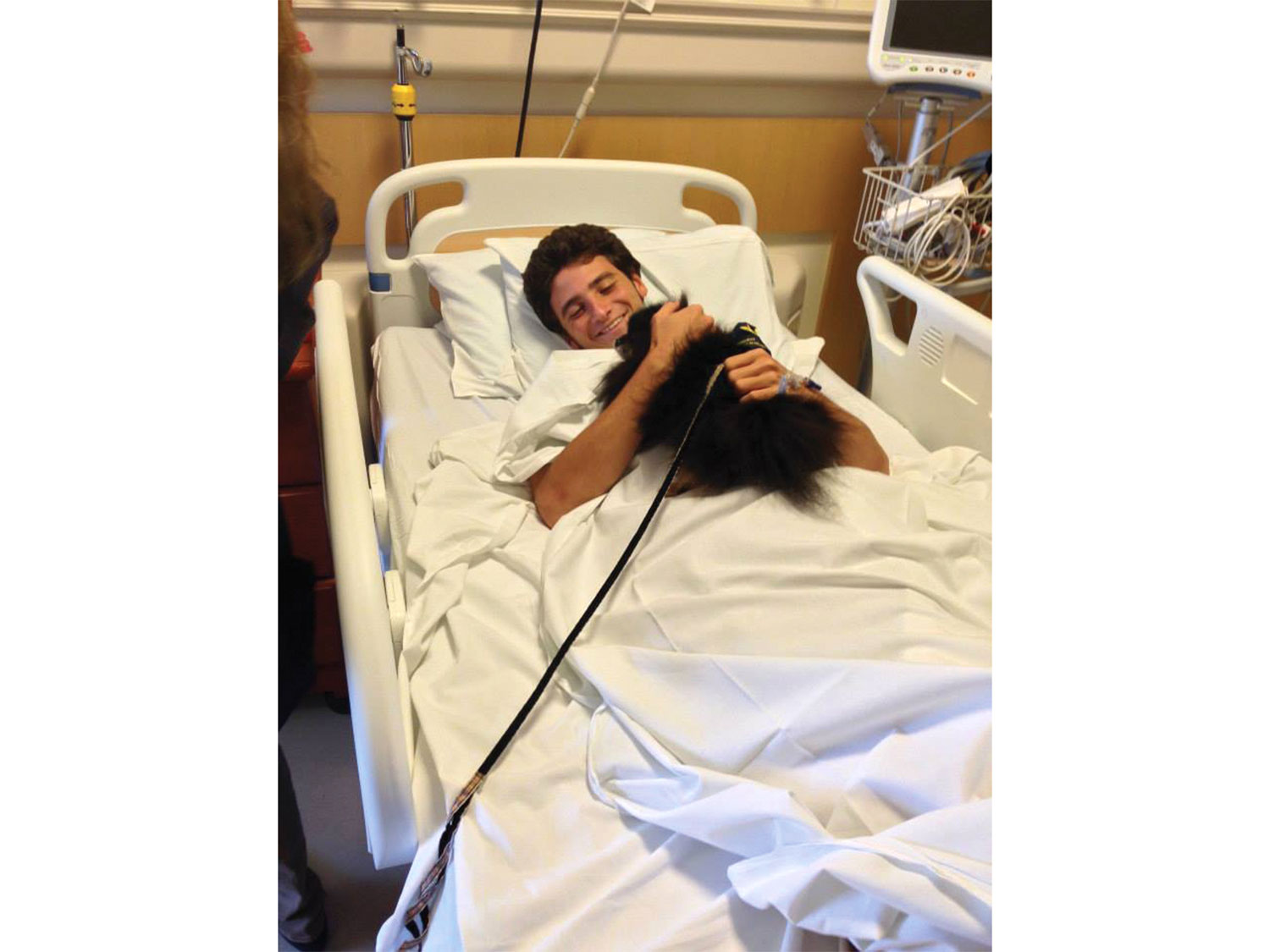
Photo courtesy of Alec Kupelian
From there, everything changed.
“Saturday was prom,” Kupelian said. “Sunday, I had an MRI. Monday, I had a biopsy. Tuesday was my port placement, and by Wednesday, I started chemo.”
Kupelian was diagnosed with Ewing’s sarcoma, a type of cancer that often spreads to the lungs and bones. He was 19 at the time and spent a year getting chemotherapy and radiation at UCLA. While there, he became involved with TCA, which at that time had a physical space in the hospital for teens and young adults, including a lounge where young people could hang out together as they would outside the hospital.
“To have people who understood what I was going through during treatment and could laugh about it with me in a time where laughing is sometimes hard to come by was incredible,” said Kupelian.
Kupelian and a friend bonded over their IV poles, which they named Earl and Steve.
“They were so chatty, and they just loved to have conversations,” he said with a laugh. “There are things that only the people going through it can understand and connect on.”
The importance of this social network, said Sullivan, cannot be overstated.
“Seeing that they’re not alone, that there’s a community that supports them and that they can move forward and life is going to be beautiful, there’s still so much opportunity, is critical,” she said.
Since the COVID-19 pandemic, more cancer care has become remote. To that end, TCA put together a teen and young adult advisory group to discuss ways to bring young people together, whether online or in person. The advisory group worked with TCA to build a website and began making videos, including interviews with young people who have cancer diagnoses or are in their survivorship stage.
“We started with the bricks and mortar, but we really had to evolve upon that, because we need to bring the program where the patients are at,” Casillas said.
Kupelian is one of many TCA patients who have maintained those close friendships well past his time in the hospital.
“I still have friends from treatment,” he said. “I got married this last year, and one of my friends from treatment offered to have my wedding at their house for free.”
At the beginning of a new partnership, staff from TCA lend their support to staff from the hospital to identify needs and strategize what a teen and young adult program might look like, since all U.S. hospitals function differently. From there, hospitals that want to pursue a program further may apply for a grant from TCA to help fund staff such as nurse navigators, social workers, program managers or mental health specialists.

Photo courtesy of Alec Kupelian
Since its inception, TCA has provided 49 grants, funding 85 positions in 35 cities throughout the country.
A critical element of care for this age group is also fertility education and preservation.
“Patients may not be thinking about having a child right now—say they were diagnosed when they were 18—but you do want to make sure they have all options for their future,” said Casillas.
In addition to its grantmaking programs, TCA offers ongoing training, education, resources and connections for its existing partners. Those include monthly webinars for health care providers, access to advisory panels and ongoing support from TCA staff.
Recently, the organization launched Play It Back, a program that pairs cancer patients and survivors with a music producer. Together, they work for six months to a year writing songs and lyrics and producing their own music.
“They meet other young people from all across the country who are equally passionate about music and about music production,” said Sullivan. “It really becomes such a therapeutic way for them to move forward.”
Daltrey said he would like to see more individuals in the music industry give back to the age group that pays their bills.
“The music industry itself needs to give, and start to think about this, because they haven’t been quite as generous as they should be,” he said. “We need a little bit more support from the big music companies, so let’s give them a kick.”
His greatest hope for TCA, he said, is to have an adolescent and young adult program in every hospital in the U.S.
“I would like that to be available to everyone who needs it in America,” he said, “all across the country.”