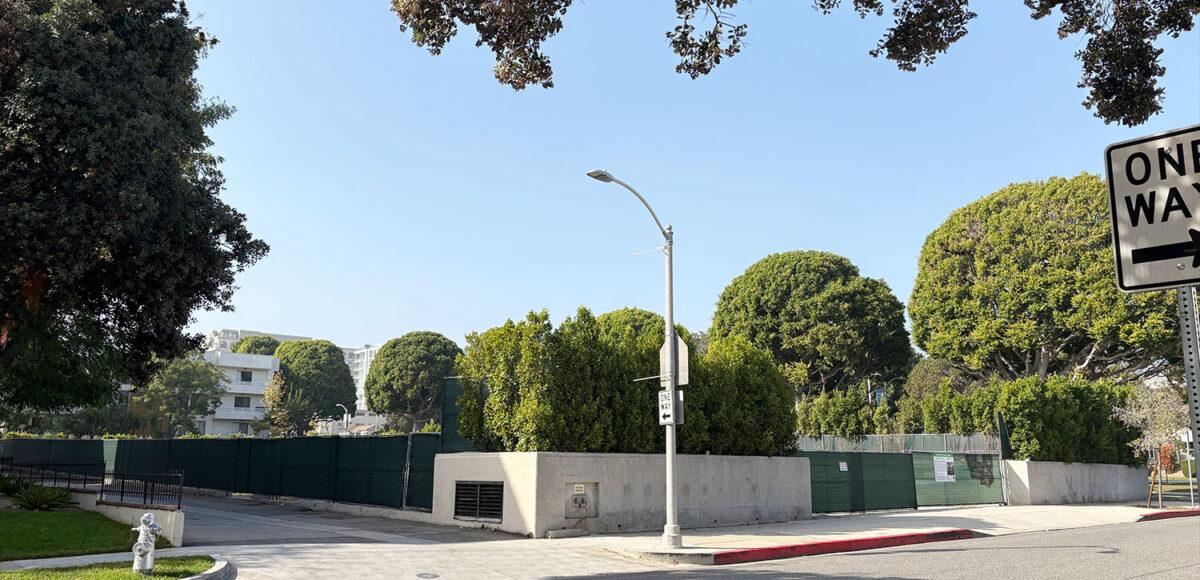

Beverly Hills officials are facing pressure from the state and a developer to overturn the Planning Commission’s recent decision to deny a permit and review for a Builder’s Remedy development at 8844 Burton Way.
On Nov. 17, an attorney representing the project’s developer filed an appeal with the City Council over the commission’s decision. Three days later, on Nov. 20, the California Department of Housing and Community Development (HCD) sent a Notice of Potential Violation (NOPV) to the city regarding the commission’s vote.
In his appeal letter to the city, attorney Dave Rand argued that the commission’s decision was illegal.
“The Commission broke the law,” the letter states. “The City Council must correct this.”
In its NOPV, HCD concluded that “City Council should be mindful of the specific requirements for making findings of denial … [i]f the City Council is unable to make such findings, HCD urges the City Council to approve the Project.”
A preliminary application for the proposed project was submitted by developer Crescent Heights in December 2023. Following revisions, the final proposal called for a 26-story residential building with 200 units, including 22 affordable units.
The project utilizes Builder’s Remedy, the state law that permits developers to circumvent certain local development codes in exchange for providing affordable housing units.
At its Oct. 21 meeting, the Planning Commission voted 4-1 to instruct city staff to draft language denying a request for a development plan review and density bonus permit for the project. That language was revisited at the commission’s Nov. 5 meeting, at which time the commission voted 3-2 to adopt the proposed denial resolution.
Members of the commission who voted to deny the project cited an array of reasons. Commissioner Gary Ross alleged that the applicant “played games with what is and isn’t feasible,” alluding to a provision in state law that prevents city officials from imposing conditions on Builder’s Remedy projects that would render them infeasible.
Commissioner Myra Demeter called the negotiation process with the developer “disturbing,” and ultimately concluded that the project “is not really going to work for me,” adding that she does not mind if it is appealed to City Council.
Vice Chair Lou Milkowski said he believes that the project will have a negative impact on health and safety because it is not aligned with the city’s general plan. He then called the development “a mammoth monstrosity.”
In his 13-page, strongly worded appeal to city officials, Rand outlined the reasons for his allegation that the denial of the project was unlawful.
A large portion of the letter deconstructs Commissioners Ross, Demeter and Milkowski’s verbally stated reasons for denial, again calling them “illegal.”
“[T]he three Planning Commissioners who voted to deny the Project did not state any valid bases for denying the Project during their verbal deliberations … the Commission went on a fishing expedition looking for any possible basis to reject the Project,” the letter states. “Ultimately the denial was devoid of any legitimate legal or evidentiary basis and therefore must be overturned.”
In its Nov. 20 NOPV, HCD primarily addressed the reasons given by the commission for its Oct. 21 decision. Those reasons included allegations that affordable units were not adequately dispersed throughout the building and that the project posed health and safety risks.
HCD wrote that neither of those reasons appears to be valid.
State law stipulates that affordable housing units must be dispersed across more than one floor, which they are in the project proposed by Crescent Heights.
“HCD reinforces to the City Council that dispersal of affordable units as proposed by the applicant should not be identified as a reason for denial,” the NOPV states.
With regard to concerns about health and safety risks, cities may only deny Builder’s Remedy projects on those grounds if they make written findings, supported by overwhelming evidence, that demonstrate a specific, adverse impact on public health and the impossibility of mitigating or avoiding that impact.
Members of the commission expressed concern that public health would be impacted by traffic near the development and by the height of the building, which they worried would not allow for emergency access.
Based on its review of a transportation assessment prepared for the Burton Way project, HCD stated in its letter that “there is no ‘significant, quantifiable, direct, and unavoidable impact’ related to traffic” and that the department is “not aware of any evidence in the record that would suggest that emergency access to all floors of the building would be an issue.”
HCD also pointed out that city staff came to the same conclusion in their Oct. 21 report.
The NOPV was the third communication from the state regarding the city’s handling of the proposed project at 8844 Burton Way. A Notice of Violation was issued by HCD on Dec. 2, 2024, and a Letter of Technical Assistance was sent on Oct. 28.
The developer’s request for a development plan review and density bonus permit will now go before the City Council. According to a representative from the city, no date has been set yet; however city officials believe it is likely to be heard in February.
In a statement to the Courier, Rand said that the city will face “substantial penalties if it fails to reverse the Planning Commission’s decision and approve this Project.”
“We are hopeful the appeal hearing is promptly scheduled and that the City Council follows clear direction from the state to approve the project,” he said.