
“The Choral” was a much-anticipated film. Not only was it written by the dream team of writer Alan Bennett (“The History Boys”) and director Nicholas Hytner (winner of multiple Tony and Olivier awards), but the cast was starry as well, led by Ralph Fiennes. Set during World War I, just as conscription is about to scoop up all the eligible young men who have not yet enlisted, the Yorkshire town of Ramsden is feeling the pinch particularly hard. That is not to say the feckless youth, personified by Lofty (Oliver Briscombe) and his pal Ellis (Taylor Uttley), are much affected. Lofty should know better because he delivers the dreaded telegrams to families awaiting word that their sons will return. They won’t. But Ellis and Lofty are 17 and feel immortal.
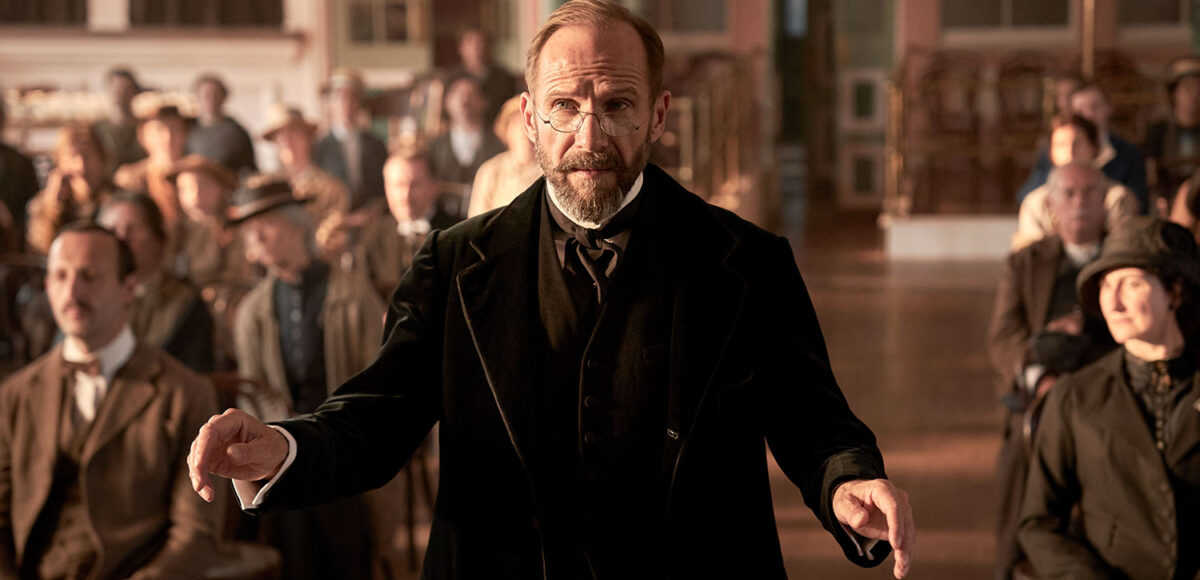
For Alderman Duxbury (Roger Allam), the owner of the local mill, there is another loss to contend with. He founded and funds the local choral group, and their director has just enlisted. Replacement choices are few. The local photographer has a suggestion that won’t go down easily. Dr. Henry Guthrie (Ralph Fiennes) has returned to town and may be available. As undertaker Herbert Trickett (Alun Armstrong) points out, he won’t be a popular choice. Guthrie has spent many years in Germany as a much-respected artist. The locals will look unfavorably on what they perceive to be consorting with the enemy during these times. But Guthrie it is and it will be Bach’s St. Matthew Passion that he will be conducting. But possibly not. The anti-German feeling extends to anything written by Bach, Beethoven, Brahms and Mendelsohn. Instead, he chooses “The Dream of Gerontius” by Elgar. They are aghast. Elgar? Composer of “Pomp and Circumstance”? Guthrie explains that Elgar has more facets than marches, and he had a grand success in Germany conducting the “Gerontius.”
Guthrie, his standards high, calls for auditions, and every available voice in town is conscripted into his army of music. A few gems are found, but everyone else will be used to fill out the background. More problematic is the Alderman. He demands to sing lead tenor. He is the right age to play an old man dying and being led away from the devil by an ethereal young maiden; a tenor, however, he is not.
Every member of the choral, young and old, has their own drama going on. For Lofty, Ellis and their friend Mitch, it’s about girls and how to get them. For Mary, the young Salvation Army soprano and one of the gems, it’s finding her voice and who she is; for Bella, it’s discovering where her passion lies. Is it with her missing-in-action fiancé Clyde or her new flirtation with Ellis? Life becomes even more complicated when Clyde returns, minus a limb but eager to rekindle their romance. A former star of the choral, Clyde is reluctant to return to the choral when he realizes he’s been replaced in Bella’s heart. Pressure is exerted and he acquiesces, bringing with him his beautiful tenor. They need a star tenor to anchor the production and it isn’t the Alderman. If Guthrie rewrites the scenario of “Gerontius,” making the old man a young man, Clyde, who is dying in the war, reframing all the other actors as soldiers and Mary as a nurse then they would have a viable scenario. Even the Alderman is thrown a bone and promised the role of the devil.
It’s all highly suspect, reworking Elgar’s composition, but they are in a small village so it’s unlikely he’ll find out. But Mary has learned that he is receiving an honorary degree in Manchester, less than an hour away, and without Guthrie’s knowledge she invites him to a rehearsal. What are the chances? Elgar arrives and discovers their plans, going ballistic and threatening them all with a lawsuit. What started off promisingly ends very badly as he huffs off to the limo that brought him. Will they proceed? You will have to wait and see.
The plot is a good one, but Bennett has overladen it with subplots, denying each its own proper development. His ambition to tie the inhumanity of war into the embrace of music that would soothe the savage beast was noble but far too diffuse. It was as if Bennett wove a tapestry, but forgot to tie the threads and they unraveled. It often feels like a play with too many characters. The enigmatic character of Guthrie shows very little depth. His time in Germany leaves us with questions and no answers, only hinting at his former life. His character has some marvelous unspoken moments, but subtext is one thing and total inscrutability is another.
All of the characters interact easily and knowingly but we’re not in on the game. There is enough drama in fitting disparate, sometimes dissonant souls into a life-defining concert, but it is a drama that is blunted by the many poorly defined interactions outside the rehearsal hall. Too much going on is the same as not enough.
The fault doesn’t just lie with Bennett’s screenplay but also with his longtime collaborator Hytner. It is the director’s job to keep things moving for the audience to engage and help the actors deepen their performances. The pace is often glacial, hovering too long on a meaningful look or an unspoken moment of longing. One of the greatest theater directors working today, it is surprising that he was unable to drive the action so that there was a compelling pace.
The cast was filled with famous names who should have lit up the screen. Roger Allam, the Alderman, is a star of stage, television and screen. He was the original Javert in “Les Misérables,” so it was a nice piece of acting for him to sing poorly as Girontius. The other elders, have little to define them. The youngsters were all good, especially Jacob Dudman as Clyde who effectively portrays a heartbreak that involves more than lost love. Ralph Fiennes as Guthrie was good, but it’s disappointing that he wasn’t great. He is little more than a tense, mysterious man who withholds emotion from everyone.
The true bright spot in all of this is the appearance of Simon Russell Beale as the officious, grandiose and lecherous Elgar. Arriving like a summer wind and exiting like a howling storm, this man of genius lets it be known that he has no equals and certainly not in the hinterlands. His performance makes you wish there had been more of that energy in the rest of the production.
“The Choral” is a good movie and worth a view. Its themes are effective and universal. I was just hoping it would be better and more resonant.
Now playing at the Laemmle Royal; wide release to follow on Jan. 16.
Neely Swanson spent most of her professional career in the television industry, almost all of it working for David E. Kelley. In her last full-time position as Executive Vice President of Development, she reviewed writer submissions and targeted content for adaptation. As she has often said, she did book reports for a living. For several years she was a freelance writer for “Written By,” the magazine of the WGA West, and was adjunct faculty at USC in the writing division of the School of Cinematic Arts. Neely has been writing film and television reviews for the “Easy Reader” for more than 10 years. Her past reviews can be read on Rotten Tomatoes where she is a tomatometer-approved critic.