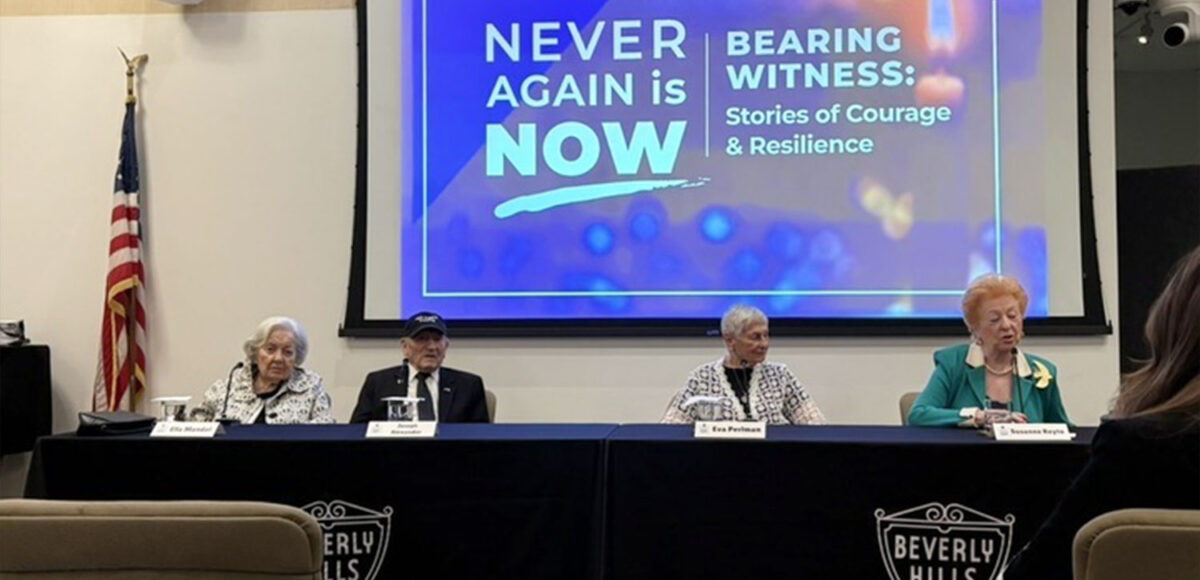
Four Holocaust survivors shared their stories and hopes for the future in a panel discussion at Beverly Hills City Hall on Jan. 20.
The event, part of Mayor Sharona Nazarian’s “Never Again is Now” initiative, was focused on bearing witness to the horrific events of the Holocaust and World War II. It was co-organized by student advocate Eleanor Samuel and moderated by Frank Mottek, the host of KABC’s “Mottek on Money.”
“Tonight’s program is … a call for all of us to come to action,” said Nazarian. “We’re living in a moment when hatred, antisemitism, dehumanization are once again being normalized in ways that are deeply, deeply troubling. We do this to educate. We do these events to educate so such atrocities never happen again to any race, religion, culture or background.”
Mottek began by asking each panelist to share their interpretation of the meaning of “bearing witness” and their story of living through the Holocaust.
Panelist Susanne Reyto spoke first. Born in 1944 in Hungary, Reyto entered the world just six days before the Nazi invasion of her country. She and her mother were still in the hospital when the Nazis arrived and established their headquarters on the hospital’s grounds. Reyto and her family eventually immigrated to Australia.
“It was very difficult, but we had no choice,” she said. “We had to learn a new language. We had to learn a new way of life, and coming from totalitarianism to freedom is not so easy … however, [we learned] to deal with it and knowing what my parents had gone through, the learning lessons of resilience, hope and after surviving, thriving and really doing as well as one can.”
The next survivor to speak, Eva Perlman, shared her story of being born eight months before Hitler came to power. Perlman described her family’s survival as the result of “absolute miracles.” Her family soon moved to France but still required help from neighbors.
“We owe our lives to many non-Jewish people who helped us,” she said. “Any non-Jew in whose house we lived, whether they were our landlord or landlady, risked their lives by sheltering us. No Jew could survive in Europe unless we had help from non-Jews. So, I’m eternally grateful to some of the people in my life.”
Panelist Joseph Alexander, who turned 103 in November, survived 12 concentration camps, including Auschwitz and Dachau. Born in a small town in Poland, Alexander and his family fled after the Nazis invaded and forced many Jewish residents to leave. They were later sent into the Warsaw ghetto, where Alexander lived for six months.
“You can’t even imagine the life of the ghetto, how terrible, how bad it was,” he said. “You walked out in the morning, was dead people on the streets, on the sidewalks, everywhere.”
Eventually, Alexander was sent to a concentration camp and moved “from one camp to another,” he said, until he finally landed in Auschwitz, where he narrowly missed being sent to the gas chambers. His group was divided into two lines, and when a guard wasn’t looking, Alexander ran to the other line.
“I didn’t run back to the other side, I wouldn’t be here talking to you tonight,” he said. “The people [in the other line] went straight to the gas chamber.”
Finally, panelist Ella Mandel, born in 1926 in Poland, shared her story of being 13 years old when the Nazis invaded and closed the Jewish community off in a ghetto with barbed wire. Mandel described a horrific day in which her family and neighbors were called to the cemetery by the Nazis for what was called a “selection.”
“‘Selection,’ where Jews were involved, would always be sad, sad, very sad,” she said. “As we got to the cemetery, they picked the small children, put them against the wall, in every child’s face, head, a bullet. We started crying and screaming, ‘What are you doing?’ They said, ‘Deutschland, Germany has no room for children, no room for grandparents. All those are going to be shot and left in the cemetery.'”
Among those murdered was Mandel’s 9-year-old sister.
The panel closed with each survivor’s story of coming to America and their hopes for future generations.
“If … the young generation was able to … be informed enough and feel strong enough to withstand all the hatred and to stand up to the bullies, perhaps you can eliminate some of the hatred around us,” said Reyto. “And it’s only doing it every day, and we can never give up, because we never know what tomorrow brings, and we have to prevent the worst things from happening.”