Metro Station Art Inspired by Beverly Hills

Representatives from the Los Angeles Metropolitan Transit Authority (Metro) presented an update on the progress of the Metro D Line Extension project at the Beverly Hills Traffic and Parking Commission’s Feb. 5 meeting.

Metro staff apprised commissioners on the status of construction at two stations that will open in Beverly Hills: one at Wilshire and La Cienega boulevards, and another at Wilshire Boulevard and Reeves Drive (Beverly Drive Station).

The extension project is being completed in three sections. The Wilshire/La Cienega Station is part of Section 1, and the Beverly Drive Station is part of Section 2. Section 1 also includes new stations at Wilshire Boulevard and La Brea Avenue, and Wilshire Boulevard and Fairfax Avenue. Construction for Section 1 started in 2014. Work on Section 2 got underway in 2018.

According to Metro, work on the Wilshire/La Cienega Station, which is expected to open this quarter, is near completion. The restoration of utilities between La Cienega Boulevard and South Hamilton Drive was finished in December 2025, and restoration on the south side of Wilshire Boulevard is “substantially completed,” according to a report written by city staff.

This month, Metro anticipates completing the replacement of curbs and gutters both north and south of Wilshire Boulevard in the area that has been under construction. Ramps along several parts of Wilshire Boulevard are also expected to be removed.

“Section one is very, very close to opening,” said Beverly Hills Project Manager Christine Chung at the meeting. “Metro CEO will be announcing the official date when determined.”

The Beverly Drive Station is expected to open in spring 2027. Construction on the station resumed on Jan. 2 following a holiday break, and crews are currently working on both the interior and exterior of the station, including the escalator and elevator shaft, stairways and walkways, plumbing, and electrical work.

Metro is also currently working on preparations to reopen North Canon Drive at Wilshire Boulevard by March 14. An existing soundwall has been removed as part of that effort.

Going forward, Wilshire Boulevard between Crescent and El Camino drives will be maintained as two lanes in each direction between the hours of 9 a.m. and 4 p.m. and may be reduced to one lane in each direction overnight.

According to the same report written by city staff, miscellaneous utilities work, including sewer mains, manholes and water main connections are substantially complete.

The art that will be featured in the Wilshire/La Cienega Station was deeply inspired by the city of Beverly Hills.

Artist Mariana Castillo Deball collaborated with one of the lead paleontologists during excavation for the Wilshire/La Cienega Station. According to Clare Haggarty, the director of public arts and design at Metro, the land for that station produced more fossils than any other area.  Deball utilized the recovered relics for fossil rubbings which she then included in her station artwork.

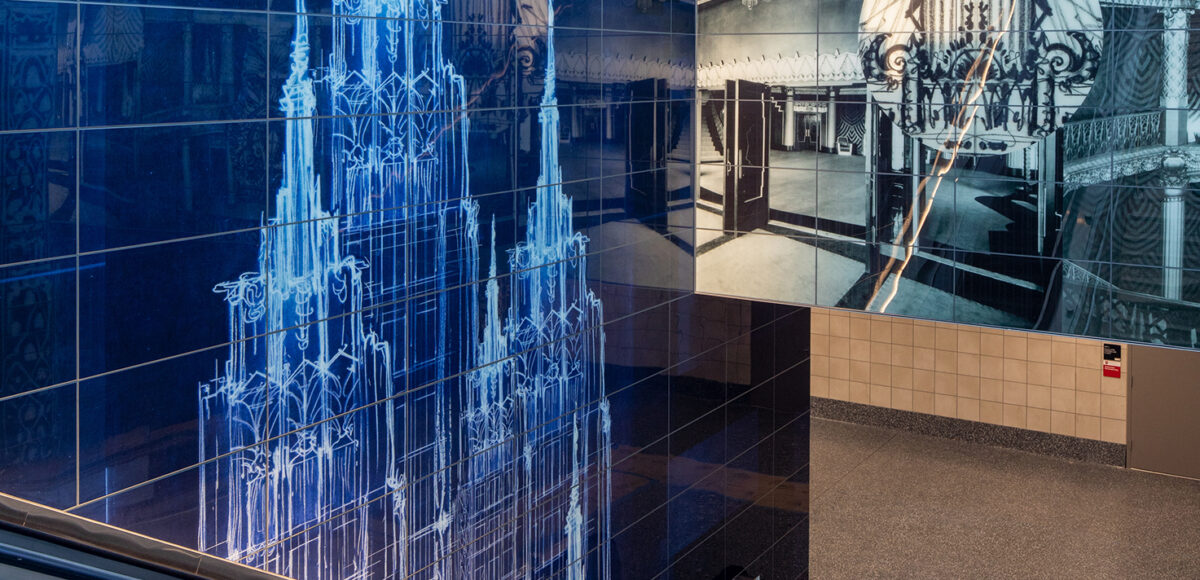
Artist Todd Gray, inspired by early designs for the Saban Theatre, created pieces for the entrance of the station intended to conjure the idea of a blueprint and descending into a theatrical space.

The entrance of the station will feature artwork by Devon Tsuno, a fourth-generation Angeleno whose grandfather worked as a gardener in Beverly Hills for 30 years. Tsuno’s piece depicts azaleas and other plants descending along the escalator walls into the station, inspired in part by his family history.

“A lot of azaleas were planted in gardens here that his grandfather had a hand in,” said Haggarty. “So, it has a really personal connection to the artist.”

Other contributors were inspired by historical elements of Beverly Hills, the people who live and work in the city and the city’s theaters and connection to the world of cinema.

Commissioners expressed their endorsement of the visual components of the upcoming station.

“I’m truly blown away,” said Commissioner Michael Karric. “It’s really impressive, just how much thought and just how intentional it really is in conjunction with the actual station. The fossils—that’s incredible. I can’t wait to tell people about it when I’m waiting for the train … I can’t express how excited I am about it. Thank you for all your hard work and everything you do to make the Metro feel like a place that’s welcoming and safe and interesting.” Commissioner Negar Kamara echoed Karric’s sentiments.

“This was absolutely fascinating,” she said. “I am so impressed by all the diversity, the people, the artists, the artwork, you know, from history to the vegetation to the community and the people in our community.”

Sections 1 and 2 of the Metro D Line Extension project are funded largely through federal grants and Measure R, which was approved by voters in 2008. The entire extension will cross nine miles of the city when it’s complete, starting at the Wilshire/Western Station and ending at the Westwood/VA Hospital Station.

Post Tags