
“The Bride” is a fever dream written and directed by Maggie Gyllenhaal. A mash-up of styles, genres and other films, it’s as though Mel Brooks, the Marx Brothers, Busby Berkley and James Whale were poured into a cauldron and came out as a Dada project directed by Salvador Dali. She references all of them and more in this chaotic blowout of a delicious movie about everything and nothing.
A warning is given. Mary Godwin Shelley appears on screen, back from the dead, to announce her disappointment in her early demise (poetic license because she died in her 50s) and her unfinished work—she had intended to write a companion piece to Frankenstein, pun intended, one that would be entirely from the female perspective. After Mary’s onscreen warning of what’s to come, we are transported to Chicago in the 1930s. The city is owned by Lupino, the gangster controlling all the rackets and cops in town. He does not cotton to women with big mouths and the jars behind him attest to his dislike of mouthy women. Ida, a wild thing, unapologetic of her sex, both gender and employment, has run afoul of the big boss. Slapped around by his henchmen, Ida takes a fatal fall and is hastily buried. (Note for those not versed in film history: combine Ida and Lupino and you have the name of one of the first successful female directors in the talkie era.)
Frankenstein, heretofore called Frank, has been wandering the earth for eons, alone and in desperate need of companionship. It is not mere coincidence that his travels have taken him to Chicago where he alights on the doorstep of Dr. Euphronious. He has heard that she is capable of reanimation. She is reluctant to try again because all previous successful experiments had been on animals. He is very convincing. First order of business, a not too stiff stiff. Under cover of night, they steal off to the nearest cemetery and dig up a fresh corpse, the recently deceased Ida.
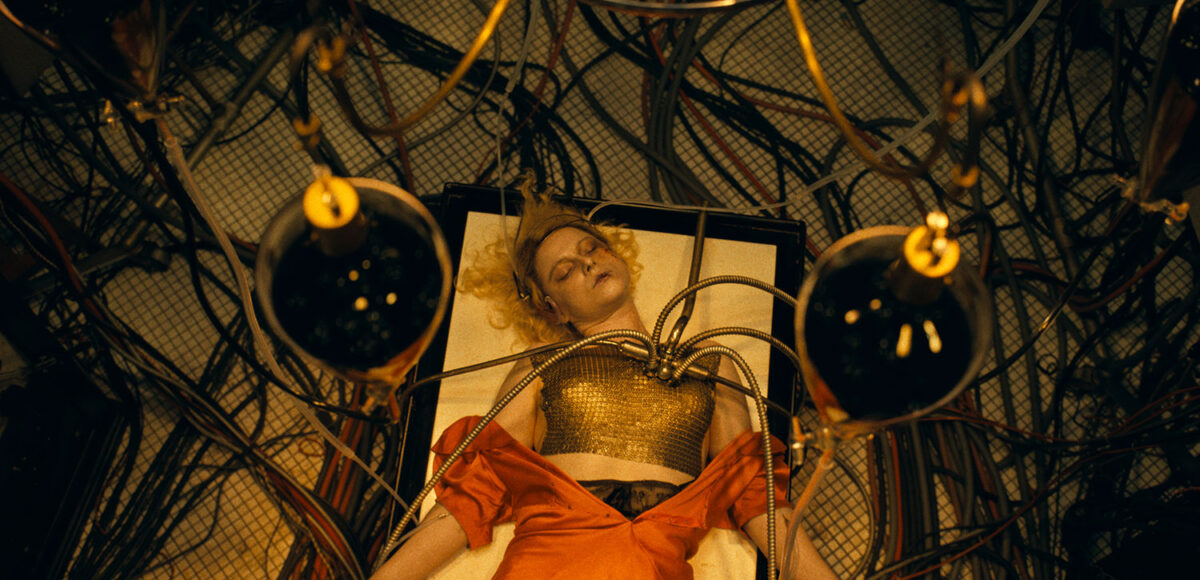
Electrodes and wires akimbo, sparks fly, literally and figuratively, and a recognizable Ida, hair statically enhanced, emerges from the laboratory gurney. The primary side effects, however, are the indigo stains at her mouth and along her arms resembling a Rorschach test gone awry. Still, all in all, not a bad try. Stripped of memory, she can be whatever he, or primarily she, makes her to be. He’ll call her Penelope; she’ll make it Penny, but either way, she’s the Bride.
Arm in arm, emerging from Euphronious’ elegant mansion, Frank wants to take her to the movies. He wants to share his love of screen star Ronnie Reed, the handsome song and dance man. She does not yet understand, but Ronnie Reed is everything Frank wants to be. He daydreams himself on screen mimicking the dance steps and melodies of his hero (think Peter Boyle as the monster with top hat and tails, performing “Putting on the Ritz” in “Young Frankenstein”). Ronnie Reed and the Bride are Frank’s Achilles’ heels.
They are, to say the least, an unusual looking couple and, inevitably, attract the wrong kind of scrutiny. Frank has always had a hard time gauging his own strength and the body count begins to rise. Running afoul of the law, they take it on the lam, stealing a car and capturing the imagination of the public following their exploits in the news. Detective Jake Wiles and his intrepid secretary/assistant Myrna Malloy (as in Myrna Loy, the box office queen in the 30’s) are on the case but always a step or two behind. The wily Wiles knows, however, that Frank will be stopping at every theater showing a Ronnie Reed movie along the way and begins to track him by the movies playing along their escape route.
Penny is the catalyst, fighting alongside Frank and driving the getaway car. Her independence and “take no prisoners” approach has lit a fire in women across the country who copy the indigo pattern on Penny’s face and chant “Me Too, time’s up.” They are Bonnie and Clyde on no particular mission. Their relationship has been growing and Penny, now devoted to Frank, is willing to make it legal. Forces are combining to thwart their plans.
Gyllenhaal has made a film of sound and fury signifying nothing, but that is, in a way, her point. She has mashed everything up and doesn’t stay on one thing too long. Yes, there’s a momentary feminist bent but this is an entertainment not a diatribe. The adventures of Frank and Penny, whose true identity eventually becomes known as they are chased not just by the police but by Lupino’s men as well. They skip merrily from one misadventure to another, growing closer as the chaos increases. They are partners in crime and love and what Dr. Euphronious has joined together, let no man cast asunder.
Although criticized by many for its meanderings and stunted themes lacking in development, I would propose that this is exactly the point. Feminism may be a somewhat undeveloped undercurrent but “The Bride” is pandemonium and an homage to many of Gyllenhaal’s favorite things. I have caught a few of the obvious homages like Ida Lupino and Myrna Loy, but there are, no doubt, many others. The color palette is frighteningly bold, with its primary colors bleeding off the screen. The playlist is a mishmash of songs, old and new, from the canon of 30’s hits like “I’ve Got a Feeling I’m Falling” and punk rock songs from Fever Ray to the occasional dip into Schubert. Stay for the end credits and be treated to the song you knew had to be coming. Hildur Guđnadóttir has created a punk score that both mirrors and contrasts with the mood on screen.
Costuming by three-time Oscar winner Sandy Powell contributes to the bright and messy themes. Production designer Karen Murphy has created a specific time and place set that locates the film in the here and now of the era using the saturated tones chosen by Gyllenhaal. Cinematographer Lawrence Sher blends the real with the surreal.
And what a cast! Jessie Buckley is Ida/the Bride/Mary Shelley and carries this hodge podge on her often bared shoulders. Christian Bale, as you’ve never seen him, plays the subdued Frank awakened by his love for the Bride, a somewhat reluctant Clyde Barrow to her shoot from the hip Bonnie. Annette Bening is the easily convinced Dr. Euphronious and Jeannie Berlin is her hilarious maid and Igor-figure Greta stealing everything but the wall paper. Jake Gyllenhaal, Maggie’s brother, plays the movie god Ronnie Reed, seen primarily in on-screen movie clips doing his own singing and dancing. There may be something more than transference in Frank’s idolization of this star. The sympathetically crooked Detective Wiles is Peter Sarsgaard, Maggie’s partner in real life; his assistant, the lovely Myrna Malloy is played by a luscious Penelope Cruz.
Initial box office returns indicate that “The Bride” may not be everyone’s cup of tea but it was mine and time will tell if this worthy film might gain more traction in cult status as people gradually catch on to the joke.
Now playing at The Grove and other theaters throughout Los Angeles.
Neely Swanson spent most of her professional career in the television industry, almost all of it working for David E. Kelley. In her last full-time position as Executive Vice President of Development, she reviewed writer submissions and targeted content for adaptation. As she has often said, she did book reports for a living. For several years she was a freelance writer for “Written By,” the magazine of the WGA West, and was adjunct faculty at USC in the writing division of the School of Cinematic Arts. Neely has been writing film and television reviews for the “Easy Reader” for more than 10 years. Her past reviews can be read on Rotten Tomatoes where she is a tomatometer-approved critic.