
“Peaky Blinders: The Immortal Man” is a continuation of “Peaky Blinders,” one of the most outstanding series of recent years, which spanned six seasons in the life of a Birmingham, England, gangster organization known as the Peaky Blinders. Run by the Shelby family, whose Romany (Gypsy) and Irish origins made them outsiders on multiple levels, it was a status they embraced. Arthur Shelby, the eldest, bedeviled by uncontrollable anger issues and mental illness, was passed over for leadership in favor of younger brother Tommy. Like any good godfather, he schemed to increase the family’s power, wealth and eventually, he hoped, legitimacy. Although he succeeds beyond his imagination with riches beyond measure, a foothold in various legitimate businesses, and a wife and children, he is also surrounded by death; death of his daughter Ruby, death of his beloved Aunt Polly and numerous other friends, relatives and business associates. Keeping current with the times, the series drew in their ties to the Boston Irish mob, the IRA and Oswald Mosley’s fascists before Tommy rode into the sunset, leaving Birmingham better than when he started. The main question to be asked is whether one needs to have seen the series to appreciate the film. Although an acquaintance with the original might add background, this movie stands on its own.
“Peaky Blinders: The Immortal Man” opens several years after the series ended. World War II is raging and the Nazis are making a full court-press on the Brits, the last holdouts against the Germans in Europe. They are bombing London in a blitzkrieg of terror and destroying factories all over Britain, specifically targeting those supporting the British war effort. Meanwhile, in Germany, Hitler has come up with an ingenious plan, one that was actually put into practice: more than 100 million counterfeit pounds were created in a ploy to destroy the economy of Great Britain and thus cause a bloodless capitulation (this plan almost succeeded). John Beckett, a member of Moseley’s British Nazi party, has been chosen to lead the effort and carpet Britain with the fake money. (There is no indication that the real John Beckett, a leading member of the British Nazi party, was involved with the counterfeit scheme.)
Tommy, long retired to his country estate with only Johnny Dogs as a companion, is haunted by the past, especially the night terrors of his experience in the trenches of World War I, and the death of his daughter Ruby, who succumbed to tuberculosis. He wants nothing to do with the past or the here and now. He left the Peaky Blinders life behind and has no interest in what has become of them. Whether aware or oblivious, the Peaky Blinders found new, violent life under the leadership of Tommy’s son Duke, born of a youthful dalliance with a Romany lover. With his other son fighting at the front, Duke has been leading a gang of violent miscreants in terrorizing the town anew and stealing whatever they choose with the blessing of crooked politicians and police. When they hijack a shipment of weapons, Duke’s Aunt Ada, now a well-liked politician and MP, has had enough. Driving into the countryside, she pleads with her brother to return and set things right. The people still revere him but are terrified of his son. Her pleas fall on deaf ears. Tommy cannot be moved.
Duke’s audacious activities have not gone unnoticed by John Beckett. Clearly Duke, unmoved by patriotism or compassion of any kind, is an excellent choice to move the counterfeit money into the mainstream. The enticement he offers, a healthy cut of the profits, is too good for the amoral Duke to pass up. They strike a bargain and the stage is set for a collision of murders, crimes and loyalty that will finally bring Tommy back to Birmingham.
Stephen Knight, creator of the original series and writer of the film, has found a way to blends in most of the original elements, many of the original characters and create an engrossing real-life plot that often leaves you on the edge of your seat. The tone is somber, the action moves forward at an alarming pace, the villains, although a bit too black and white, are identifiable and loathsome. Knight weaves in just enough fact-based activity that the film remains somewhat grounded. There was such a Nazi plot, as recounted brilliantly in the 2007 Austrian film, “The Counterfeiters,” directed by Stefan Ruzowitsky. Oswald Mosley was the leader of the British Union of Fascists, a party he created that espoused anti-Semitism and sought alliances with Mussolini’s Italy and Hitler’s Germany. That he was or was not involved in the counterfeit plot is immaterial; he very well could have been. The plausible non-fiction elements of the plot blend nicely with the fictional ones.
Loaded down with the kind of violence and explosions endemic to the original series, they are, nevertheless, organic to the plot and the characters. Director Tom Harper keeps the pace moving at a fast, sometimes almost too fast, clip. The cinematography of George Steel and Ben Wilson is effectively grimy, muddy and evocative of the frozen temperatures and barren landscapes. Production designer Jacqueline Abrahams and costume designer Alison McCosh contribute beautifully, perhaps not the right word, to this realistic period piece with the bombed-out buildings and the tattered clothing caked in mud. The punk score by Antony Genn and Martin Slattery adds to the thumping action of the characters, underscored by the resurrection of Nick Cave’s “The Red Right Hand,” used so prominently in the series as the musical theme of Tommy Shelby.
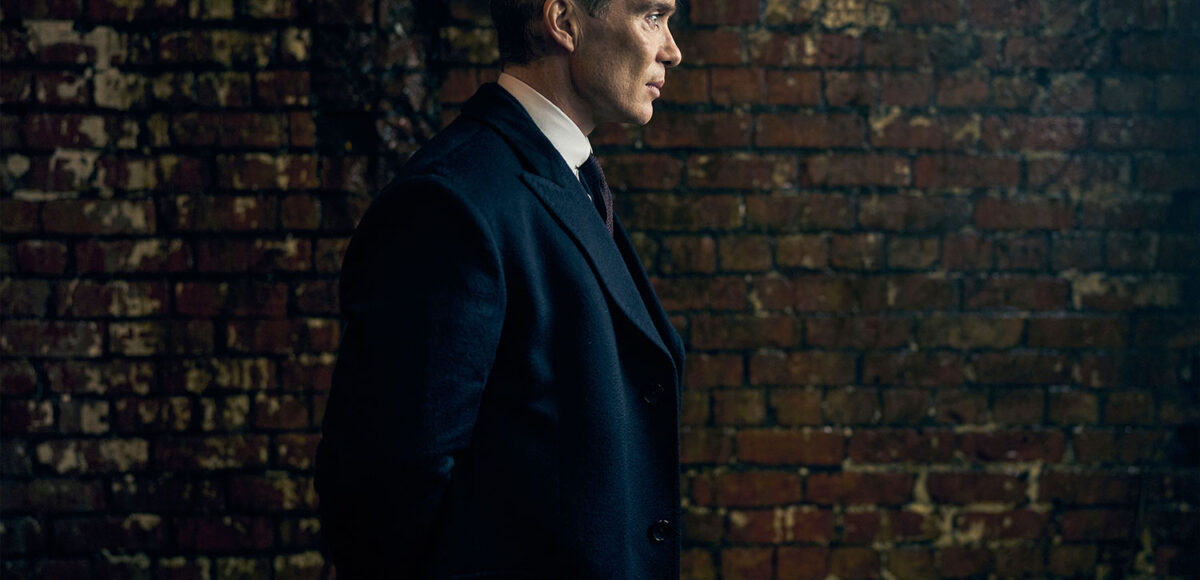
Knight and Harper have assembled a cast worthy of the film. The extraordinary Cillian Murphy brings a melancholy and resolve, along with the uncanny ability to engender sympathy for a character whose cursed life has been conducted on the wrong side of society. Seeing his careworn and haunted face up close is one of the best reasons to see this film on the big screen. His beauty is offset by the pain in his eyes. Murphy is an actor whose every feeling can be expressed in the twitch of an eyelash or the tight grimace of his lips. His criminal son is played effectively by Barry Keoghan with the dimness he showed in “The Banshees of Inisherin” and the cagey immorality of his character in “Saltburn.” He revels in criminality and shows only snatches of consciousness. He’s not what you’d consider a rooting interest, as one had for the Tommy Shelby of yore, but he has just enough mystery to keep you guessing. Several of the original characters from the series appear, most notably Sophie Rundle as Ada, Stephen Graham as Hayden Stagg, a former antagonist turned ally, Ned Dennehy as Charlie Strong and Ian Peck as Curly, as Tommy’s past loyal henchmen, but most are there as recognizable place markers. Rebecca Ferguson is the Gypsy seer and twin sister to Tommy’s first love, long dead, and Duke’s aunt. Her character is a plot pusher, there to remind the audience that Tommy has Gypsy origins and believes in the curses and forecasting so important to that culture. Tim Roth is the villain John Beckett, and although it is always a pleasure to see Roth on screen, Knight has cast him in black and white without any shading. One expects him to twirl his non-existent mustache for effect.
See this on the big screen where all the colors, emotions, and visuals are heightened.
Now playing at the Alamo Drafthouse downtown, the Landmark Sunset 5 or the Egyptian in Hollywood. Streaming on Netflix beginning March 20.
Neely Swanson spent most of her professional career in the television industry, almost all of it working for David E. Kelley. In her last full-time position as Executive Vice President of Development, she reviewed writer submissions and targeted content for adaptation. As she has often said, she did book reports for a living. For several years she was a freelance writer for “Written By,” the magazine of the WGA West, and was adjunct faculty at USC in the writing division of the School of Cinematic Arts. Neely has been writing film and television reviews for the “Easy Reader” for more than 10 years. Her past reviews can be read on Rotten Tomatoes where she is a tomatometer-approved critic.