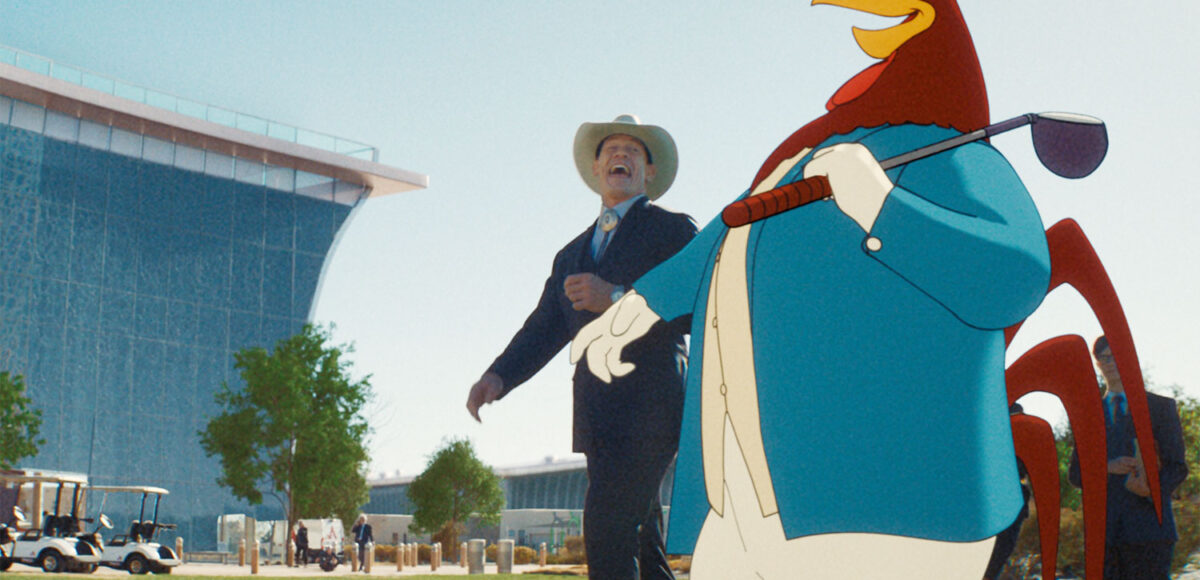

Prepare to laugh out loud at the antics of your favorite Looney Tunes characters, particularly Wile E. Coyote and his nemesis the Road Runner, and their straight-faced human counterparts in this live-action/animation hybrid as they pull you into a David and Goliath courtroom drama in “Coyote vs. Acme.”
The travails of Wile E. Coyote, the self-described genius, in his hunt for the Road Runner always ended in failure when the defective Bondesque devices he used to outwit the clever desert fowl invariably resulted in his bodily harm. There were the pianos incongruously falling from the sky onto him in the desert or the rocket-powered roller skates meant to propel the devious canine at supersonic speeds to catch said bird. All failed in disastrous ways and all were produced by the Acme Corporation. He died what should have been a thousand deaths, but, hey, he’s a cartoon, so he shook off the 200-foot plunge or survived that head-on collision with a truck to chase again. But he’s getting older and rebirth isn’t what it used to be. When he spots a billboard advertising the services of personal injury lawyer Kevin Avery, whose tagline is “Injured by a Falling Piano?” he knows he’s found his guy. Avery specializes in cartoon injuries and promises settlements that are fast and easy.
Wile E. arrives at the storefront office of Avery, Maltese and Jones in downtown Albuquerque. Wile E., their new client, dangles his defective Acme Corporation rocket-powered skates that were uncontrollable and caused grievous bodily harm. Kevin has handled hundreds like this and pulls out a prefab contract offering $50 on the spot, his pro forma agreement with Acme. Dubious and unimpressed, Wile E. presents the proverbial bottomless cartoon box full of failed gadgets. He wants his day in court, something that might be a bit difficult because he communicates with signs, as in poster boards on sticks, and he only has a few, a sight gag gift that keeps on giving. It is Paige, the office intern and Kevin’s niece, who pushes Kevin to take a meeting with Acme. His law school nemesis, Buddy Crane, leads Acme, and his long-ago taunts have never been forgotten or forgiven.
Seated in the luxurious meeting room atop the high-rise offices of Acme, Buddy and his associate Bill Pelicanos smirk, knowing that Avery has never won a case. Faced with Wile E.’s box of evidence, Crane smiles and hands Avery his best and only offer, $50,000. Avery is elated; not so his client. They’ll be going to court. Avery faces this decision with dread. Avery and Associates will be facing off against the leading corporation in town, nay, the country! Discovery will be almost impossible because past settlements are off the table and many of the injured have been sequestered out of sight. It is no coincidence that Daffy Duck is in a Looney bin. Bugs Bunny is their Deep Throat leading them to a topsecret Acme program called “Project Sisyphus.” Paige, the only one who paid attention in school, explains to the Avery group that Sisyphus was a mortal that Zeus condemned to pushing a rock up a hill only to have it roll down again, necessitating a push back up the hill, ad nauseam, or at least for eternity. This is the very definition of a cartoon character’s life, condemned to do the same thing over and over, always expecting a different outcome, always coming close but never achieving liftoff.
It’s the knowing references that really take this “kids’ movie” into the adult realm. Starting with Kevin’s law firm, Avery, Jones and Maltese named after the three men instrumental in the creation of Looney Tunes and, specifically, the Coyote and Road Runner series (Tex Avery, Chuck Jones and Michael Maltese). This is basically a courtroom drama where the underdog faces the well-financed, corrupt corporation and its team of more successful and infinitely better-funded team of lawyers. Kevin is Paul Newman, the down-on-his-luck lawyer turning down a lowball settlement offer to take on the medical establishment in “The Verdict.” Or this is Paige as Erin Brockovich urging her boss to look beyond the obvious and see a conspiracy; or Bugs Bunny as Avery’s Deep Throat leading him to uncover the corruption behind Operation Sisyphus. We’ve been given a cartoon box-full of sly references, including the choice of location, a tip of the hat to Bugs Bunny who, when facing danger, would say, “I shoulda turned left at Albuquerque.”
Director Dave Green and writer Samy Burch adapted Ian Frazier’s original 1990 humor piece in “The New Yorker” entitled “Coyote vs. Acme” to a polished gem. The casting is pitch perfect and they all played it straight, no wink winks, making it all that much funnier. Will Forte makes his journey from loser to winner absolutely endearing. Martha Kelly as Dottie Jones is hilariously deadpan and John Cena, Buddy Crane, is a cartoonishly evil lawyer. In a tiny but noticeable role, Nancy Linehan Charles has a great moment as the suspicious motel clerk refusing to rent a room to the Coyote, claiming that they don’t allow pets. Kevin disabuses her of that notion, revealing for the first time that a real lawyer lies beneath that sad sack exterior.
You might notice that this film was distributed by Ketchup Entertainment. In a truly head-scratching moment, Warner Bros. management originally shelved the completed film, choosing to take a tax write-off for it instead. The uproar could be heard all the way to the proverbial Albuquerque. “We’re moving in a different direction” was the explanation given by the new management. David Zaslav made the shelving one of his first moves as the new head of Warner Bros. Discovery. With lame-brained artistic and financial moves like this one, it’s no wonder he thought the best way out of the company’s economic woes was to sell the storied studio to Paramount, in effect shelving the entire enterprise. There’s a reason that the opening credit reads, “A Warner Bros. Pictures Production, a wholly owned subsidiary of Acme Corporation.”
Now playing at the AMC Century City among other theaters.
Neely Swanson spent most of her professional career in the television industry, almost all of it working for David E. Kelley. In her last full-time position as Executive Vice President of Development, she reviewed writer submissions and targeted content for adaptation. As she has often said, she did book reports for a living. For several years she was a freelance writer for “Written By,” the magazine of the WGA West, and was adjunct faculty at USC in the writing division of the School of Cinematic Arts. Neely has been writing film and television reviews for the “Easy Reader” for more than 10 years. Her past reviews can be read on Rotten Tomatoes where she is a tomatometer-approved critic.