
Erika Fabian, a Hungarian Holocaust survivor, escaped the Nazis through the ingenuity of her mother and sister, and through the assistance of neighbors and friends. Since immigrating to America in 1956, she obtained a master’s degree from UCLA and became a renowned photojournalist and actor.
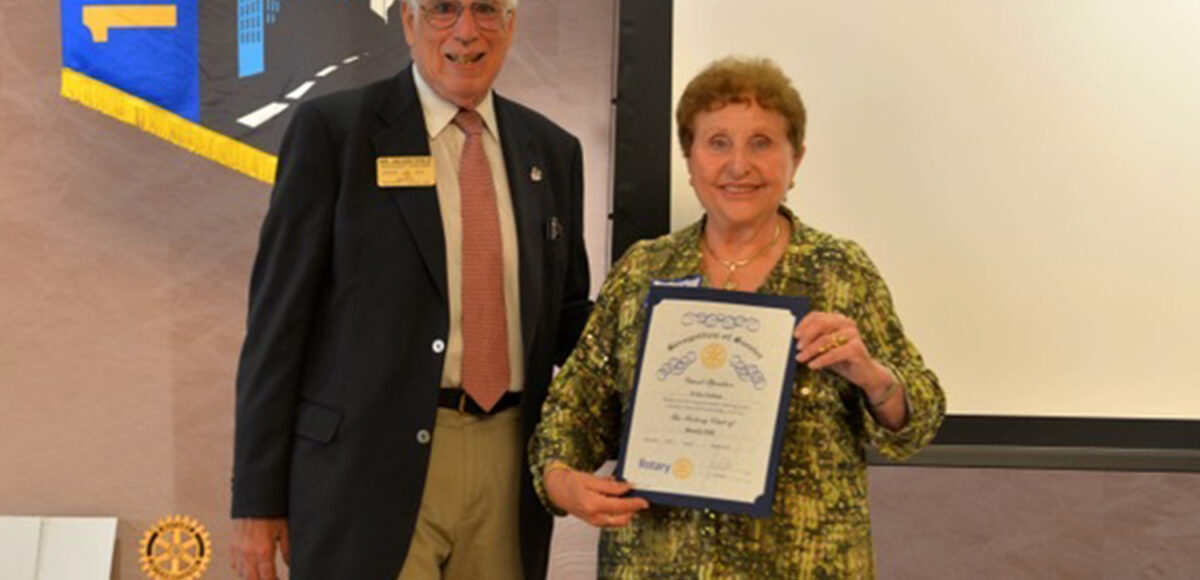
Fabian has authored 26 books. On Aug. 4, she shared her story with the Rotary Club of Beverly Hills.
“I’m truly honored to be invited to be your speaker today,” she told members of the club. “The story I want to tell you is not easy, but it has obviously a very positive ending.”
Fabian’s story begins at dawn when she was four years old. Jolted awake by banging on the door, she and her mother and sister stalled as others in their building were led outside by the Nazis. When the banging stopped, a neighbor informed Fabian’s family that he told the Nazis Fabian’s family had already left their apartment.
“He said, ‘I’m the one who told the Nazi that you had left already. That’s why they stopped banging on your door,’” Fabian said. “So, he saved our lives.”
From there, the family went to a safe house, and within days, they fled to a friend’s house who worked as a doctor. He was able to secure spaces for Fabian and her sister in a hospital, pretending to be sick children, while their mother went to get false papers. Those papers would identify them as Christians.
At first, the plan worked; Fabian and her sister stayed in hospital beds entertaining one another with stories. But by the third day, the Nazis came for all the children in the hospital.
“We put our shoes on, went downstairs, all of us, sick, young, older, didn’t matter,” said Fabian. “We were lined up against the wall of the building outside the building with Nazi officers in there. We knew they were Nazis because they wore their black uniforms and boots … when all the kids were out of the building, they were told to start walking.
“And as we started to walk, it was pitch dark. It also started to rain. So, we walked and walked through the city and getting more and more wet. And finally, I said to my sister, ‘I can’t carry my briefcase anymore. I’m too tired. I’m just going to sit down over here and rest.’ She said, ‘Don’t you dare.’ She picked up my briefcase and said, ‘I’ll carry it for a while.’ We also knew that the kids who sat down—we heard what sounded like bangs—and we figured it must have been gunshots. And we figured the kids who sat down were shot.”
The children were herded into another building, but once again, Fabian and her sister were rescued at the last minute. The following morning, a man dressed in a Nazi uniform came to the door calling their names.
At first, Fabian said, she didn’t want to go.
“I said to my sister, ‘He’s wearing a Nazi uniform, he’s going to kill us. Let’s not go. He doesn’t know where we are,’” she said. “And my sister said, ‘Don’t be stupid. We’re the only ones he’s calling. Get up and let’s go.’”
The choice was the right one. The man in the Nazi uniform was an actor, commissioned by the same friend who set the children up in the hospital. After leading them through the streets of Budapest, he took them into a building where they reunited with their mother.
“My mother was there, and this always makes me feel like crying,” Fabian said. “My mother looked, hugged us, and then she went outside and notified this young Nazi that we were with her, and he left.”
Fabian and her sister were given new birth certificates with Christian names. Her mother made them memorize them as well as the Christian version of the Lord’s Prayer.
Fabian stayed in Hungary with her family until 1956, when they moved to America. She had a prodigious career as a photojournalist and has shared her story widely.