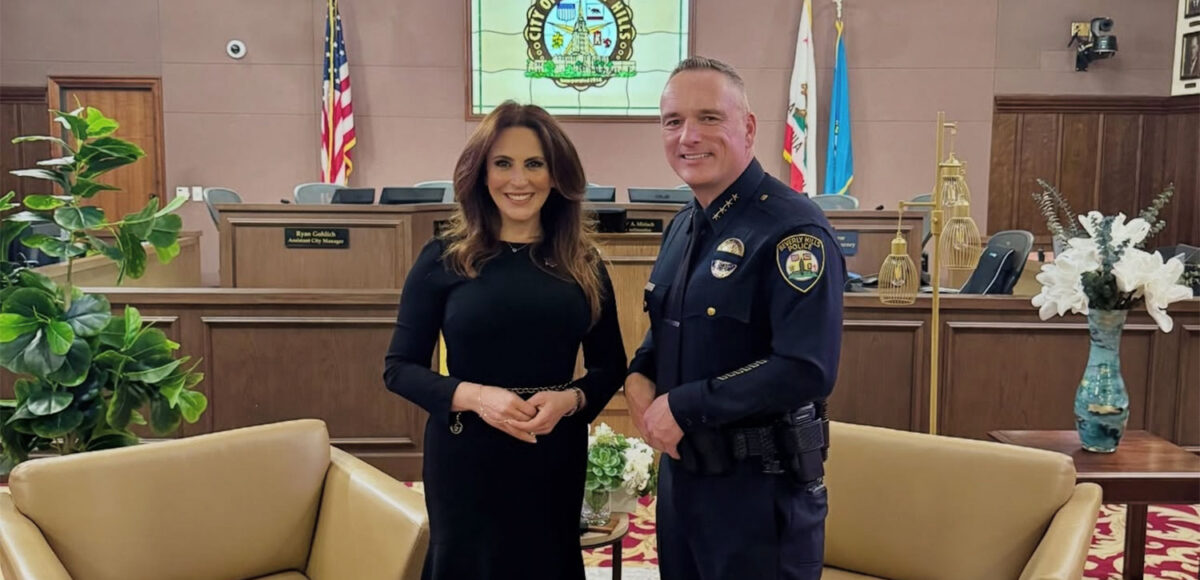

Beverly Hills Mayor Sharona Nazarian emphasized her commitment to public safety when she took office in the spring. She expanded upon her vision this week during a conversation with Beverly Hills Chief of Police Mark Stainbrook.
The conversation, held at the City Hall Council Chambers, was the sixth installation of “Straight Talk with Sharona,” one of Nazarian’s mayoral initiatives intended to open a dialogue with members of the community.
During the event, Nazarian and Stainbrook discussed the organization of the Beverly Hills Police Department (BHPD); existing and future safety plans for the city; evolving technologies and more. They also took questions from the audience.
Stainbrook explained that the department is staffed by nearly 250 people, including roughly 140 officers and 100 civilian employees. Their budget is about $100 million annually, with a ratio of approximately 4.8 officers for every 1,000 citizens.
“It’s a very high ratio compared to other departments,” said Stainbrook.
Some of the department’s staff works closely with schools and houses of worship to ensure that they are protected in their day-to-day activities and are prepared in case of an emergency.
Schools in the Beverly Hills Unified School District (BHUSD) have full-time, contracted security personnel. BHPD also sends its own officers annually to review the buildings’ layouts and develop response plans to emergencies should the need arise. Two full-time school resource officers at BHPD, who are experts on juvenile law, are tasked with liaising with the schools as well.
“I feel like we have a good, close working relationship with the schools,” said Stainbrook.
Many Beverly Hills residents have expressed concern about safety issues that may stem from Metro stations slated to open in the city, the first of which is expected to begin operations at Wilshire Boulevard and La Cienega Boulevard in 2026. Stainbrook said that all city departments are engaged in, and working to address, those concerns.
“It’s not just a police problem or initiative,” he said. “The whole city is working on the Metro station … we have a regular meeting with Metro, and we’re trying to work out all these details before the station opens.”
The station will have a public safety kiosk, which Stainbrook said will be the first and only such kiosk at an L.A. Metro station. Community service officers will staff the kiosk and will have the ability to take reports and patrol the area.
Additional officers will also be dispatched to the area to patrol aboveground, and the city is working on partnerships with other agencies to patrol underground.
Stainbrook said that it’s important to establish the fact that the station will be well-guarded as soon as it becomes operational.
“We want a heavy presence at the Metro station when it first opens to kind of set the tone about security and safety,” he said.
Some of the safety measures that will be utilized at the Metro station rely on the city’s existing technology, including the Real Time Watch Center.
The Real Time Watch Center includes 3,000 cameras positioned throughout the city which are monitored around the clock, allowing officers to respond quickly when help is needed. The city also employs drones and has almost 120 automated license plate readers surrounding the city.
“Our Real Time Watch Center is the envy of the nation,” said Nazarian. “We have so many people wanting to come to Beverly Hills to tour this remarkable space.”
Going forward, the city plans to implement tools that utilize AI to increase efficiency and offer real-time updates to residents when help is on the way. One program, which is currently being tested, will use artificial intelligence to generate reports based on footage from officers’ body cameras, which officers will then review and edit.
Another program will communicate with civilians who have called in non-emergency situations. Updates will include how far away officers are, documents to have ready for when they arrive and follow-up messages to provide feedback.
“All in all,” said Stainbrook, “it should be really interesting.”
Members of the audience raised questions about safety around the new Metro station and various traffic safety concerns.
Attendee Wendy Goldman said she lives in West Hollywood near Doheny Drive and Cynthia Street. She expressed her concern over several car crashes that have happened at the intersection recently.
“The neighbors are in an uproar about this area,” she said. “The traffic people in West Hollywood are telling me that they can’t get cooperation with the other side of the street [in Beverly Hills] … can we possibly find resources, or help me find resources, or tell me who to talk to about this?”
Another attendee who did not offer her name voiced her worry about tourists taking pictures of palm trees in the middle of the road, citing an incident in which a small child ran into the road to get to his mother who was in the middle of the street.
“It’s very, very dangerous … and I hate for tragedy to happen before we put someone there or put cameras or put signs,” she said.