
Agnieszka Holland’s films are always challenging, whether it’s the story she’s telling or the way she chooses to tell it. Her latest is a portrait of Franz Kafka, best known for “The Metamorphosis,” a psychological horror study where the main character awakes one morning to find he has been transformed into a cockroach. Symbolic of Kafka’s feelings of isolation and otherness, this novella, like most of his other works, did not find an audience during his lifetime. Dead at the age of 40 from tuberculosis, he had implored his best friend, Max Brod, to destroy his unpublished writing after his death. Thankfully, he did not or we would never have known the full genius of the man who wrote “The Castle” and “The Trial,” among others.
Holland’s expositional narration works as the film meanders through Franz’s past, present and future, using his contemporaries to expound on their friend’s idiosyncrasies. The shift to modern times, showing guides leading people through Prague and discussing the significance of his work is often jarring, but it mainly serves to juxtapose Franz’s disdain of commercialization with the current monetization of all things Kafka in Prague. But Prague and Kafka are now inseparable, as shown by the city’s most famous sculpture: the magnificent abstract moving stainless steel puzzle of Franz’s head by sculptor David Černý. Holland then returns to Kafka’s rather stultifying daily life. He was, as she shows, overwhelmed by the mundane; something he didn’t seem able to escape.
Embracing Kafka in Prague was a long time coming. Although the Jewish population of Prague was vibrant during his lifetime, it had not always been so. Born in Bohemia, later known as Czechoslovakia, Franz spoke and wrote in German, with a smattering of Yiddish, rather than in Czech, which was not uncommon in the Jewish Ashkenazi population. Like many other places, there was a deep history of antisemitism.
The Kafkas were middle class, but patriarch Herman had higher aspirations. Leaving home in southern Bohemia, he was unwilling to follow in his father’s footsteps as a kosher butcher. Instead he branched out into haberdashery. Herman was a tyrant who disapproved of his son’s writing and would brook no argument. So Franz, who was an excellent student, was forced into law. This led to work in the insurance business, which for him was a suffocating profession he tried unsuccessfully to leave many times. But Franz was good at what he did, and his employers accepted his many absences and lapses because of it. What Franz longed to do was write, finding moments whenever he could. He spent his evenings with friends, Bohemian in both senses of the word, listening to their poetry and stories, occasionally sharing the beginnings of his. They immediately recognized the genius submerged in self-doubt and self-destruction.
His intensity and iconoclastic personality emerged early. He was a man who recognized the absurdity of life but was unable to assimilate. Ambivalent in all things but his writing, he had commitment issues and went from woman to woman in search of intelligence, beauty and daring. He might alight briefly if he found some of those traits, but never, despite a couple of failed engagements, did he find anyone who fulfilled his impossible standards. He haunted brothels and night clubs throughout his short life.
Franz, as recounted by a friend, had the innocent charm of a martyr. A secular Jew, he veered from one religious philosophy to another, declaring that meaning is in the search for God, not in the finding. Franz, the manchild, was depressed, isolated, seemingly friendless despite the men who supported his work and encouraged him to satisfy his artistic needs. They celebrated when he was published and discussed with him his amazing ability to channel his ennui and depression into his writing.
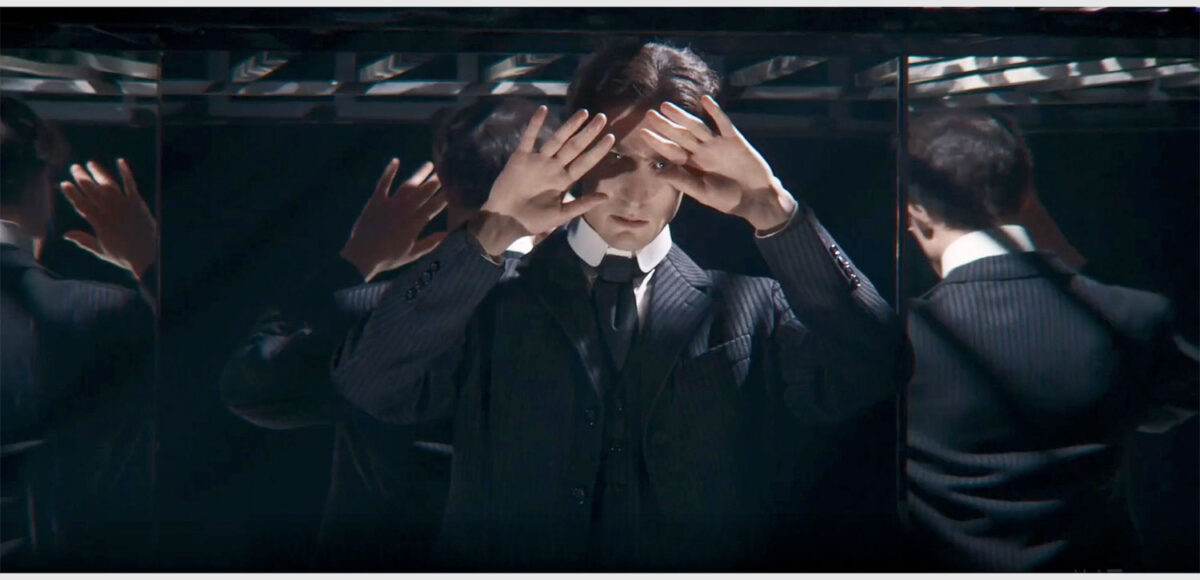
Holland intensifies the restless anxiety that constantly surfaces, underscoring it with the kinds of early German Expressionist camera angles and stark lighting made famous by Robert Wiene in the 1920 classic “The Cabinet of Dr. Caligari.” The dark palette serves to accentuate Franz’s personality and his rather abstract beauty.
The cast is exceptional. Especially notable was Marek Pospichal playing a beggar who gets into an argument with Franz over the money dropped into his tin, revealing a pettiness in him not previously noted. Sebastian Schwarz as Franz’s best friend Max Brod, is used primarily as a tool to push the story forward and tie it to the time period after his death. Peter Kurth played Hermann Kafka as the quintessential German autocrat and bully, making us cringe in terror whenever he opened his mouth. Idan Weiss was the perfect Franz Kafka, both in appearance, he’s actually a dead ringer, and ambivalent narcissism. He holds the center beautifully and brings the audience along with him in his existential journey.
“Franz” gives a rather full picture of this dark, complicated, isolated man whose loneliness was in his imagination. His schizoid existence, juggling his life between his bullying father’s demands and the path he wanted to take, revealed itself in his writing. Holland’s film will make you want to rush out and read his works again, or in my case, for the first time.
In German with English subtitles.
Opening Aug. 28 at the Lumiere Beverly Hills.
Neely Swanson spent most of her professional career in the television industry, almost all of it working for David E. Kelley. In her last full-time position as Executive Vice President of Development, she reviewed writer submissions and targeted content for adaptation. As she has often said, she did book reports for a living. For several years she was a freelance writer for “Written By,” the magazine of the WGA West, and was adjunct faculty at USC in the writing division of the School of Cinematic Arts. Neely has been writing film and television reviews for the “Easy Reader” for more than 10 years. Her past reviews can be read on Rotten Tomatoes where she is a tomatometer-approved critic.