
Beth Kean, the CEO of the Holocaust Museum LA at The Goldrich Cultural Center (HMLA), spoke to the Rotary Club of Beverly Hills at its Aug. 24 meeting. She provided a background of the museum’s founding by Holocaust survivors who wanted to share stories and evidence of their experiences, as well as a look into the future and the museum’s recent $70 million expansion.
Kean explained that her personal interest in the Holocaust stemmed from her grandparents, who were survivors.
“I can’t remember a time where I didn’t know about the Holocaust,” she said. “My earliest memory was probably as a little girl, just seeing a lot of candles on Yom Kippur and wondering, why are there so many candles burning? And just hearing, well, because my family died in Auschwitz.”
HMLA was founded in 1961 by a group of Holocaust survivors who emigrated to Los Angeles and met at an adult education class at Hollywood High School about a decade after the end of World War II. Recognizing one another from their arm tattoos and accents, they soon began sharing their stories.
“For them, this adult English class became more of like a therapy session,” Kean said.
The participants soon realized that many of them had kept letters, correspondence, documents, photographs and other items from before, during and after the war that would shine a light on their experiences. Partnering with the Jewish Federation in Los Angeles (JFEDLA), the group put together an exhibit. After an ad ran in the L.A. Times, 10,000 people attended to see the items and hear the survivors’ stories.
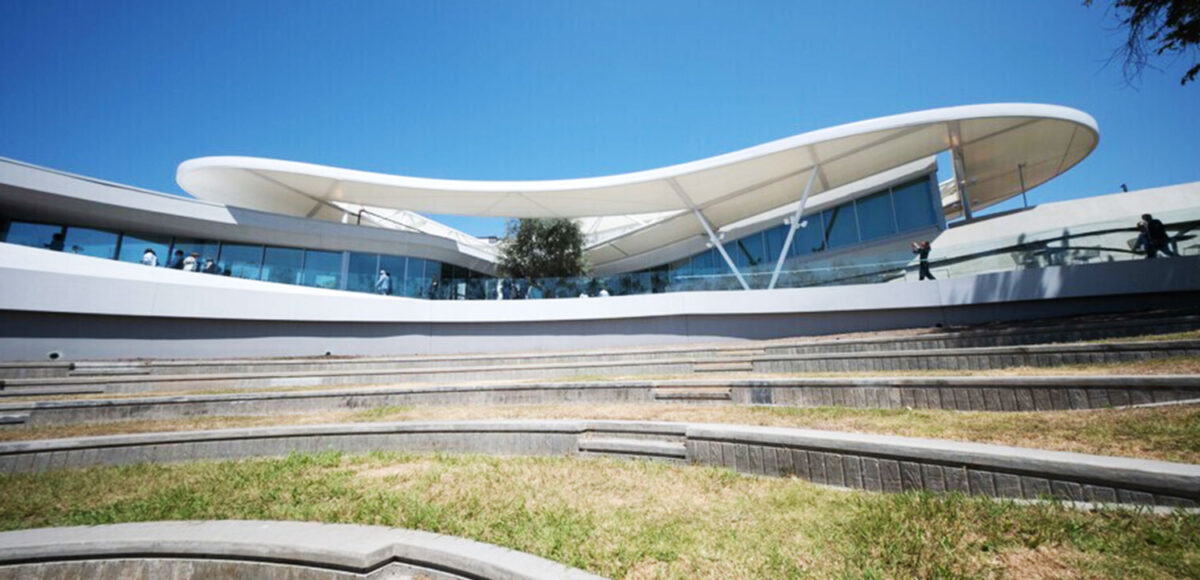
The exhibit was housed in the JFEDLA building and continued to collect artifacts. The collection soon grew to include a memorial in Pan Pacific Park, and in the mid-2000s, the organization decided it was time for a permanent home. Jona Goldrich, a Holocaust survivor, real estate developer and co-founder of HMLA, secured a land lease from the city and Hagy Belzberg designed the building, which is largely underground and built into the landscape of the park.
When Kean came on as CEO, she recognized that demand for the museum’s exhibits and offerings was exceeding their capabilities.
“We were turning away school groups, which was just heart-wrenching,” she said.
The organization conducted a feasibility study in 2019, then received an $8.5 million grant from the state in 2020. Since then, HMLA has raised $66 million towards the expansion project, and expects to open the new site in September. The underground museum is now part of a complex that also includes a 15,000-square-foot above-ground structure.
The complex is named the Goldrich Cultural Center.
HMLA will maintain its mission of education, which focuses on teaching the community, including students, how to stand up and speak out against hate. Noting the recent rise in antisemitism that coincides with the Holocaust survivor population dwindling, Kean explained that the institution is focusing on answering the question, “How are we going to continue to educate about the Holocaust in a post-survivor world?”
During a question-and-answer period, Kean responded to inquiries about how HMLA works together with other local Holocaust museums and Jewish organizations such as the Simon Wiesenthal Center, the Skirball Center and the USC Shoah Foundation, which collects audio-visual testimonies from survivors. She explained that the institutions all work in close collaboration, sharing artifacts and even staff at times.
Kean said that HMLA is the “brick and mortar” for the USC Shoah Foundation’s content, “so when visitors come to our museum—and we can accommodate 500,000 people now with our expanded footprint—they will be able to access all 55,000 survivor testimonies.”
She also said that there is a group called the Los Angeles Antisemitism Roundtable, started in 2022, which meets monthly and consists of HMLA, Stand with Us, the Simon Wiesenthal Center, the Anti-Defamation League, the American Jewish Committee, JFEDLA and the Board of Rabbis of Southern California.
“The reason why we got organized is because we realized that we all have our niche and expertise, but we need to take a unified approach in fighting antisemitism in our city, and how can we do it in a positive way to build community together,” she said.
Another attendee noted that Beverly Hills real estate investor and philanthropist Stanley Black is “an important member of this club,” and requested that Kean speak about his contributions to HMLA.
Happily acquiescing, Kean noted that Black was one of Goldrich’s “best, best friends” and that she’d joined the two men on several occasions for their card games and Sunday brunches at Canter’s Deli. Black, she said, was extremely interested in acquiring a real boxcar, which was used to transport victims to concentration camps.
Black found a boxcar that was unearthed near the Majdanek death camp in Poland and brought it to Los Angeles. It is now installed permanently on the roof of the expansion building.