

Fascinating, mesmerizing and audacious from the moment main character Naz opens the play with his very funny seven-minute monologue, breaking the so-called fourth wall and speaking directly to the audience. “Purpose,” now playing at the Geffen Theatre, is that rare experience that leaves you thunderstruck. This introduction to the Jasper family as filtered through the eyes of the younger son is a master class in comic timing that could be choreographed into a tap dance of apologetic explanation. It is also a perilous theatrical device tried often, succeeding rarely. Only two examples come to mind: Tom, the soon-to-disappear son in “The Glass Menagerie” and the stage manager in “Our Town,” and neither uses comedy to offset the tragedies that will follow. “Purpose” is a drama of family dysfunction that is underpinned by the comedy of the absurd because what is family if not absurd.
Naz is still trying to find his way. His latest foray into the adult world of professional life has been in Canada on a photographic assignment. A call from an old friend, Aziza, draws him to Niagara Falls. As he explains to us, Aziza is heeding her biological clock and has asked him to be her sperm donor for the child she’d like to conceive. He’s due to fly to Chicago the next morning to be back for his brother’s homecoming, but sure. Unfortunately, they oversleep and he misses his flight. Out of guilt and gratitude, Aziza offers to drive him the 8-9 hours to his home.
Naz, with Aziza in tow, arrives to greet wayward brother Solomon Jr., who has just been released from a Club Fed where he has been doing time for embezzlement and wire fraud, crimes that have definitely put an end to his formerly lucrative, and that may have been the problem, career as a State Senator. Apparently he saw the lines between campaign funds and personal luxuries as a bit too fungible. His wife, Morgan, was drawn in and will soon have to start serving her sentence. What strikes the very talkative Aziza numb is the realization that the Jasper patriarch, Solomon “Sonny” Jasper, is the Jasper of civil rights fame; the man who stood with Jesse and Martin and John and all the other icons. He’s the golden-voiced orator and pastor who was in demand throughout the country, although now retired. She’s dazzled, dumbstruck and giddy. When Claudine, Naz’s mother, enters she is excited beyond measure that Naz has brought a girl home for the first time. It’s not like that, he tries to explain. Aziza, he insists, has only dropped him off and has to leave immediately, as he personally pushes her out the door. Crisis averted, or so he thinks. But it’s not, because the cagey and determined Aziza is eager to accept Claudine’s invitation to stay overnight. It’s snowing and it would be inhospitable to send her out there alone.
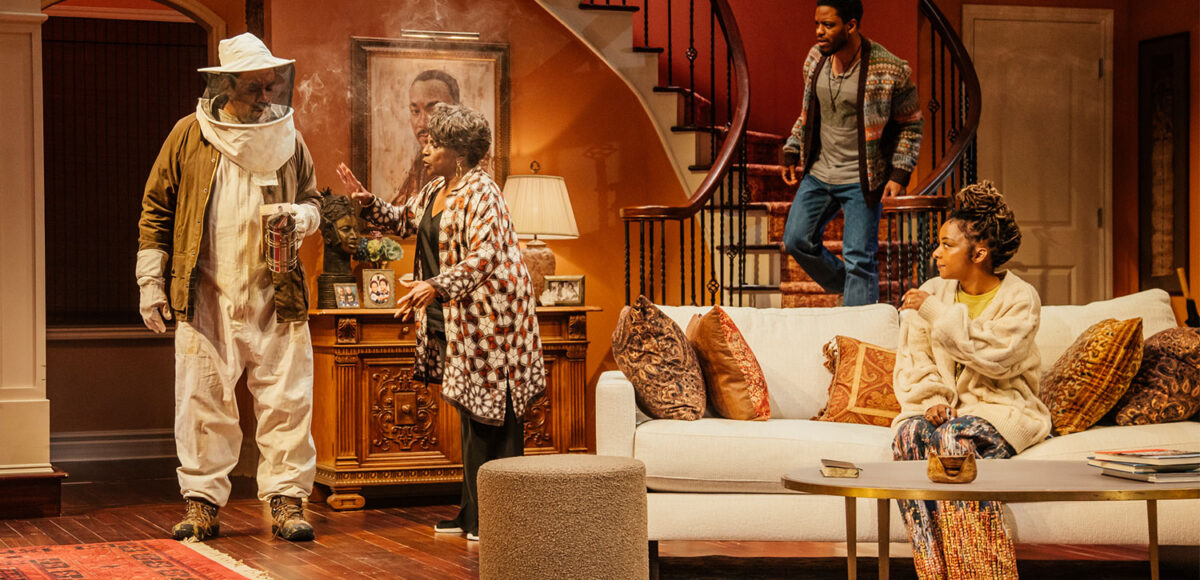
The level of discomfort that Naz feels will soon be amplified, as he narrates his view of what is happening and how it will soon be overflowing with madness. Crowded out by his mother and brother, as unrepentant a crook as you might ever meet, when Sonny finally appears, decked out in a beekeeper’s suit complete with veil, gloves and coveralls, looking like a nuclear scientist avoiding radiation poisoning, an apt description for what will follow. Aziza gushes with admiration; Junior is having a laugh; Claudine is maternally hovering; and Naz is dying from embarrassment, one he will endeavor to share with us. The much-revered Sonny is a cold fish, remote and full of disdain for the family members who did not live up to his expectations.
Dinner will soon be served, but Morgan has yet to appear. Claudine ascends the stairs to demand her presence. She’s in no mood for opposition because, for some reason, Morgan has left her two children, Claudine’s precious grandbabies, with her mother. When, at long last, Morgan is seated at the table, the fun begins. This is a jaw-clenching dinner scene reminiscent of the ferocious dinner in “August Osage County” where barely hidden resentments, years in the making, detonate into the open. And just like that, our little comedy of manners morphs into a drama of the unruly.
Playwright Branden Jacobs-Jenkins has brilliantly dissected the American family, its hopes and dreams, its faults and expectations, its defensive mechanisms and protective insulation, none of which is particularly healthy but all of which is recognizable. Junior is Solomon Jasper Jr., burdened with all the expectations that glorious name should have inspired. Instead, he’s a convicted felon still vying for Daddy’s attention, making one wrong move after another; Naz, our bright comedic presence fights the disappointment he spread when he dropped out of divinity school, the chosen successor no longer in the game; and Claudine has spent her life as the handmaiden trying to keep Sonny’s too too solid flesh from melting in the eyes of the flock. It is Aziza’s eyes that are opened to this great American tragedy, turning tail and vowing to find a different donor.
This brief synopsis only skims the surface of the ocean this play offers us. The cast, all from the original Broadway production, and many from its Steppenwolf Theatre origin, are nothing short of spectacular. Glenn Davis plays Junior, seething with anger and disappointment. The emotional ups and downs he displays tie in nicely to what may or may not be his self-proclaimed bipolar diagnosis. He was nominated for a Tony as Best Actor in a Featured Role. Alana Arenas as Morgan makes great use of her limited time on stage and burns everyone around her. Latanya Richardson Jackson, nominated for a Tony in the Featured Actor category, is fiery and dangerous, a mother lion protective of her den but also on the verge of eating her young. Kara Young, already with two Tony Awards for Featured Actress, including one for “Purpose,” is the perfect comic relief and foil to Naz, gushing in her adoration of a childhood idol, whose snap back to the reality of the situation heightens the drama of her awakening, making the tension that much more taut after her hilarious simpering.
Harry Lennix, a favorite of mine for many years, is the imperious Solomon “Sonny” Jasper, a man having a difficult time finding purpose after years of being a leader, “B-level,” as Naz would have it, but a leader, nonetheless. His coldness, his remote attitude made almost vicious in the treatment of his sons, especially his namesake, and the relationship he has established over many years with his wife, is all business absent of any tenderness of emotional attachment. His character development, or rather his slow development over the course of the evening, is a marvel to watch. He is not of a generation to apologize or recognize his own faults and this has taken a toll on his family, one he doesn’t acknowledge.
And finally, John Michael Hill, our marvelous protagonist and narrator, guides us through the potholes of the Jasper family with the comedic timing of his many explanatory monologues. He gradually becomes the tragic hero before our eyes without a tragedy, succumbing to the family frailties heightening the sense that the play is nudging forward, the false premise that family, even flawed, comes before all else. He and Lennix were both Tony-nominated for Best Actor.
Jacobs-Jenkins is a playwright whose awards have already pushed him to the forefront of great American playwrights of the 21st century. He was a Pulitzer Prize finalist for two of his plays, “Gloria” and “Everybody,” won the Pulitzer for “Purpose” and has two Tonys, one for “Appropriate” and the other for “Purpose.” He was named a MacArthur Fellow (the genius award) in 2016. No mere flash in the pan (obviously), he has several new plays in development. We are fortunate beyond words that the Geffen was able to bring the entire Broadway cast for this outing. Director Phylicia Rashad kept the action moving at a fast clip.
Rarely do you have the opportunity to come out of the theater, after a well-deserved ovation, and realize that you have just witnessed greatness. That is the very definition of “Purpose,” a play that demonstrates all the many definitions of that word.
Running time: 2 hours and 50 minutes, including one intermission
Now playing at the Geffen Theatre through Dec. 20.
Gil Cates Theater at Geffen Playhouse
10886 Le Conte Avenue, Los Angeles, CA 90024
Phone: (310) 208-2028 or www.geffenplayhouse.org.
Neely Swanson spent most of her professional career in the television industry, almost all of it working for David E. Kelley. In her last full-time position as Executive Vice President of Development, she reviewed writer submissions and targeted content for adaptation. As she has often said, she did book reports for a living. For several years she was a freelance writer for “Written By,” the magazine of the WGA West, and was adjunct faculty at USC in the writing division of the School of Cinematic Arts. Neely has been writing film and television reviews for the “Easy Reader” for more than 10 years. Her past reviews can be read on Rotten Tomatoes where she is a tomatometer-approved critic.