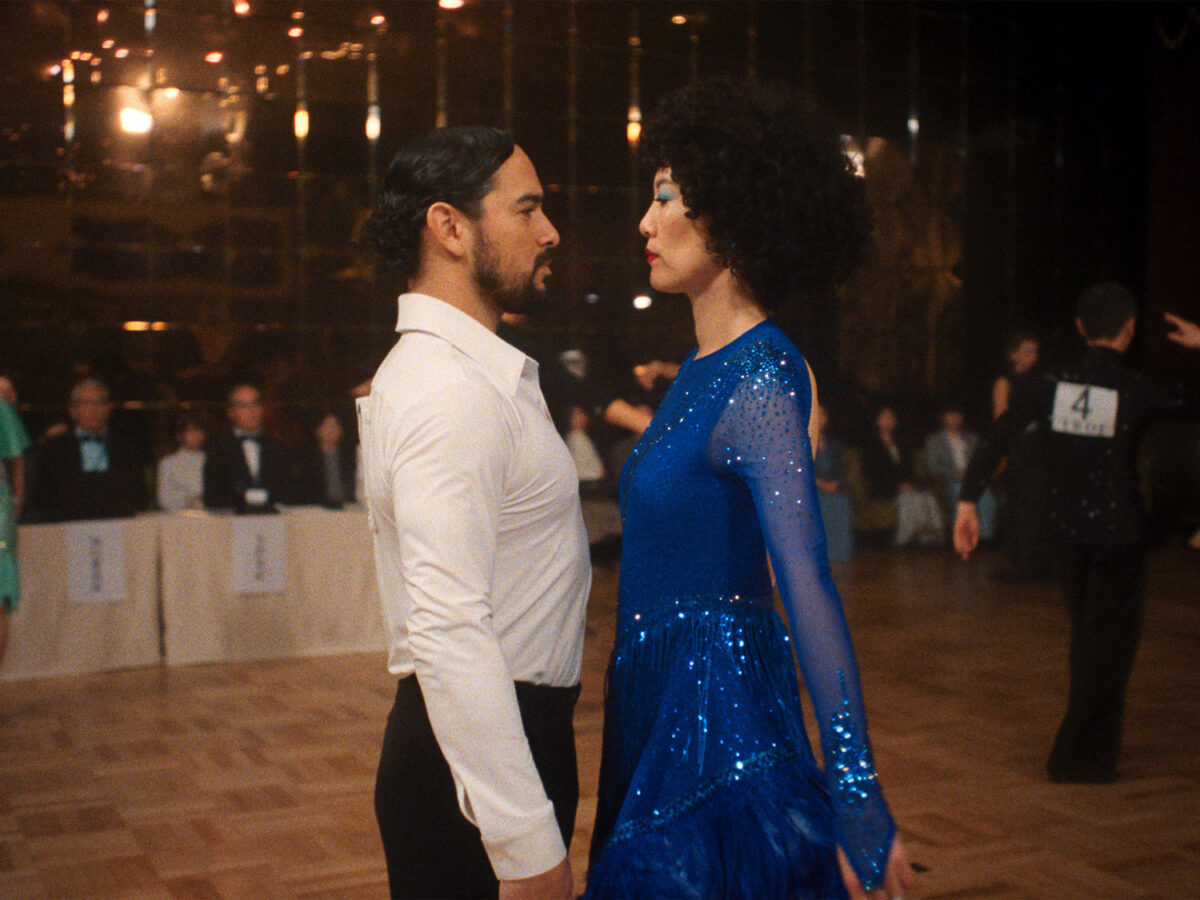

“Love is never having to say you’re sorry.” Erich Segal (“Love Story”) couldn’t have been more wrong. Theo and Ivy Rose are proof positive of the results. Scowling, seated in front of a marriage counselor, their assignment was to list 10 things they liked about the other. Quite to the contrary, Theo’s list is quite short with the shape of her head being at the top. Ivy, on the other hand, has a long list of what she hates. Appalled, the therapist declares that they are irredeemable. Shocked, they leave, laughing at her incompetence and, despite the horrors expressed in that room, you see a complicated couple still committed. It’s really a question of whether they should be committed. So opens “The Roses,” a darkest of dark romantic comedies.
The quintessential perfect couple, Theo and Ivy met in a restaurant kitchen in London. He, an architect, was escaping a stultifying meeting celebrating the completion of what he considered a mind numbing apartment complex and she, a sous chef, was putting together another of her creations for which she would get no credit. Their touch was electric; their immediate coupling, in the restaurant walk-in fridge, was lightning hot and fast. Before long, well actually it took a few years, they were off to California to start a new life. Ivy found work interning in Northern California restaurants and Theo began his rapid ascent at a prominent firm designing upscale projects for forward-thinking clients. They were their own mutual admiration and support network.
Kids came, a boy and a girl, and Ivy stayed home, her creative talents relegated to the home kitchen and imaginatively designed cakes and entrées for one and all. Their social circle was quite limited to his colleagues at work, the intensely competitive Rory and his far more talented wife Sally. Along the way they picked up Barry and Amy whose interests couldn’t have been farther from their own. Barry, a lawyer, loves guns and firing ranges and Amy loves exploring the boundaries of sexual acceptability with anyone in the vicinity.
Ivy, somewhat lost in her new environment with limited creative output now that the kids have started school, is grateful to Theo when he renovates a shack on the beach so she can have her own restaurant. On the surface, and isn’t everything always just on or below the surface, they still seem to have that magic together. Subtly, perhaps not so subtly, there is an imbalance in their relationship. It certainly didn’t start out that way. It was, after all, her idea that they move to the States, but with Theo on the rise and Ivy treading water, the shadow of Theo’s patronizing attitude toward the little woman begins to percolate. It’s probably not deliberate; he more than likely is unaware of it but Ivy begins to seethe under her wide smile and sparkling eyes. He’s successful and doing something he loves; she, less so, serving maybe two or three covers per lunch hour. Still, apart from her tight smile and the success he wears on his sleeve at which all are encouraged to marvel, this is still a seemingly supportive and loving couple. That will all change. Welcome to the textbook Love-Hate relationship.
A metaphoric storm, and an actual storm, have reversed their positions. Ivy is now renowned and successful beyond her dreams and Theo has been relegated to her former position as guardian to the kids. Civility is fraying at the edges and the words previously unspoken begin to be aired. And yet, as they point out, they’re British and the British invented repressed feelings. To say more would diminish the pleasure, full of schadenfreude and cynicism, that will come.
This is the story of a marriage. Granted, most marriages are not between two wildly successful individuals jockeying for position, but even the most mundane relationship flows with support and admiration and ebbs with resentment, neediness and recrimination. Someone is to blame or someone is not. The simple act of respect, the foundation of any relationship, is not so simple. No, Erich Segal, love is very much knowing how and when to say you’re sorry and when to yield, if only in the moment. Love isn’t all passion, sex and admiration, it’s also learning to negotiate the differences, resentments, the successes and the failures; and Ivy and Theo have become less and less accommodating to one another. They play a zero-sum game.
At the heart of that zero sum game is the house, a magnificent feat of architectural blending of nature and nurture; not exactly minimalist but not excessive either with a view that rivals Big Sur in both beauty and danger. An ode to modernism with the ironic touch of an AI helper named Hal (for those who have never seen “2001: A Space Odyssey,” look it up). This spectacular house, designed by Theo, representative of what he both lost and gained in his career, becomes the center point of the nuclear war they inflict on one another.
This is not the first screen adaptation of Warren Adler’s novel “The War of the Roses.” But Tony McNamara has made it his own, taking those relationship fissures and ripping the fabric as he tries to weave it back together. There are laugh-out-loud moments, surprises and lots of tension. Jay Roach, the director known for his deft comedic touch, has taken all of McNamara’s ingredients and stirred the pot so that the result is a bitter froth that curdles and amuses. They have given an accurate portrayal of a long-term marriage that survives as much on shared joy as it does on shared enmity. What happens when no one is willing to give an inch? Watch and see. Roach keeps everything moving and even interweaves characters that are totally tangential, like Benny and his libidinous wife Amy. Rory, a rival architect, is a necessary irritant, full of Schadenfreude toward Theo, but who cringes at his wife Sally’s clever malice and superior talent.
Roach was blessed with an outstanding cast. Andy Samberg as Barry is out of his league no matter where he turns but seems oblivious. Kate McKinnon, Amy, is hilariously inappropriate, something that has long been in her wheelhouse. Jamie Demetriou plays Rory as a second-rate architect who lives to criticize and Zoë Chao is his much cleverer and more gifted architect wife. They both live to demean but only she has enough firepower in her arsenal. Watch for a sensational appearance by Allison Janney. Saying any more would criminally diminish her effect.
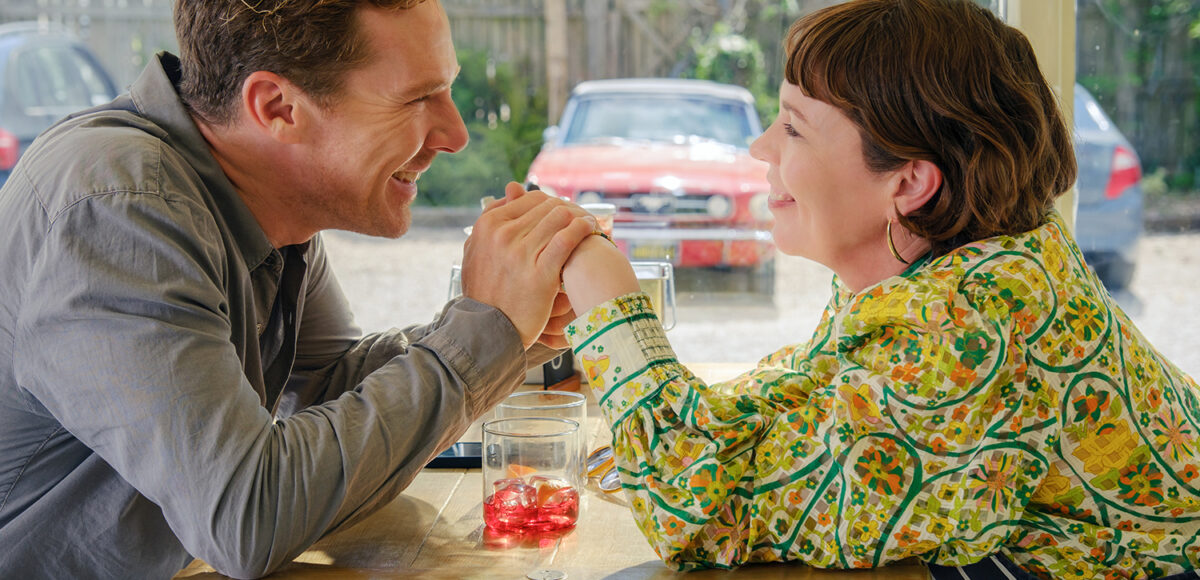
“The Roses” is a very good movie, but what makes it exceptional are the two leads: Benedict Cumberbatch as Theo and Olivia Coleman as Ivy. Cumberbatch’s Theo is a walking incongruity, confident and rather supercilious when successful and a mass of insecurities and vulnerability encased in an impenetrable box of resentment when not. His eyes light up or darken depending on the situation and his comedic timing is impeccable, always just this side of tragic and/or vicious. Coleman, here, is given free rein to her dark, yet always very funny, side. Those wide eyes, so sparkling when Ivy and Theo were still discovering their strengths, eventually give way to slightly slitted, darker orbs framed by a wide, tight smile. The back-and-forth repartee between these two rather repressed individuals is a lesson in restraint that makes the result all the more hilarious and devastating. Originally aiming to wound, eventually the duo definitely are homing in on the kill.
While most will point to “The Roses” as the death of a marriage, I submit that it is not. Love and hate, vulnerability and strength lie in most long-term relationships. One is reluctant to acknowledge the negatives but they are there and usually to a greater degree than admitted. The ultimate strength of Coleman’s and Cumberbatch’s portrayals is the ability to express vulnerability and hope even while aiming for the jugular. The opposite of love isn’t hate, it’s indifference.
Now playing at AMC theaters including the AMC Century City 15.
Neely Swanson spent most of her professional career in the television industry, almost all of it working for David E. Kelley. In her last full-time position as Executive Vice President of Development, she reviewed writer submissions and targeted content for adaptation. As she has often said, she did book reports for a living. For several years she was a freelance writer for “Written By,” the magazine of the WGA West, and was adjunct faculty at USC in the writing division of the School of Cinematic Arts. Neely has been writing film and television reviews for the “Easy Reader” for more than 10 years. Her past reviews can be read on Rotten Tomatoes where she is a tomatometer-approved critic.