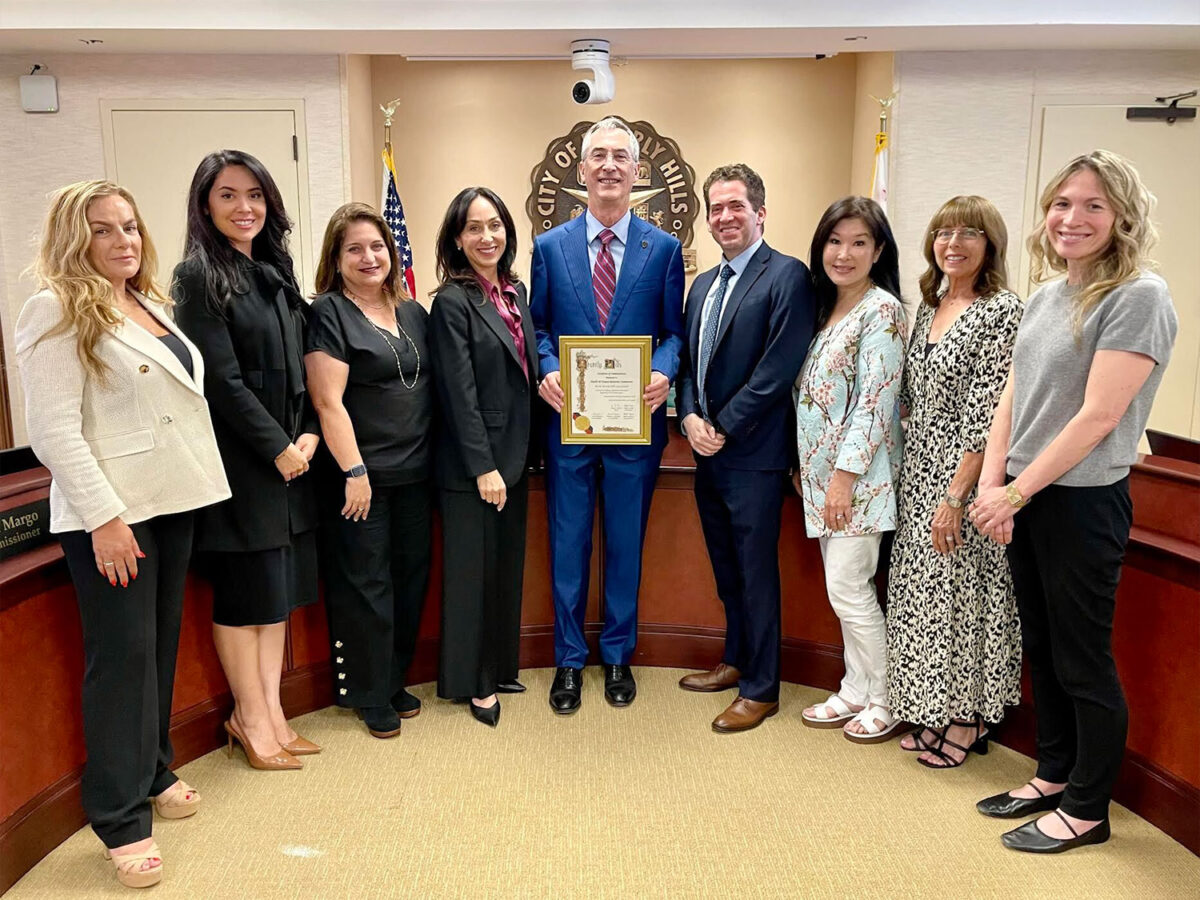


The Beverly Hills Planning Commission voted unanimously at its June 11 meeting to approve an ordinance amending its regulations regarding accessory dwelling units (ADUs) and junior accessory dwelling units (JADUs), bringing the city into compliance with recent state law.
The amendments will revise the Beverly Hills Municipal Code (BHMC).
Beverly Hills last revised its ADU ordinance in 2024. State lawmakers have since enacted additional measures expanding property owners’ building options. The approved amendments reflect those changes while also streamlining the municipal code to make it easier for residents and applicants to navigate.
The amendments address new legislation including Senate Bill 543 (SB 543) and Assembly Bill 1154 (AB 1154). Both were signed into law by Governor Gavin Newsom in October 2025 and both went into effect in January.
SB 543 increased from two to eight the number of detached ADUs permitted on properties with multi-family dwellings, with the total not to exceed the number of existing units on the lot.
On single-family properties, owners may now build up to two ADUs plus a JADU under state law, plus one additional unit under local regulations. Properties larger than 13,000 square feet may qualify for a fourth unit, per the city’s incentive provisions.
AB 1154 removed the owner-occupancy requirement for JADUs that provide independent sanitation facilities. The new amendments to the city’s municipal code follow suit, except where a JADU shares sanitation facilities with the primary residence.
Additionally, state law prohibits cities from imposing deed covenants or recorded restrictions on ADUs. As such, the city will remove covenant requirements for standard ADUs while maintaining them for JADUs and for the city’s incentive ADU program.
Because state law requires that ADU reviews rely only on objective standards, city code will be revised to reflect that ADUs converted from historically significant structures are required to preserve the character-defining features identified in the property’s landmark designation report.
A staff member will be authorized to develop objective design standards for historic contexts going forward.
Finally, a privacy requirement adopted by City Council in May, which updated regulations to clarify which windows it applied to, was inadvertently applied only to single-family ADU regulations. The new amendments extend it to multi-family properties as well.
During the meeting, one written public comment was read, which expressed concerns about parking.
“As a Zone 9 resident, I support ADUs and the additional housing they provide,” the comment stated. “However, I am concerned that ADU tenants often have no practical parking options as overnight street parking is prohibited. On my block alone, there are regularly around 20 vehicles parked overnight with disabled parking placards, demonstrating that overnight street parking already exists in practice. Given this reality, I encourage the city to consider some form of overnight parking accommodation for ADU residents.”
ADUs and JADUs count towards the city’s Regional Housing Needs Allocation (RHNA) numbers, which require 3,104 units to be accommodated through zoning regulations during the 2021-29 planning cycle. The city has issued building permits for 201 ADUs, JADUs and ancillary living quarters so far in this cycle.
The Planning Commission’s vote moves the issue forward to the City Council. If approved, the city will have 60 days to submit the updated ordinance to the California Department of Housing and Community Development for compliance review.
In other business, the commission reviewed the city’s 2026-27 through 2030-31 Capital Improvement Program (CIP) for conformance with the general plan. The review is required by state law annually and is a mandatory step in the budget process.
The CIP allocates funds over the course of five years to city projects such as the construction and improvement of utility infrastructure, storm drain improvements, traffic infrastructure and park maintenance. For fiscal year 2026-27, the CIP includes 83 active projects.
During the City Council’s fiscal year 2025-26 priority setting session, it approved a plan to carry out a zero-based budget exercise for the CIP in response to projected long-term deficits in the general fund. The approach is a change from previous incremental budget allocations that rolled existing projects, prior-year funding assumptions and unspent funds forward.
The city’s Oct. 7 Memorial, a permanent structure that will commemorate the victims of the Oct. 7, 2023, attack against Israel, was added to the CIP.
Several other projects, including a land acquisition fund and planned enhancements for the city’s southeast area, were flagged for future general plan consistency review.
Staff will forward the commission’s resolution to the Finance Department and the City Council for their consideration during the remainder of the budget discussions.